
Best AI Finance Tools in 2026: The Complete Guide for Finance Teams, CFOs, Analysts, Accountants, and Investors
AI finance tools are no longer experimental add-ons sitting on the edge of the finance department. In 2026, they are becoming part of the daily operating system for accounting, FP&A, audit, accounts payable, investment research, variance analysis, forecasting, compliance, reporting, and decision support. Gartner has predicted that 90% of finance functions will deploy at least one AI-enabled technology solution by 2026, while fewer than 10% will see headcount reductions from AI, which tells us something important: AI is not simply replacing finance teams; it is changing how finance teams work. (Gartner)
The best AI finance tools help us move from manual spreadsheet chasing to faster analysis, cleaner workflows, better controls, and more confident decisions. Some tools are built for CFOs and FP&A teams, some for accountants and AP teams, some for auditors, and some for investment analysts who need to read and summarize complex financial documents. The real challenge is not finding an AI finance tool. The challenge is choosing the right tool for the right finance workflow.
What Are AI Finance Tools?
AI finance tools are software platforms that use artificial intelligence, machine learning, natural language processing, automation, predictive analytics, and increasingly AI agents to support financial work. These tools can analyze financial data, extract information from invoices and documents, generate forecasts, detect anomalies, automate reconciliations, summarize contracts, prepare variance explanations, assist with budgeting, and answer questions about financial performance.
Unlike traditional finance software, modern AI finance tools do not only store data or run fixed reports. They can interpret patterns, respond to natural-language questions, suggest explanations, and trigger automated workflows. Microsoft’s Finance solution in Microsoft 365 Copilot, for example, connects ERP data and workflows into tools finance teams already use, including Excel and Outlook. (Microsoft) That shift matters because finance teams do not want another disconnected dashboard. They want AI inside the tools where work already happens.
Best AI Finance Tools in 2026: Quick Comparison
Compare the top AI finance tools by rank, best-fit users, and primary use cases for finance teams, CFOs, analysts, accountants, auditors, and investors.
| Rank | AI Finance Tool | Best For | Primary Use Case |
|---|---|---|---|
| 1 | Microsoft 365 Copilot for Finance | Enterprise finance teams | ERP-connected analysis, reconciliations, Excel workflows |
| 2 | Vena AI / Vena Copilot | FP&A teams using Excel | Budgeting, planning, reporting, variance analysis |
| 3 | Datarails | Excel-native FP&A | Consolidation, reporting, budgeting, AI finance insights |
| 4 | DataSnipper | Audit and finance validation | Audit testing, evidence matching, Excel agents |
| 5 | Vic.ai | Accounts payable teams | Autonomous invoice processing and AP automation |
| 6 | Stampli | AP collaboration | Invoice approval workflows and duplicate detection |
| 7 | Hebbia | Investment research and document analysis | Financial document search, extraction, and analysis |
| 8 | ChatFin | Finance and accounting teams | AI finance assistant for accounting workflows |
| 9 | Tellius | Finance analytics teams | AI-powered decision intelligence and analytics |
| 10 | Xero | Small businesses | AI-assisted bookkeeping and accounting |
| 11 | Booke AI | Bookkeepers and small firms | Reconciliation and transaction categorization |
| 12 | Betterment / Wealthfront | Personal finance and investing | Robo-advisory and automated portfolio management |
How to Choose the Best AI Finance Tool
Start with your finance team’s main workflow, then match the right AI tool to your planning, accounting, audit, research, or enterprise finance needs.
FP&A and Forecasting
Accounts Payable
Audit and Controls
Investment Research
Small Business Accounting
Enterprise Finance Copilot
Final Step: Governed Data + Human Review
No matter which AI finance tool you choose, finance teams should use clean data, strong access controls, approval workflows, and human review before making financial decisions.
1. Microsoft 365 Copilot for Finance: Best AI Finance Tool for Enterprise Teams
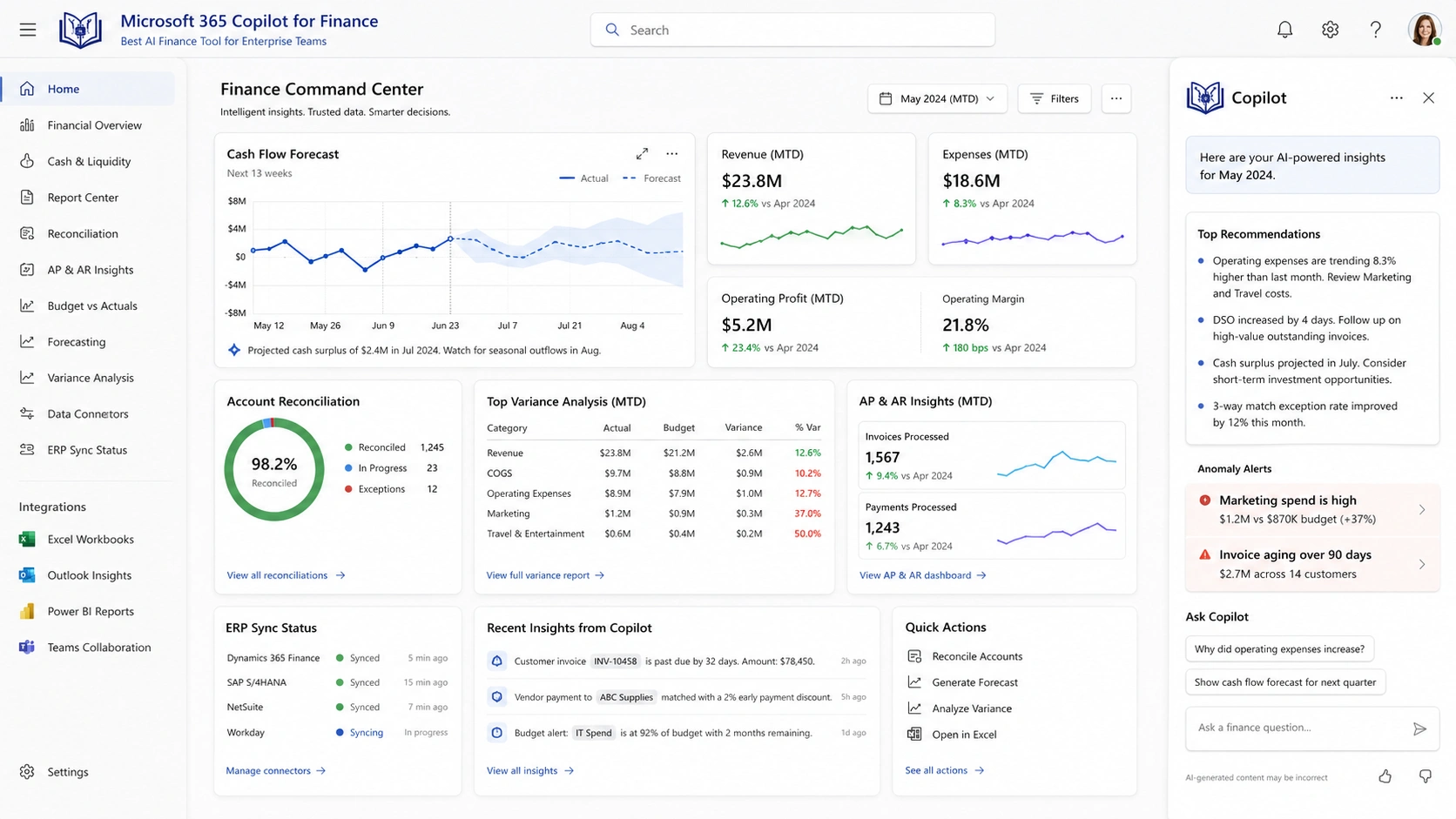
Microsoft 365 Copilot for Finance is one of the most important AI finance tools in 2026 because it brings AI into the Microsoft environment where finance teams already spend much of their day. Instead of forcing teams to leave Excel, Outlook, Teams, or PowerPoint, Microsoft’s role-based finance solution connects finance workflows with ERP systems such as Microsoft Dynamics 365 Finance and SAP. Microsoft says the Finance solution in Microsoft 365 Copilot is generally available and brings ERP-connected data and workflows directly into everyday productivity tools. (Microsoft)
This is especially useful for reconciliation, variance analysis, collections, reporting, and financial review cycles. We can think of Copilot for Finance as an AI assistant that understands both the finance workflow and the productivity workspace. For companies already using Microsoft 365, Dynamics, SAP, and Excel-heavy reporting processes, the adoption path can be more natural than replacing the entire finance stack.
Its biggest advantage is workflow fit. Finance teams do not want to copy financial data into random AI chat tools and risk governance issues. They want controlled access, ERP context, and traceable analysis. Copilot for Finance is strongest when the organization already has clean finance data, strong Microsoft adoption, and a clear plan for which tasks AI should support.
2. Vena AI / Vena Copilot: Best AI Finance Tool for FP&A Teams That Love Excel
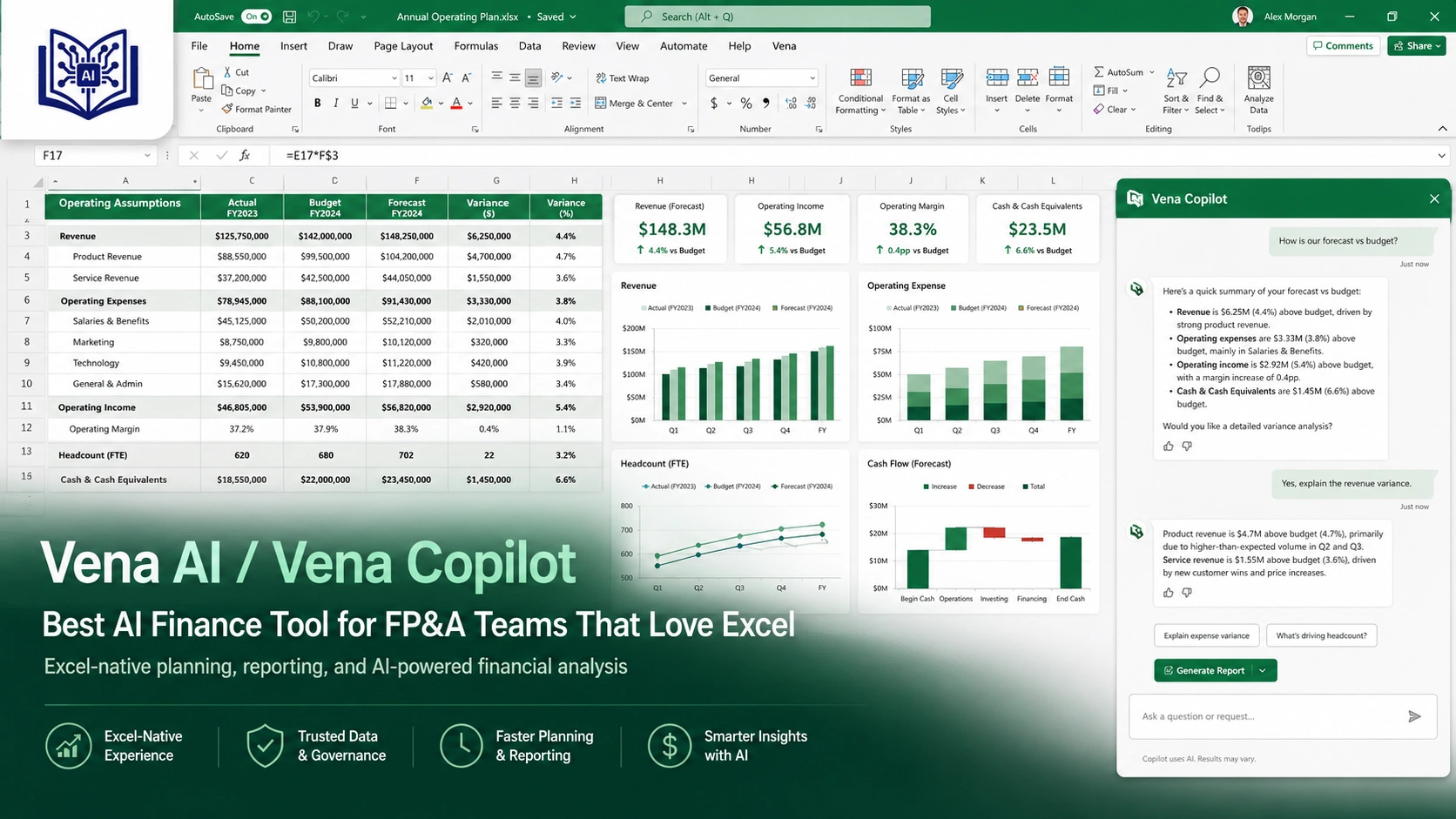
Vena AI is designed for finance teams that want AI-powered planning without abandoning Excel. Vena describes its AI for finance as intelligence embedded in Excel, grounded in governed data, and purpose-built for finance teams. Its AI capabilities support driver-based planning, governed model alignment, and collaboration through Excel Live in Teams. (Vena Solutions)
The reason Vena stands out is simple: FP&A teams live in Excel, but uncontrolled spreadsheets create version-control problems, manual consolidation delays, and reporting risk. Vena gives teams a familiar Excel interface while adding centralized data governance, planning workflows, reporting, and AI assistance. That makes it attractive for mid-market and enterprise teams that are not ready to remove Excel from the process but know they need more structure.
Vena is best for budgeting, forecasting, board reporting, variance analysis, workforce planning, revenue planning, and scenario modeling. Its positioning around Microsoft Teams and Excel also makes it useful for collaborative finance meetings where leaders ask questions in real time and expect answers quickly. For FP&A teams, this is where AI becomes practical: not just generating text, but turning everyday finance questions into governed insights.
3. Datarails: Best Excel-Native AI FP&A Platform
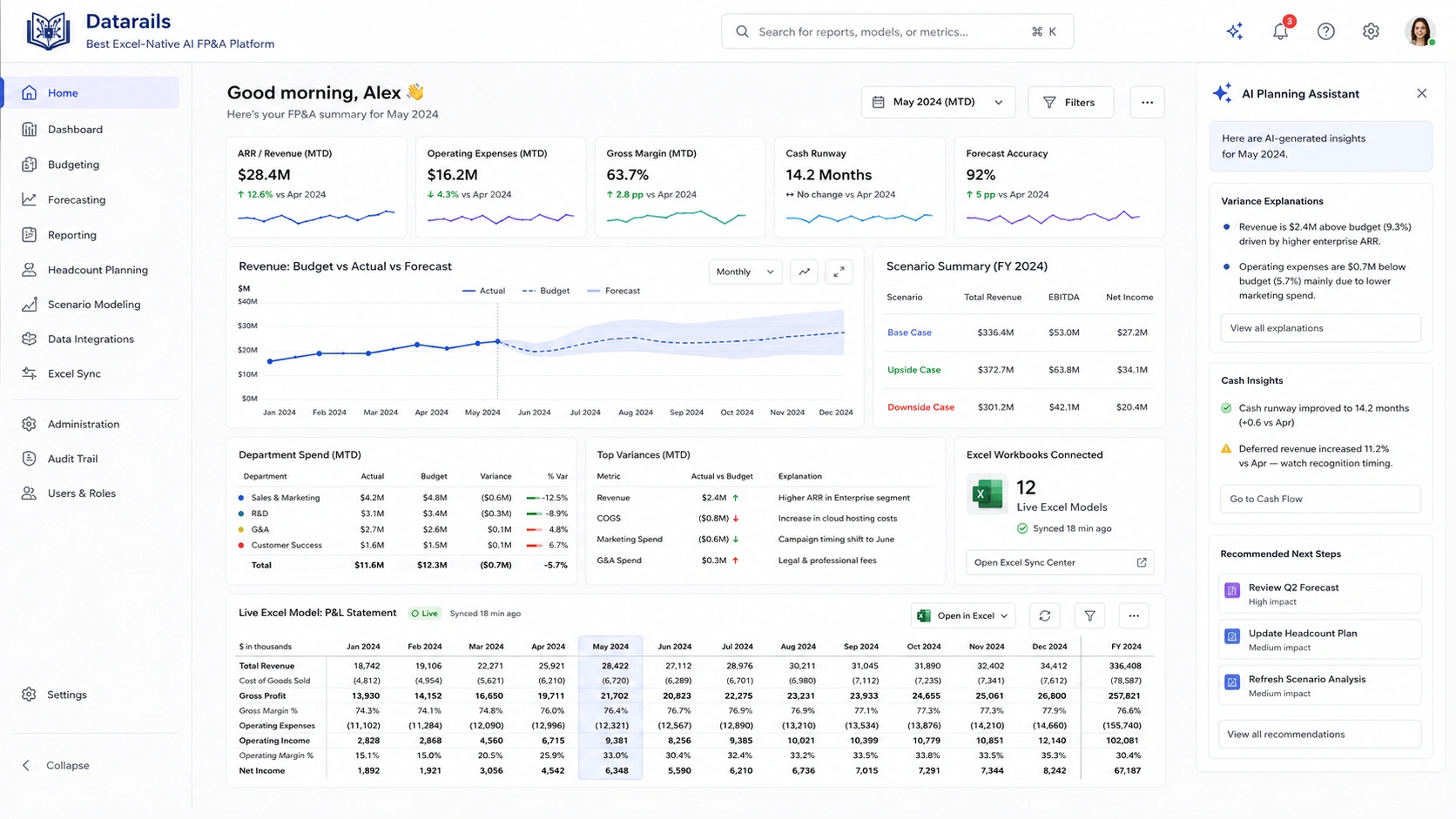
Datarails is another strong AI finance tool for FP&A teams, especially teams that want to keep Excel while improving consolidation, reporting, budgeting, and planning. Datarails describes its FP&A platform as a solution that helps finance teams with consolidation, reporting, budgeting, and planning, while giving them access to Genius by Datarails, its AI-powered finance capabilities. (Datarails)
Datarails is useful for companies with many spreadsheets, scattered data sources, recurring reports, and manual monthly close analysis. Instead of asking analysts to spend days pulling numbers together, Datarails helps centralize financial data and generate more useful reporting outputs. Its AI layer can assist with faster decision-making by working on top of consolidated finance data.
For finance teams comparing Datarails and Vena, the choice usually comes down to existing workflows, implementation preference, integration needs, reporting complexity, and how much structure the team wants around Excel. Both are strong FP&A-focused AI tools, but Datarails is especially compelling for teams that want to modernize spreadsheet-based planning without pushing users into a completely unfamiliar interface.
4. DataSnipper: Best AI Tool for Audit and Financial Validation
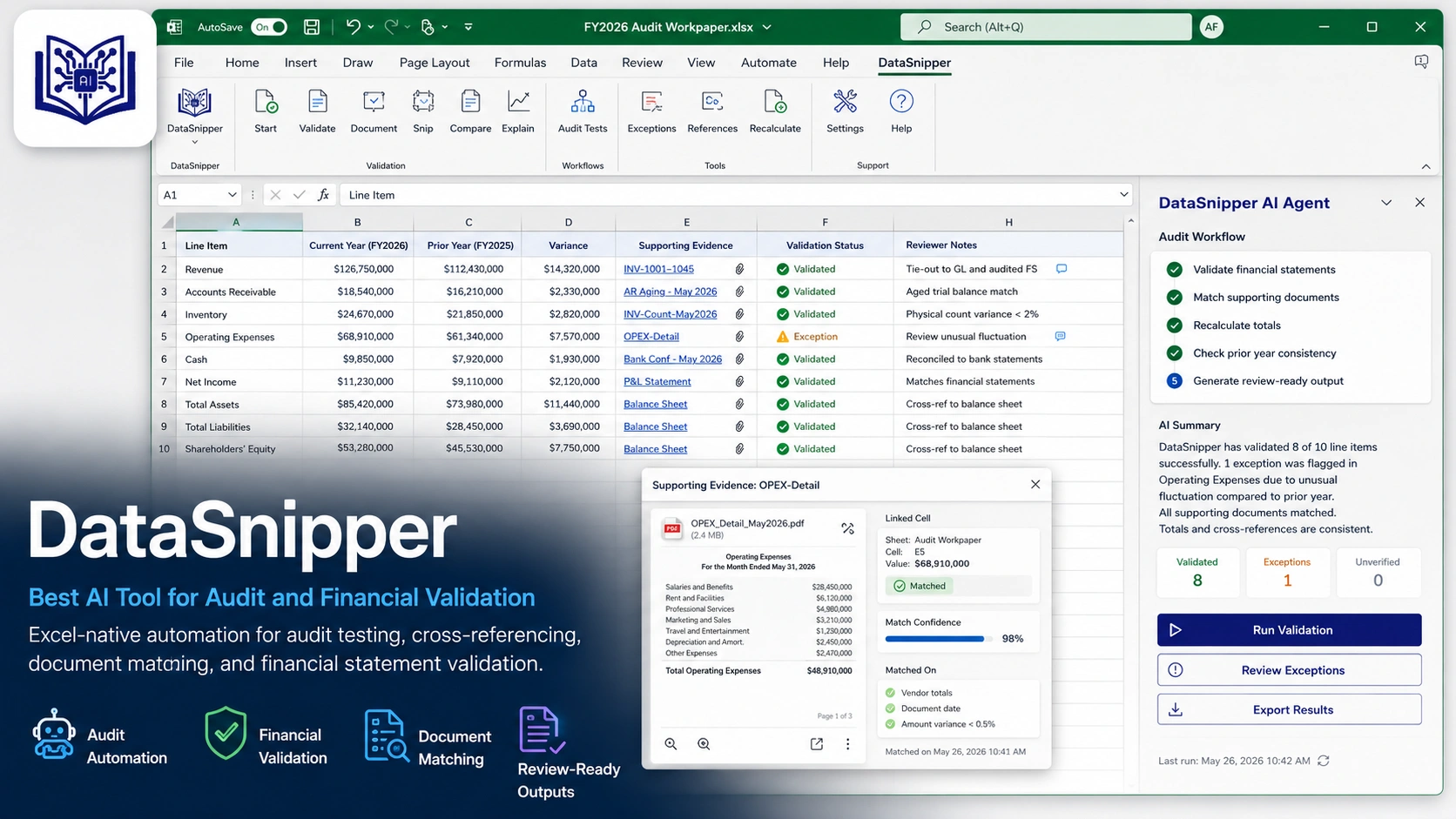
DataSnipper is one of the most specialized tools on this list, and that specialization is exactly what makes it valuable. It is built for audit and finance teams that need to test, validate, match, document, and review evidence inside Excel. DataSnipper describes itself as an agentic platform for audit and finance, with AI agents that handle audit and finance testing while teams remain in control. It also states that it is trusted by all top 100 accounting firms and Fortune 500 companies they serve. (DataSnipper)
For audit teams, AI is not useful unless it supports accuracy, transparency, and reviewability. DataSnipper is strong because it works inside structured audit workflows, links results to source evidence, and helps maintain an audit trail. Its resources describe AI tools in internal audit as solutions that automate data extraction, document matching, control validation, and workpaper preparation while maintaining clear links to evidence. (DataSnipper)
We recommend DataSnipper for external auditors, internal audit teams, financial controllers, and finance teams that perform high-volume testing. It is not a general-purpose CFO dashboard. It is a serious productivity tool for evidence-heavy finance work where speed matters, but trust matters more.
5. Vic.ai: Best AI Finance Tool for Autonomous Accounts Payable
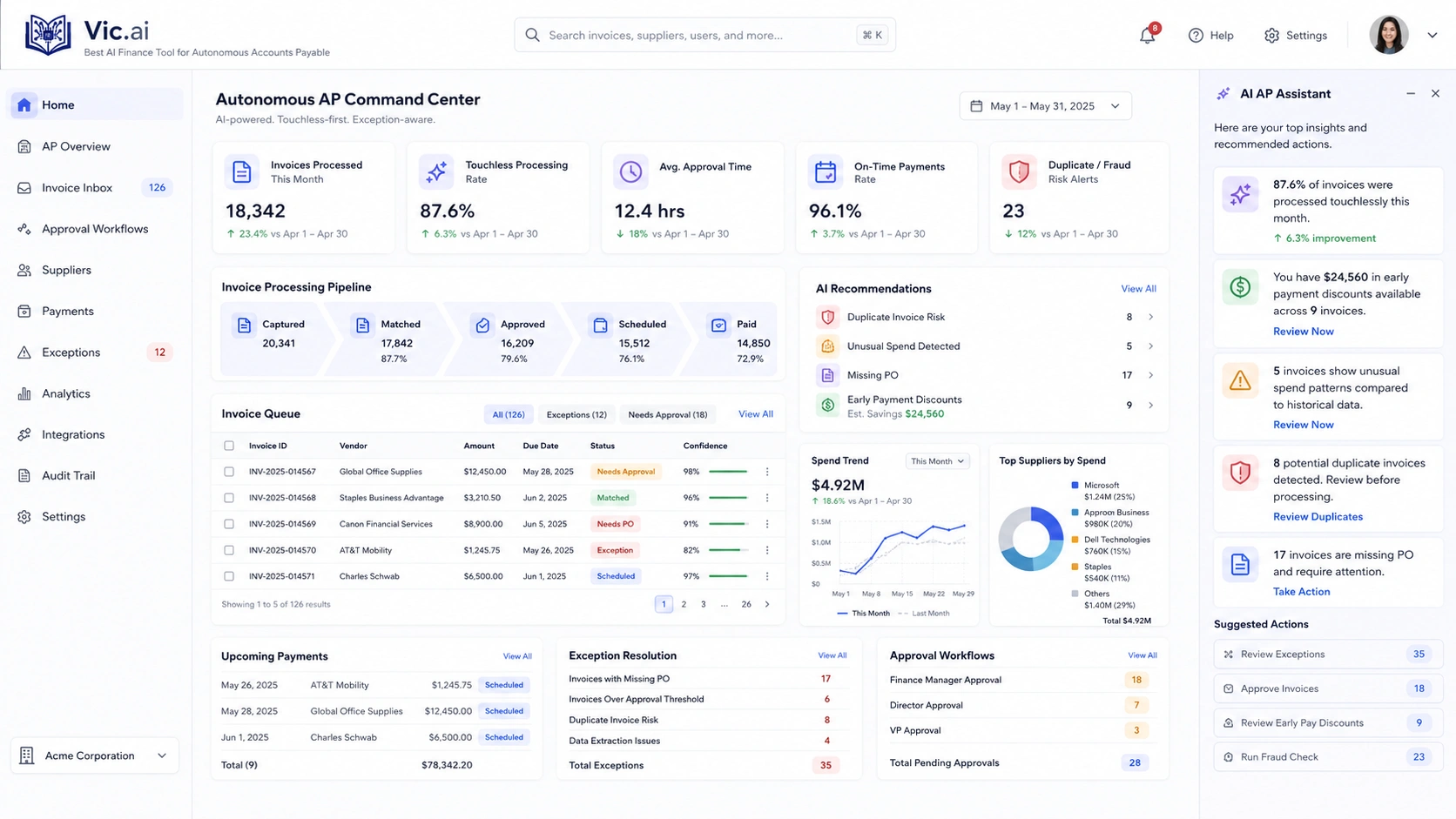
Vic.ai is one of the strongest AI finance tools for accounts payable automation. It positions itself as an AI-first AP platform that helps teams put AP on autopilot, gain real-time insights, manage spend, and improve accuracy and efficiency. (Vic.ai) Its AP automation page highlights invoice processing, PO matching, intelligent routing, approvals on autopilot, and faster error-free workflows. (Vic.ai)
This makes Vic.ai especially valuable for companies processing large invoice volumes. Traditional AP automation often still requires humans to review, code, route, and approve too many exceptions. Vic.ai focuses on increasing autonomy across the AP lifecycle, including invoice capture, coding, approvals, ERP synchronization, governance, and performance controls. Its Q1 2026 product release specifically emphasized expanded AP autonomy and stronger approval intelligence. (Vic.ai)
Vic.ai is best for finance teams that want to reduce manual invoice entry, speed up month-end close, improve AP visibility, and reduce duplicate or incorrect payments. It is not the right tool for investment research or financial forecasting, but for AP transformation, it is one of the most relevant AI platforms in 2026.
6. Stampli: Best AI Tool for AP Collaboration and Invoice Approvals
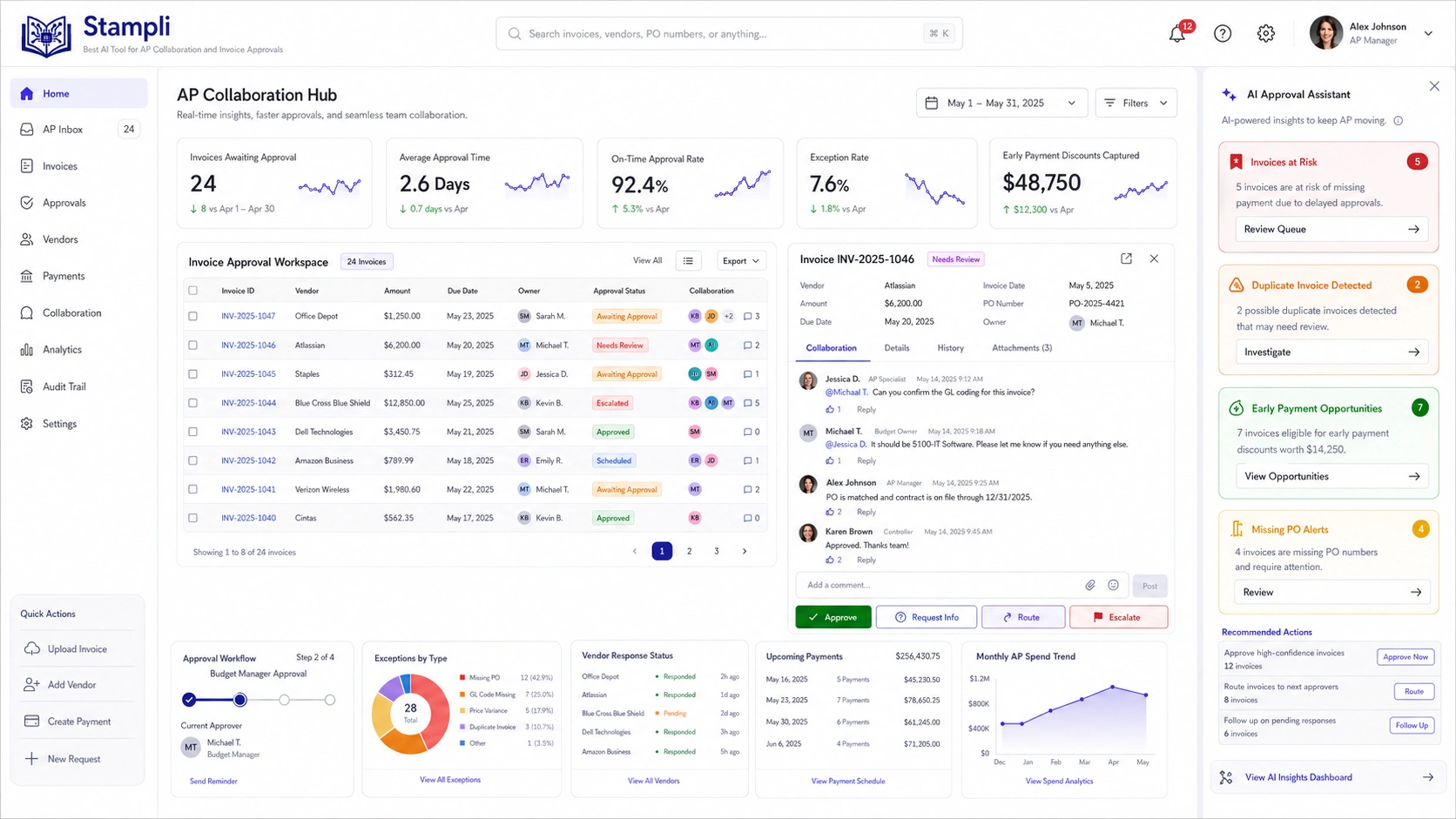
Stampli is another strong AP automation platform, especially for teams that need better invoice collaboration and approval workflows. Jotform’s 2026 AI finance tools guide describes Stampli’s AI assistant, Billy the Bot, as a tool that automates accounts payable by extracting invoice data, detecting duplicates or fraud, supporting audit trails, and streamlining approvals. (Jotform)
The main value of Stampli is that it brings AP conversations, approvals, invoice data, and audit history into one workflow. In many companies, invoice approvals get stuck in email threads, Slack messages, paper trails, or informal manager follow-ups. Stampli helps centralize that process and gives teams visibility into where an invoice is, who needs to approve it, and whether something looks wrong.
We recommend Stampli for companies that already have accounting or ERP systems but need a better AP layer on top. It is particularly useful for mid-sized businesses with growing invoice volume, distributed teams, and approval bottlenecks. Compared with Vic.ai, Stampli may appeal more to teams that prioritize collaboration and control, while Vic.ai may appeal more to teams aiming for deeper AP autonomy.
7. Hebbia: Best AI Finance Tool for Investment Research and Document Analysis
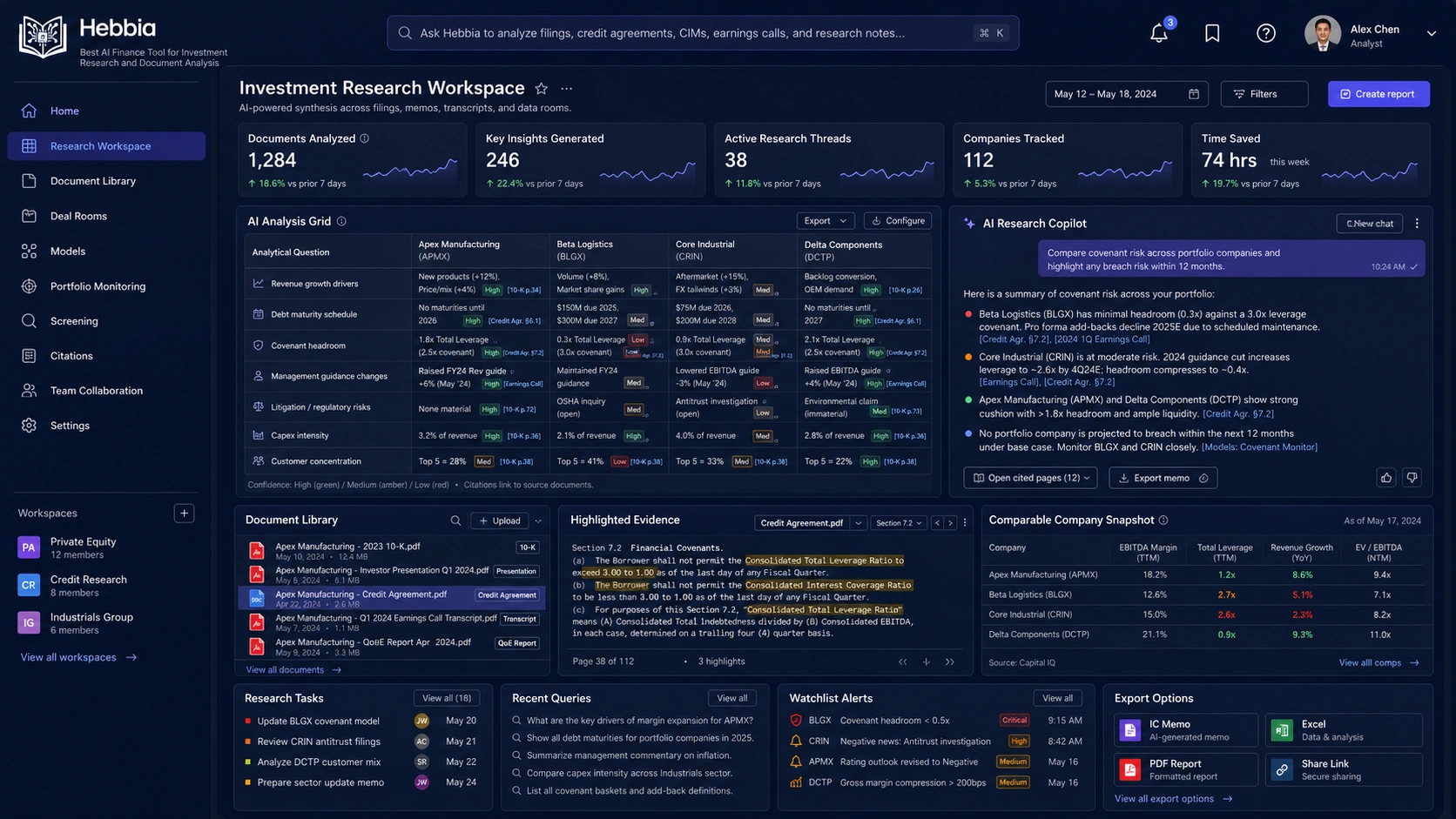
Hebbia is built for knowledge-heavy financial analysis, especially where analysts need to process large volumes of documents. Its competitor article on AI tools for financial analysis lists tools for financial research and emphasizes document analysis, data extraction, and AI-supported review workflows. (Hebbia)
This category matters because finance professionals do not only analyze numbers. They read annual reports, earnings call transcripts, loan documents, investment memos, contracts, filings, due diligence materials, pitch decks, market reports, and policy documents. The bottleneck is often not calculation; it is finding the right answer inside thousands of pages.
Hebbia is best for investment teams, private equity firms, asset managers, consultants, legal-finance teams, and analysts who need to ask complex questions across large document sets. Unlike basic chatbots, document intelligence tools are valuable when they provide source-grounded answers and help analysts verify where information came from.
8. ChatFin: Best AI Finance Assistant for Accounting and Finance Teams
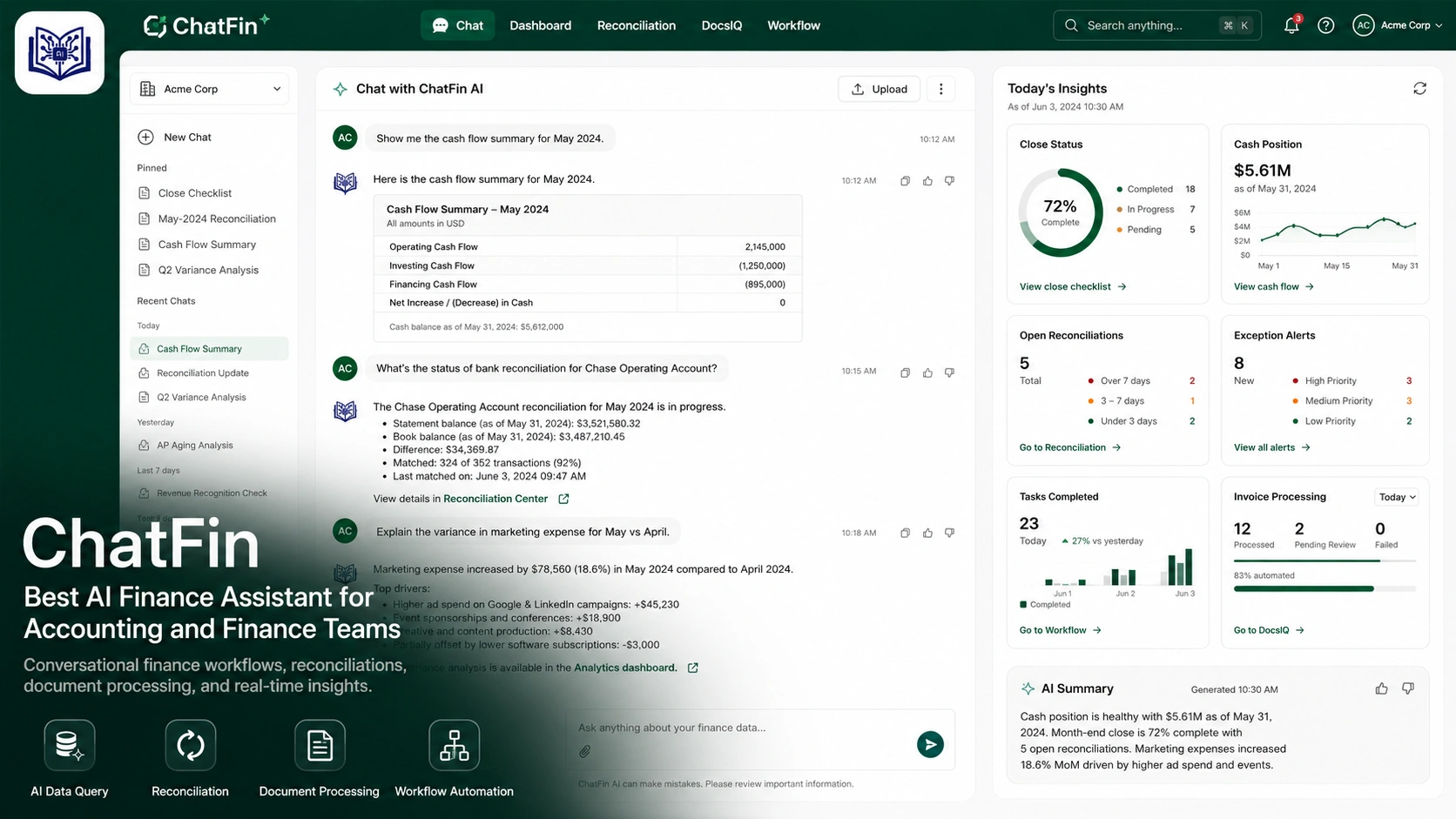
ChatFin is positioned around AI tools for finance and accounting, and its 2026 guide focuses directly on AI tools for finance and accounting teams. (ChatFin) The main idea behind tools like ChatFin is to give finance users a conversational interface for accounting workflows, financial analysis, reporting, and decision support.
The appeal is clear: finance teams often have data but struggle to retrieve answers quickly. Instead of waiting for a custom report or asking an analyst to pull numbers manually, users can ask finance questions in plain English. A finance assistant can help with explanations, summaries, variance narratives, journal review support, and accounting-related queries.
ChatFin is best for teams that want a finance-specific AI assistant rather than a general chatbot. The difference matters because finance workflows require context, controls, accounting terminology, and reliable outputs. A general AI tool may write a nice paragraph, but a finance-focused assistant should help connect the answer to actual finance data and accounting logic.
9. Tellius: Best AI Finance Analytics and Decision Intelligence Tool
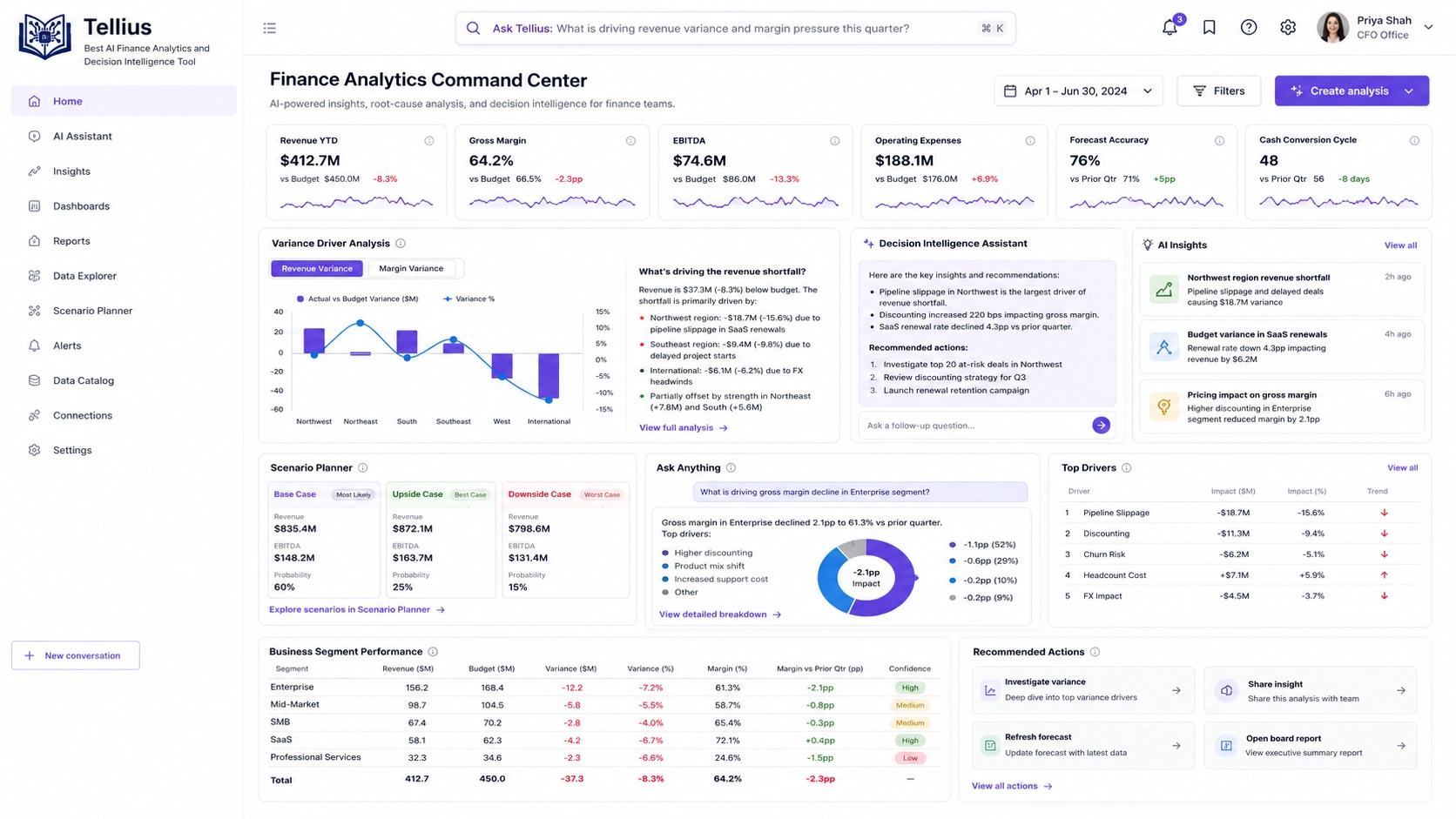
Tellius focuses on decision intelligence and analytics, and its 2026 guide compares AI tools for finance teams across broader finance analytics needs. (Tellius) Tools in this category are valuable when finance teams need more than static dashboards. They need to ask why revenue changed, what drove margin compression, where cost anomalies appeared, and which business units need attention.
AI analytics tools can reduce the distance between question and answer. Instead of manually slicing data across regions, products, customers, channels, and time periods, teams can use AI-assisted analytics to find drivers, surface anomalies, and generate explanations. This is especially useful for CFO offices, revenue operations, business finance teams, and enterprise analytics teams.
Tellius is best for organizations with mature data infrastructure and a need for deeper diagnostic analytics. It may be too advanced for a small business that only needs bookkeeping, but for finance teams trying to improve performance management and decision speed, it is a strong category to evaluate.
10. Xero: Best AI Accounting Tool for Small Businesses
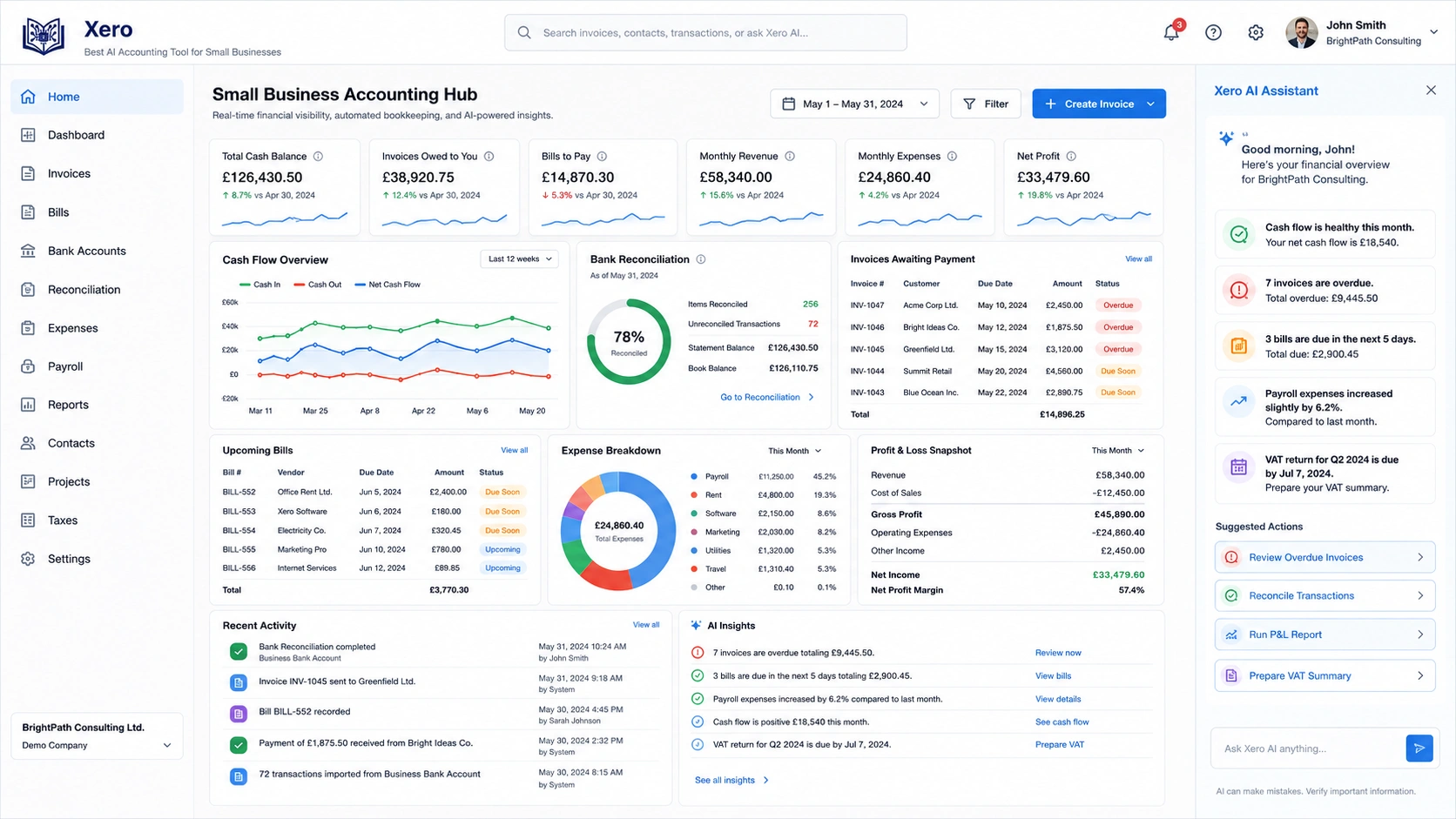
Xero remains one of the best finance tools for small businesses because it combines accounting workflows with automation and AI-assisted features. Jotform’s 2026 AI finance tools guide identifies Xero as an accounting solution for small business owners that uses AI to support invoicing and reconciliation tasks, with integrations that help connect the platform to other business tools. (Jotform)
For small businesses, the goal is not to build a complex finance transformation program. The goal is to send invoices, reconcile bank transactions, track expenses, understand cash flow, and stay organized for taxes. Xero helps business owners and bookkeepers manage those basics with less manual effort.
Xero is best for startups, freelancers, agencies, shops, service businesses, and small companies that need cloud accounting with automation. It is not an enterprise FP&A platform, but it is one of the most practical AI-assisted finance tools for smaller teams.
11. Booke AI: Best AI Bookkeeping Tool for Reconciliation and Transaction Categorization
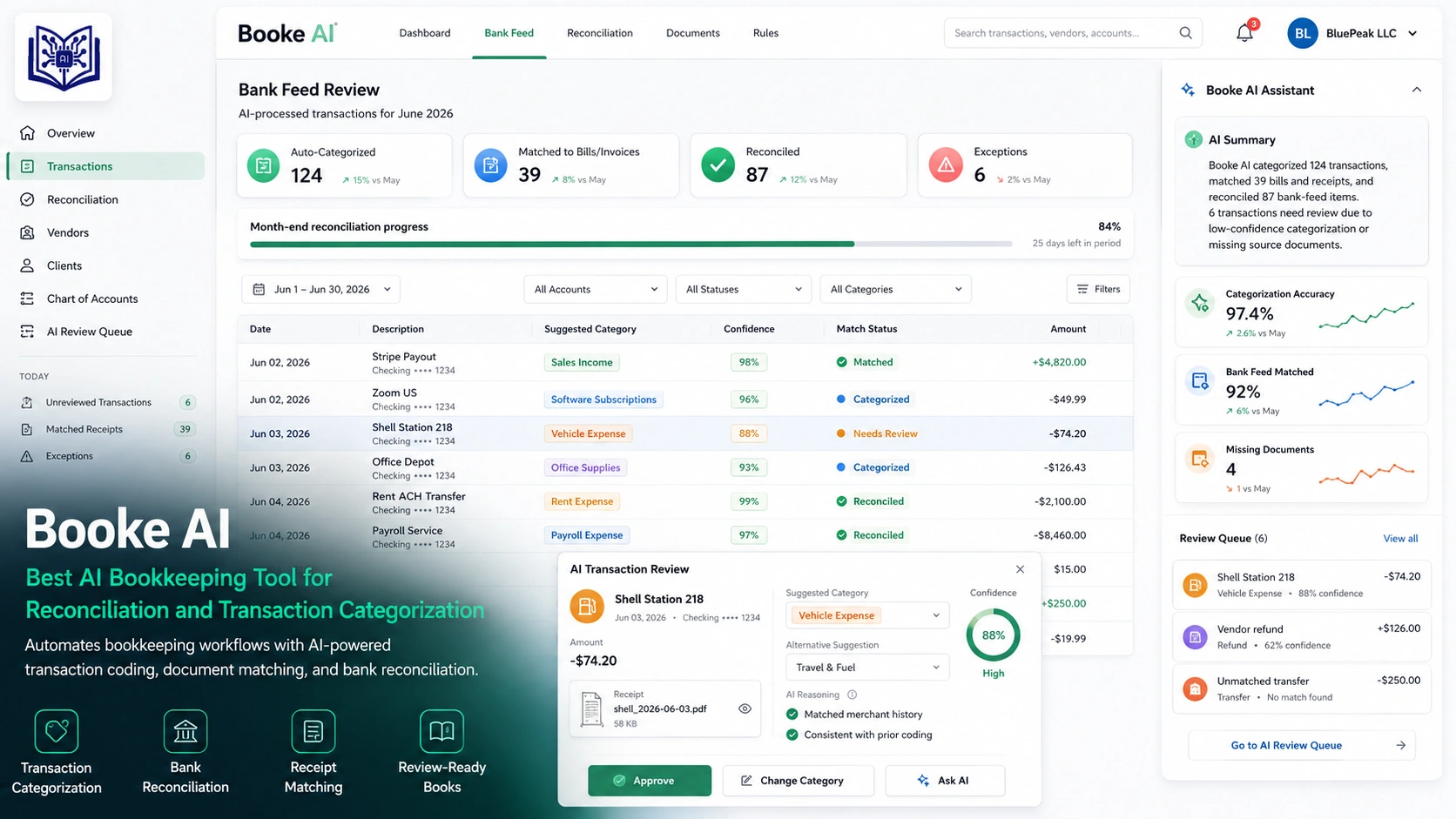
Booke AI is useful for bookkeepers, small firms, and businesses that want to automate reconciliation, transaction categorization, and document handling. Jotform’s AI finance tools guide describes Booke AI as a bookkeeping automation platform that supports transaction categorization, reconciliation, OCR-based invoice reading, and integrations with QuickBooks and Xero. (Jotform)
Bookkeeping is one of the most natural use cases for AI because so much of the work involves repeated classification, matching, checking, and follow-up. AI can help categorize transactions, identify inconsistencies, extract invoice information, and reduce repetitive manual work. That does not mean bookkeepers disappear. It means bookkeepers can spend more time reviewing exceptions, advising clients, and keeping financial records clean.
Booke AI is best for small accounting practices, freelancers, and businesses already using QuickBooks or Xero. It is particularly helpful when monthly reconciliation consumes too much time and the team wants a faster way to keep books up to date.
12. Betterment and Wealthfront: Best AI Finance Tools for Personal Investing
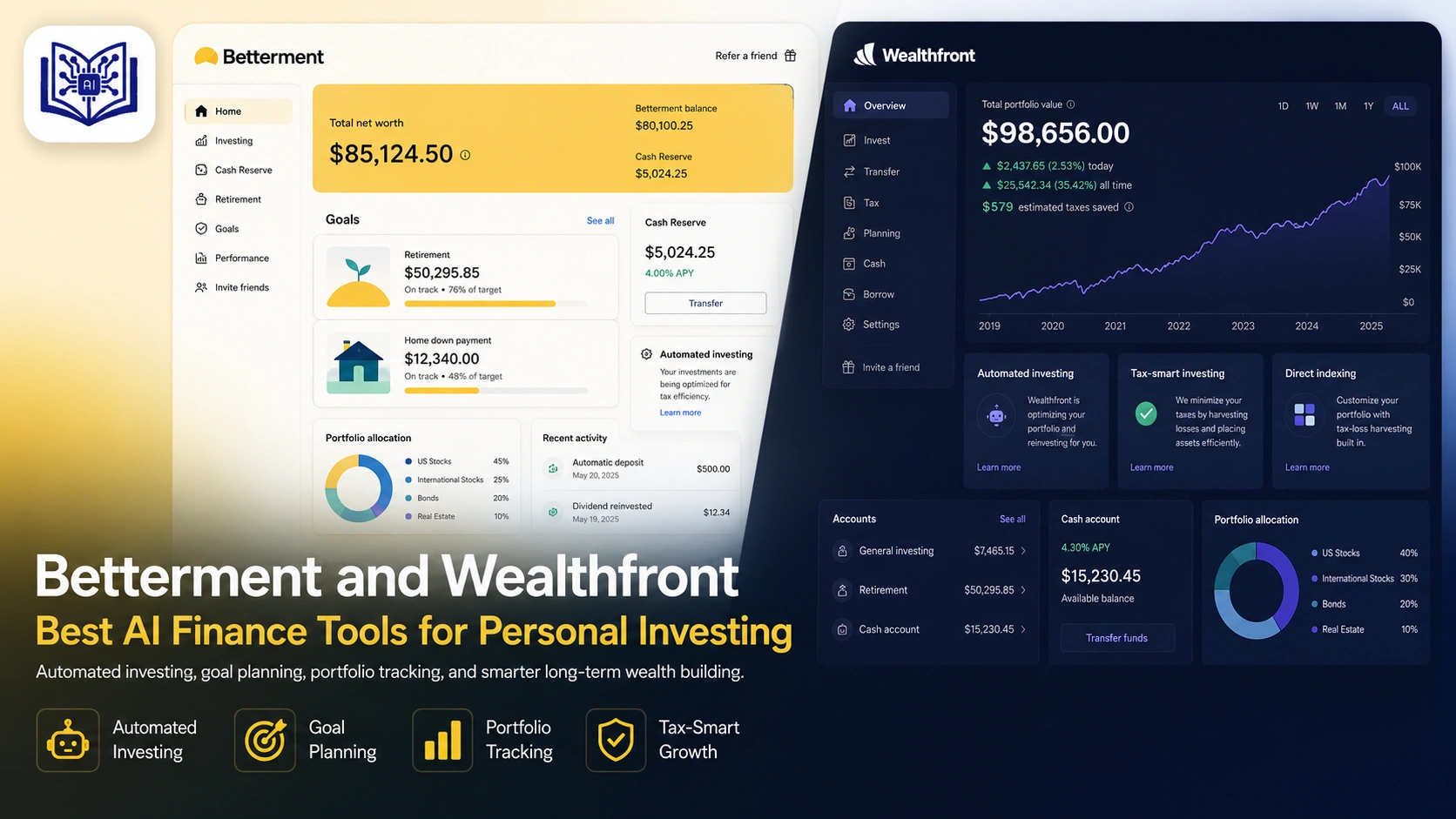
Betterment and Wealthfront are robo-advisory platforms that use automated portfolio management, goal-based planning, tax-aware strategies, and rebalancing to support personal investing. Jotform’s 2026 guide includes Betterment and Wealthfront among the top AI finance tools, describing Betterment as useful for automated investing and Wealthfront as strong for tax-efficient investing and financial planning. (Jotform)
These tools are different from enterprise finance platforms because they are designed for individuals rather than CFO teams. Their role is to help users invest based on goals, risk tolerance, and time horizon. For users who do not want to pick individual stocks or manually rebalance portfolios, robo-advisors can simplify long-term investing.
We recommend robo-advisors for personal finance users who want automation, low-cost portfolio management, and goal tracking. However, users with complex tax, estate, business, or high-net-worth needs may still require professional human advice.
Best AI Finance Tools by Use Case
Match your finance workflow with the right AI tool for FP&A, ERP analysis, accounts payable, audit, investment research, analytics, bookkeeping, and investing.
| Use Case | Recommended Tools |
|---|---|
|
FP&A, budgeting, and forecasting
|
|
|
ERP-connected finance workflows
|
|
|
Accounts payable automation
|
|
|
Audit testing and evidence validation
|
|
|
Investment research and document review
|
|
|
Finance analytics and decision intelligence
|
|
|
Small business accounting
|
|
|
Bookkeeping automation
|
|
|
Personal investing
|
|
|
Finance conversational assistant
|
How to Choose the Right AI Finance Tool
The best AI finance tool depends on the finance workflow we are trying to improve. If our problem is slow budgeting and forecasting, we should focus on FP&A tools such as Vena or Datarails. If our problem is invoice overload, Vic.ai or Stampli will be more relevant. If our problem is audit evidence and validation, DataSnipper is a better fit. If our problem is investment document analysis, Hebbia belongs on the shortlist.
We should also evaluate data governance before choosing any AI finance platform. Finance data is sensitive, regulated, and often connected to internal controls. A useful AI tool must provide security, access controls, auditability, role-based permissions, and clear integration with source systems. KPMG’s 2026 reporting on AI in finance highlights security, model performance, and regulatory compliance as major concerns for finance leaders, which means governance cannot be treated as an afterthought. (TechRadar)
The strongest buying process starts with one workflow, not a vague AI strategy. We should define the bottleneck, estimate the value of fixing it, test the tool on real finance data, involve users early, and measure outcomes such as time saved, error reduction, close-cycle improvement, forecast accuracy, invoice touchless rate, or report turnaround time.
AI Finance Tools: Benefits and Risks
AI finance tools can deliver major benefits when implemented correctly. They can reduce manual work, accelerate reporting, improve anomaly detection, standardize analysis, shorten close cycles, support forecasting, and give finance leaders faster access to business insights. Gartner also reported that three-quarters of CFOs are raising technology budgets for 2026, with nearly half increasing budgets by 10% or more, as AI reshapes core finance, process automation, and analytics. (Gartner)
The risks are real as well. Finance teams must guard against inaccurate outputs, weak controls, poor data quality, unauthorized data exposure, over-automation, and black-box decisions. AI should not be allowed to approve sensitive financial actions without appropriate controls. The best model is human-supervised AI, where automation handles repetitive work but finance professionals review exceptions, judgments, assumptions, and material decisions.
Final Recommendation
For enterprise finance teams, Microsoft 365 Copilot for Finance is one of the most important tools to evaluate because it connects AI to ERP workflows and everyday Microsoft tools. For FP&A teams, Vena and Datarails are two of the strongest options, especially for Excel-centered planning and reporting. For AP automation, Vic.ai and Stampli are leading choices. For audit and validation, DataSnipper is the standout. For investment research, Hebbia is one of the most relevant AI document analysis platforms. For small businesses, Xero and Booke AI are practical and accessible.
The best AI finance stack in 2026 is not one universal tool. It is a carefully selected combination of platforms matched to real workflows. Finance teams that win with AI will not be the ones that buy the most software. They will be the ones that connect AI to governed data, clear processes, measurable outcomes, and responsible human review.
FAQs
1. What is the best AI finance tool in 2026?
The best AI finance tool depends on the use case. Microsoft 365 Copilot for Finance is best for enterprise finance workflows, Vena and Datarails are best for FP&A, Vic.ai and Stampli are best for accounts payable, DataSnipper is best for audit, and Hebbia is best for investment research.
2. Which AI tool is best for FP&A?
Vena and Datarails are two of the best AI tools for FP&A teams. Both support Excel-native planning, budgeting, forecasting, reporting, and AI-assisted analysis, making them strong options for finance teams that rely heavily on spreadsheets.
3. Which AI finance tool is best for accounts payable?
Vic.ai is one of the strongest tools for autonomous AP automation, while Stampli is excellent for AP collaboration, approvals, invoice workflows, and duplicate detection.
4. Can AI finance tools replace accountants?
AI finance tools can automate repetitive tasks, but they do not fully replace accountants. Finance professionals are still needed for judgment, review, controls, compliance, advisory work, and strategic decision-making.
5. Are AI finance tools safe for sensitive financial data?
AI finance tools can be safe when they provide enterprise-grade security, access controls, audit trails, ERP integrations, and clear governance. Finance teams should avoid uploading sensitive financial data into unmanaged consumer AI tools.
“` “`