
USA, UK Jobs 2026 for Students having little or No experince
As a student if you are searching for Foreign jobs but you have little experience or no experince at all. This guide shows how to use AI tools to build an ATS-friendly CV, find entry-level jobs abroad, apply faster, and increase your chances of landing your first international job — even with no local experience, no local network, and limited time between lectures.

If you’re searching for how to get a job abroad without experience, looking for the best AI tools for student job search in 2026, or simply trying to figure out where to start — this step-by-step guide covers the complete system. By the end, you’ll have a working AI job search framework you can implement today.
How Can Someone Get a Job Abroad With No Experience Using AI
How to get a job abroad with no experience using AI — 5 steps:
- Find jobs using ChatGPT to map your opportunity landscape + LinkedIn AI for skills-based discovery
- Build an ATS-optimized CV using AI to reframe your existing skills, projects, and academic experience
- Generate personalized cover letters using AI prompt templates customized per company
- Apply faster using browser extension automation tools that compress application time by up to 70%
- Practice interviews using AI mock interview sessions before every real one
That is the system. Everything below is the complete, step-by-step breakdown of how to execute each phase.
Start Right Now (5-Minute Setup)
Don’t have time to read everything today? Do this right now and come back for the rest:
- Step 1: Open ChatGPT or Claude AI
- Step 2: Paste your skills, subjects, and any experience you have — even informal
- Step 3: Ask: “What jobs can I realistically get as an international student in [country] with these skills and no local experience?”
- Step 4: Pick your top 3 roles from the list it generates
- Step 5: Come back to this guide and follow the system for each role
That five-minute exercise has broken more job-search paralysis than any other single action I’ve recommended to students. Do it before reading further.
The Honest Truth About Finding a Job Abroad as a Student (And How AI Changes Everything)
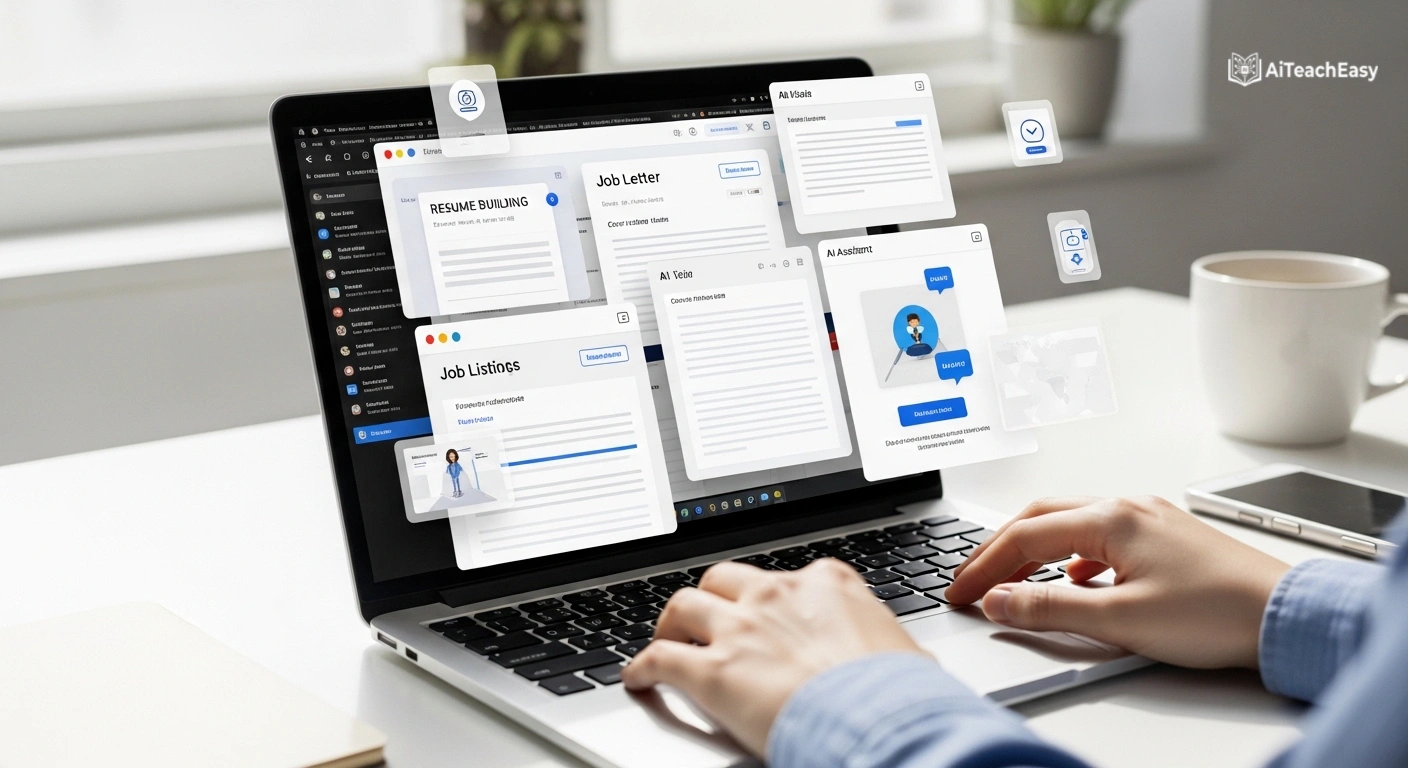
Let me be direct with you from the very first paragraph.
You land in a new country with a student visa, a suitcase, and a genuine desire to build something for yourself. You need income. You need experience. You need a job. And within your first week of searching for jobs while studying abroad, you discover what hundreds of thousands of international students discover every single year.
The job market doesn’t care that you’re smart, motivated, and hardworking. It cares about local experience you don’t have, a local network you haven’t built yet, and a CV that looks identical to every other international student applying for the same five entry-level positions in your city.
I’ve worked with students across multiple countries navigating exactly this situation. The students who break through fastest in 2026 are not the ones with the most impressive academic records. They’re the ones who learned how to use AI job search tools for students as a genuine competitive advantage — building better applications, faster, more personalized, with zero professional network required.
This is not about shortcuts. It’s about using AI tools for job search the way professionals already do — to multiply effort, not replace it.
AI Solutions for Every Student Job Search Challenge
| 😟 Challenge | 🤖 AI Solution | ⚡ Tool to Use |
|---|---|---|
| No local experience | Reframes existing skills to match job requirements | ChatGPT, Claude AI |
| Weak or foreign-format CV | Builds ATS-optimized resume for target country | Resume.io, Kickresume |
| Generic cover letters | Personalizes each letter per company and role | ChatGPT, Claude AI |
| Too slow to apply | Automates and compresses application time 70% | Simplify, LazyApply |
| Interview anxiety | Runs unlimited free mock interview sessions | ChatGPT, Claude AI |
| No local network | Identifies hidden opportunities, drafts outreach | LinkedIn AI, ChatGPT |
| Language barriers | Drafts professional English from notes in any language | ChatGPT, Grammarly |
| No CV formatting skills | Applies country-specific professional templates | Resume.io, Kickresume |
Real Student Case Study: From Zero Applications to Remote Internship in 3 Weeks

Before the framework, here is a real example — because this guide is built on experience, not theory.
A student from Pakistan studying computer science in Germany came to me after three weeks of applying to 40+ jobs with zero responses. Strong academic grades, solid coding skills, genuine motivation — but his CV was formatted for Pakistani job markets, his cover letters were completely generic, and he had no idea which roles were legally accessible under his German student visa.
We rebuilt his approach using exactly the system in this guide. Within three weeks of switching to the AI-powered workflow — targeted role identification, AI-rebuilt CV with German formatting standards, personalized cover letters per application, consistent follow-ups — he landed a paid remote internship with a UK-based software startup. He was still in Germany. The internship was fully remote. His visa conditions were not affected.
He didn’t get lucky. He got systematic.
That’s what this guide builds for you.
Why Traditional Job Searching Fails International Students (The Real Reasons)

Understanding why the traditional approach to job search for international students fails so consistently is what makes the AI solution make sense. These are not surface-level problems — they’re structural barriers that AI directly addresses.
Problem 1: Manual job searching is brutally slow for busy students.
You’re balancing lectures, assignments, visa requirements, and adapting to life in a new country simultaneously. Spending three hours per day manually browsing job boards, customizing each application, and writing individual cover letters from scratch is simply incompatible with a full academic schedule. Most students give up within two weeks because the time cost feels unsustainable.
Problem 2: “No experience” is a hard wall in traditional hiring.
Most entry-level listings abroad — even those labeled “no experience required” — implicitly favor candidates with local internships, local references, and demonstrated familiarity with local professional culture. Your experience from home is real and valuable, but it often doesn’t translate cleanly onto a CV formatted for a different market without intentional, strategic reframing.
Problem 3: Generic applications get generic results — rejection.
The most common mistake I see is students sending the same CV and cover letter to fifty employers. Automated Applicant Tracking Systems (ATS) filter out generic applications before a human ever reads them. You’re not failing because you’re unqualified. You’re failing because your application looks identical to the 200 others that arrived the same morning.
Problem 4: No local network means competing for the smallest pool.
According to research published by LinkedIn Economic Graph, a significant percentage of positions are filled through referrals before public advertising. As a new arrival, you simply don’t have that network yet. Traditional job searching puts you in competition only for publicly listed roles — the most competitive slice of available opportunities.
Problem 5: Visa uncertainty creates application paralysis.
International students often don’t fully understand which work types their visa permits. According to OECD international student employment data, this uncertainty causes many to apply far more narrowly than their visa actually allows. AI doesn’t resolve visa questions — your university’s international student office does. But it removes every other barrier on this list.
How AI Changes the Job Search: A System, Not a Shortcut

Here’s the most important concept before the step-by-step process.
AI is not a magic button that gets you a job. Students who approach it that way — “let AI write my CV and apply to everything automatically” — get the same results as students who spray-and-pray manually: bad results, just faster.
AI is a force multiplier. It compresses time spent on low-value tasks — formatting, generic writing, repetitive customization — to almost nothing. That freed time and energy go into high-value activities: researching specific companies, preparing intelligently for interviews, building in-demand skills, making genuine human connections.
The mechanism is straightforward: AI handles the volume and personalization work that used to take hours per application. You spend those saved hours on quality — choosing better opportunities, preparing more thoroughly, showing up to interviews as a genuinely ready candidate rather than an exhausted one who spent all night writing cover letters.
That’s the shift. From grinding through a system not designed to give international students a fair chance, to operating a smarter, faster, personalized system that removes structural disadvantages one by one.
How to Get a Job Abroad Without Experience: The Complete Step-by-Step AI System
Step 1 — Find Jobs Using AI Tools: Discover Opportunities Others Miss

Most students start their AI job search on one or two boards and quickly get overwhelmed by irrelevant results or too few opportunities matching their visa restrictions.
AI changes the discovery phase entirely — starting before you open a single job board.
Use ChatGPT to map your opportunity landscape first.
Spend 15 minutes with ChatGPT before any job board:
📋 Prompt — Use This Right Now: “I am an international student studying [your subject] in [country/city]. I have [X hours] per week available to work under my student visa. My background includes: [list everything — academic projects, part-time work from home, volunteer roles, technical skills, languages]. What types of jobs, roles, and industries are realistically available to me right now? Include on-campus options, off-campus part-time roles, remote opportunities, and freelance categories I might not have considered. Be specific to my location and visa type.”
This gives you a personalized opportunity map built around your actual situation — not a generic list that ignores your specific field, location, and legal constraints.
Use LinkedIn AI for skills-based job discovery.
LinkedIn’s AI tools now match candidates to roles based on skills rather than job titles alone. Instead of searching “marketing intern,” search by skills you actually have and see what surfaces. Many of the best student opportunities appear here before they hit general boards.
According to LinkedIn’s official talent solutions data, skills-based searches surface 40% more relevant opportunities than title-based searches alone. This matters when you’re an international student whose job title history doesn’t yet exist.
Use Google Jobs for hyperlocal discovery.
Search with structured queries: “part-time jobs for international students [your city] no experience 2026” or “on-campus student employment [your university name].” Google Jobs aggregates listings from multiple boards with filtering by hours, distance, and experience level — useful for visa-restricted searches.
The internal resource most students completely miss:
Your university’s career center is sitting on opportunities never publicly listed — local employers who specifically recruit international students, on-campus roles with guaranteed visa compliance, and alumni networks offering referrals. Most universities publish dedicated international student employment guides. For example, University of Toronto’s Career Centre maintains employer relationships specifically for international students. Check your own university’s equivalent before spending any time on external boards.
Step 2 — How to Build an ATS-Optimized CV Using AI (No Experience Required)

Your CV is the most important document in your AI job search for students — and the one most international students get badly wrong.
The most common mistake: taking the CV from home, translating it if necessary, and submitting it unchanged. This fails for two reasons. First, CV formats vary significantly between countries. Second, ATS systems filter your application before any human sees it, looking for specific keywords your home-country CV almost certainly doesn’t contain.
Step 2a — Match format to your target country.
📋 Prompt: “What is the standard CV/resume format for [job type] positions in [country]? What sections are expected, what length is appropriate, and what should I NOT include that might be standard in [your home country]?”
This prevents dozens of automatic rejections from format mismatch alone.
Step 2b — Reframe existing experience with AI.
Even with no formal professional experience, you have experience. Academic projects, volunteering, tutoring, leadership roles, part-time work from home, any freelance work — all of it is relevant when framed correctly for your target market.
📋 Prompt: “I’m a student with the following background: [list everything]. I’m applying for [job type] positions in [country]. Transform this background into strong, action-oriented CV bullet points that are ATS-optimized and highlight transferable skills relevant to this role. Focus on measurable results and impact, not just descriptions. Use numbers and percentages wherever possible.”
The before/after transformation:
❌ Before: “Helped with university project on data analysis”
✅ After: “Led 4-person team delivering data analysis project that reduced processing time by 30% using Python — presented findings to faculty panel of 8 professors”
Same experience. Completely different professional impression. This is accurate framing, not fabrication.
Step 2c — Use AI resume builders for final formatting.
Once you have strong content, professional formatting matters for ATS compatibility. For completely free, student-accessible options, the best free AI resume builders guide covers tools that require no credit card and rival paid alternatives in output quality.
Step 2d — Run a final ATS keyword check before every submission.
Paste both the job description and your CV into ChatGPT with: “What keywords from this job description are missing from my CV? How can I naturally incorporate them without keyword stuffing?” This two-minute check alone dramatically improves ATS pass rates.
Step 3 — Write Personalized Cover Letters Automatically Using AI

Generic cover letters are worse than no cover letter. A hiring manager who reads “I am a motivated student seeking an opportunity to grow” for the twelfth time that morning is irritated, not impressed. You’ve already been mentally rejected.
Personalized cover letters actually work. Writing a genuinely personalized one used to take 45 minutes per application. With AI, it takes three minutes. This is one of the highest-leverage actions in this entire AI job search system for students.
The cover letter prompt template — bookmark this:
📋 Prompt: “Write a cover letter for the following application. Make it sound natural, specific, and genuinely enthusiastic — not corporate or generic. Do NOT use clichés like ‘I am a motivated individual’ or ‘I would be a great fit.’ Use specific details from the job description to show I’ve read it carefully.
Job description: [paste full description] My background: [paste your CV bullet points] Company name: [name] One specific thing I genuinely find interesting about this company: [write one real thing found in 5 minutes on their website or LinkedIn] Tone: Professional but human. Confident but not arrogant. Length: 3 short paragraphs maximum.”
The “one specific thing” you write yourself is the element AI cannot generate — and it’s precisely what makes the letter work. Spend five minutes on the company’s LinkedIn or website. Find something real. Include it.
Advanced personalization technique:
Reference a specific recent company achievement: “I noticed your team recently expanded into Southeast Asian markets — the consumer behavior methodology you described in your LinkedIn announcement aligns directly with the primary research approach I used in my dissertation.”
That specificity signals a serious candidate. It cannot be faked. It gets remembered.
Step 4 — Apply Faster With AI Job Application Tools

Speed matters in student job markets. Many part-time and entry-level positions receive dozens of applications within the first 24 hours. Being early significantly improves your chances — and AI job application tools make that achievable even with a full lecture schedule.
Browser tools that compress application time:
Simplify auto-fills applications using your stored profile across hundreds of job boards. Students who switch to Simplify consistently report applying to three times as many positions in the same time.
LazyApply automates LinkedIn Easy Apply and Indeed applications at scale based on saved criteria. Use with strict filters — volume without targeting produces noise, not results.
The tracking system most students skip — and later regret:
Build a simple tracking table in Notion or Google Sheets: company name, role title, date applied, current status, follow-up date, and notes. Ask ChatGPT to generate this template in 30 seconds. Without tracking, you’ll lose count of applications, forget to follow up, and potentially apply to the same position twice — all of which damage your professional impression.
Quality versus quantity — the honest balance:
Twenty well-matched applications with genuine personalization outperform 200 generic ones — consistently, predictably, every time. For students managing job search alongside heavy coursework, the time-management frameworks in best AI tools for online classes apply directly to balancing applications with academic deadlines.
Step 5 — Prepare for Interviews Using AI: Mock Sessions That Actually Work

Getting an interview is only half the battle. Showing up unprepared to an interview abroad — where cultural expectations and question formats may differ significantly from home — is common and entirely preventable.
AI gives you unlimited, free, on-demand interview practice at any hour. There is no excuse for walking into an interview unrehearsed in 2026.
The mock interview prompt — save this:
📋 Prompt: “Act as a hiring manager for a [job title] position at a [type of company] in [country]. I am an international student with [your background]. Conduct a realistic job interview with me. Ask one question at a time. After each answer, give me direct feedback: what I did well, what was weak, and exactly how to improve. Start with warm-up questions and increase difficulty gradually. Use the interview style and cultural norms typical for [country] — be specific about expectations I might not know as an international student.”
Run this for 30–45 minutes before any real interview. The feedback — especially on vague answers and over-explaining — is often more direct than what a human practice partner provides.
Pre-interview company research prompt:
“I have an interview at [company name] for [role]. What are likely interview focus areas, what values do they typically screen for, and what questions should I specifically prepare? Suggest three intelligent questions I could ask the interviewer that demonstrate serious research — not generic questions.”
For building deeper preparation skills that serve both academic and professional contexts, how to use Claude AI for study and research covers systematic research techniques that make you stronger in both settings simultaneously.
Best AI Tools for Student Job Search in 2026

Every tool below has been personally tested in real student job search scenarios. This is not a list compiled from marketing materials.
🔧 Core AI Writing and Research Tools
| Tool | Best For | Free Plan | Pros | Cons |
|---|---|---|---|---|
| ChatGPT | CV writing, cover letters, interview prep, research | ✅ Generous free tier | Most versatile, handles every stage, easy prompting | Can sound generic without good prompts |
| Claude AI | Nuanced writing, cover letters, research analysis | ✅ Good free tier | Most human-sounding output, excellent reasoning | Slightly less known, fewer integrations |
| Grammarly | Grammar, tone, and clarity across all documents | ✅ Core features free | Catches errors others miss, tone suggestions | Premium features cost extra |
📄 Resume and CV Building Tools
| Tool | Best For | Free Plan | Pros | Cons |
|---|---|---|---|---|
| Resume.io | Professional CV formatting + ATS optimization | ✅ Limited | Clean templates, ATS-tested, easy to use | Download requires paid plan |
| Kickresume | Country-specific CV templates + AI writing | ✅ Limited | Country-format templates, AI suggestions | Free plan watermarks documents |
| Best Free AI Resume Builders | Students on zero budget | ✅ Fully free options | No credit card needed, multiple options | Requires comparing tools yourself |
⚡ Application Speed and Automation Tools
| Tool | Best For | Free Plan | Pros | Cons |
|---|---|---|---|---|
| Simplify | Auto-filling applications across job boards | ✅ Fully free | Works on 100+ boards, saves hours weekly | Requires Chrome browser |
| LazyApply | Bulk LinkedIn and Indeed applications | ✅ Trial available | Dramatically increases application volume | Risk of over-applying without targeting |
| LinkedIn AI | Skills-based job discovery + networking | ✅ Basic free | Largest professional network, AI matching | Premium features locked behind subscription |
🎯 Job Discovery and Research Tools
| Tool | Best For | Free Plan | Pros | Cons |
|---|---|---|---|---|
| Google Jobs | Hyperlocal job aggregation with filters | ✅ Always free | Aggregates all major boards in one place | No direct application tracking |
| Notion AI | Application tracking and organization | ✅ Limited | Excellent for system-building, AI features | Learning curve for new users |
| Preply | Finding paid tutoring work online | ✅ Profile free | Good earning potential, flexible hours | Platform takes commission from earnings |
Realistic Job Options for International Students Abroad (No Experience Required)

Best Jobs Abroad for Students With No Experience in 2026
Finding a job abroad without experience is possible, but not every job listed online is realistic for students. Many “easy abroad jobs” sound attractive, but they may not fit student visa rules, may require local experience, or may not be available in every city. The smartest approach is to focus on beginner-friendly jobs that are flexible, realistic, and easier to balance with your studies.
Quick Answer
The easiest jobs abroad for students with no experience in 2026 are on-campus jobs, online tutoring, freelancing, remote internships, content writing, retail, hospitality, and food service. These roles usually require basic skills, flexible hours, and less local work experience.
On-Campus Jobs
On-campus jobs are usually the safest and most visa-friendly option for international students. These may include library assistant, lab helper, student office support, campus café work, or tutoring center roles.
- Easier to manage with your class schedule
- Usually more familiar with student visa limits
- Best place to start before external job boards
Online Tutoring
Online tutoring is a strong option if you are good at mathematics, science, English, languages, writing, or exam preparation. It is flexible and often pays better than many basic part-time jobs.
- Work around lectures and study hours
- Teach students from different countries
- Use AI to write your profile and lesson plans
Freelancing
Freelancing is realistic for students with digital skills. You do not always need formal work experience; you need clear examples of what you can do and a focused service offer.
- Writing, translation, data entry, design, editing
- Build small portfolio samples before applying
- Use AI to improve profiles and proposals
Remote Internships
Remote internships help students build professional experience when local jobs are difficult to find. They can improve your CV, portfolio, and future job applications.
- Useful for degree-related experience
- Can provide projects, references, and portfolio work
- Always check visa rules and company legitimacy first
Content Creation and Digital Writing
Blogging, YouTube, LinkedIn posts, newsletters, and digital writing can become valuable over time. This path may not pay immediately, but it builds a public portfolio.
- Good for students with ideas or subject knowledge
- Builds proof of skill for future applications
- AI can help with outlines, editing, scripts, and planning
Retail, Hospitality, and Food Service
Cafés, restaurants, shops, hotels, and customer service jobs are often the most accessible offline jobs for students with no local experience.
- Good for steady part-time income
- Builds communication and local confidence
- No shame in starting here while building better skills
How AI Helps Students Apply Smarter
AI tools can help students create better CVs, write cover letters, improve tutor profiles, prepare freelance proposals, plan content, and organize applications. But AI should not replace your personal voice. The best results come when you use AI for structure, then add your own details, examples, and honest experience.
For students who want to improve study performance and career skills together, our complete AI study system guide explains how to use AI tools more effectively for learning and productivity.
✅ vs ❌ — Common Job Search Mistakes Students Make (And Exactly How to Fix Them)

ATS systems reject CVs missing the right keywords. This is mechanical and completely fixable. Ask ChatGPT to extract key terms from each job description and verify your CV contains them before every submission.
Hiring managers in 2026 frequently identify AI-generated materials that haven’t been personalized. Use AI to structure and draft, then rewrite with specific personal details and genuine observations about the company. The human layer on top is what converts applications into interviews.
Quality beats quantity — always, consistently, predictably. A targeted, researched application to a role you’re genuinely suited for outperforms fifty generic applications to roles that don’t match your background.
Working beyond your visa’s permitted hours is a serious legal matter that can jeopardize your entire student status. Your university’s international student office can clarify this at no cost. Do it once, do it properly, then apply confidently within your permitted scope.
Most students never follow up. A polite follow-up email — which AI drafts in 30 seconds — puts your application back in front of the hiring manager precisely when most other applicants have been forgotten. This single habit consistently increases interview rates for students who implement it.
The same AI tools that help you study faster also build professional skills faster. Students who use best AI tools for exam preparation alongside their job search consistently build both academic and professional competence faster than those who separate the two entirely.
Many of the most effective AI job search tools have genuinely powerful free tiers. The free AI tools no signup guide is specifically for students who want to test tools without creating accounts — valuable for international students who are cautious about sharing personal data with multiple platforms.
Your Weekly AI Job Search Routine: Practical, Sustainable, and Exam-Compatible

The biggest reason students fail at job searching while studying is not lack of effort — it’s inconsistency. They apply intensively for two weeks, face some rejection, and stop. Students who succeed treat job searching as a consistent weekly practice, not a crisis-mode sprint.
Here is a realistic weekly routine taking 60–90 minutes per day, fully compatible with a demanding lecture schedule:
Monday — Discovery Day (60 minutes)
Use ChatGPT to identify 10–15 new job opportunities matching your current search criteria. Check LinkedIn, Google Jobs, your university job board, and one specialized platform (Fiverr for freelance, Virtual Internships for remote internships). Save all opportunities to your tracking sheet. Don’t apply yet — build your quality queue for the week. Targeting well on Monday means applying well on Tuesday.
Tuesday — Application Day (90 minutes)
Choose your 3–5 best-matched opportunities from Monday. For each: customize CV keywords to match the description (10 minutes with AI per application), write a personalized cover letter using the prompt template above (15 minutes per application), then submit. Three well-prepared applications beat fifteen generic ones — every single week without exception.
Wednesday — Skill Building Day (45 minutes)
Use this time to close a specific skill gap identified in Tuesday’s job descriptions. Complete a free LinkedIn Learning module, build a small portfolio piece, or use the accelerated learning techniques in how to learn anything 10x faster to acquire a relevant skill faster than traditional self-study allows. Each skill you add expands your accessible job pool directly.
Thursday — Follow-Up and Networking Day (45 minutes)
Send polite follow-up emails to applications submitted 5–7 days ago. Connect with two or three relevant professionals on LinkedIn with personalized connection requests — ChatGPT drafts these in 60 seconds. Comment meaningfully on posts from target companies. Online networking is free, visa-neutral, and builds the local professional connections that traditional job searching requires you to already have before you start.
Friday — Interview Preparation Day (60 minutes)
Whether or not you have an interview scheduled, practice. Run the mock interview prompt with ChatGPT for the role type you’re targeting. Prepare three new STAR-format answers for behavioral questions. Research one company you applied to this week more deeply. Consistent weekly practice means you’re genuinely ready when an interview comes with 48 hours’ notice — which happens constantly for part-time and internship roles.
Weekend — System Review (30 minutes)
Review your tracking sheet. How many applications sent? Any responses? What patterns are emerging? If you’re noticing consistent rejection at the same stage, use AI to diagnose it: “Here are my last 10 applications and their outcomes. What patterns do you notice? What should I change in my targeting or application approach?”
Students who iterate based on feedback improve exponentially faster than those who keep repeating the same approach hoping for different results.
Are AI Job Search Tools Worth It for International Students in 2026?
Let me give you a genuinely honest answer rather than a promotional one.
Yes — absolutely, when you use AI to work smarter on the right opportunities.
Students who get transformational results from AI tools for job search share one characteristic: they use AI to improve the quality and speed of their genuine effort, not to replace genuine effort with automation. AI writes better first drafts. AI researches more thoroughly. AI practices interviews more patiently and consistently. All of that compounds into better applications, better interview preparation, and better performance when it matters.
No — it won’t help if you expect AI to think for you.
Students who bulk-generate 200 identical AI cover letters and mass-apply to anything get the same result as students who mass-apply manually: mostly silence, occasionally rejection, rarely success. The hiring manager receiving your application is a human who can tell when something was produced without genuine thought behind it.
The honest bottom line: AI is leverage. Leverage amplifies the direction you’re already moving. Thoughtful effort plus AI produces transformational results. Zero effort plus AI produces zero results, just delivered faster.
For students building AI habits across every aspect of academic and professional life, how students can use ChatGPT for study is the most complete guide on integrating AI into your daily workflow — covering both study and professional skill development in parallel.
Frequently Asked Questions: AI Job Search for International Students
Q1: Can I really get a job abroad as an international student with no experience?
Yes — and in 2026, the combination of AI job search tools and remote work infrastructure makes it significantly more achievable than even two years ago. Target roles where skills matter more than credentials: on-campus positions, remote freelancing, online tutoring, and remote internships. AI helps you present your actual academic background in terms that match what employers in your target country are looking for. Any project, part-time work from home, or leadership role you’ve had is experience that AI can help you frame professionally.
Q2: Which AI tool is genuinely best for student job searching in 2026?
ChatGPT is the most versatile starting point — it handles CV writing, cover letters, interview preparation, company research, and job discovery all within one tool, with a generous free tier. Claude AI is excellent for more nuanced writing, particularly cover letters that need to sound genuinely human. For students wanting to explore tools without creating accounts, free AI tools no signup covers options worth testing before committing to any registration.
Q3: Is it legal to work while studying abroad on a student visa?
This depends entirely on your specific visa type and host country. According to OECD international education guidelines, most student visas permit defined work hours — commonly 20 hours per week during term time with full-time rights during academic vacations — but restrictions vary significantly by country and institution. Your university’s international student office can clarify with certainty. Do not rely on internet forums or other students’ interpretations.
Q4: How many jobs should I apply to per day?
Quality consistently beats quantity. Three well-targeted, genuinely personalized applications per day outperform fifteen rushed generic ones without exception. In active job-search mode, aim for 10–15 quality applications per week. Track your application-to-interview conversion rate — if you’re below 10%, your targeting or application quality needs adjustment, not your volume.
Q5: What if my English isn’t strong enough for professional job applications?
AI completely addresses this barrier. Draft your cover letter or CV content in your native language, then ask ChatGPT to translate and adapt it to professional English appropriate for your target country. Run the result through Grammarly for final polish. The output will be professionally written English that accurately reflects your qualifications — not an awkward translation that signals a non-native writer.
Q6: Can I freelance internationally while on a student visa?
In many countries, receiving income through international online platforms is treated differently from having a local employer — but this varies significantly by country and visa type. According to NAFSA regulatory guidance on student employment, online freelancing income sourced from foreign clients is handled under different provisions than local employment in most jurisdictions. Your university’s international student office or a qualified immigration advisor can give you a definitive answer for your specific situation.
Q7: How do I explain being a full-time student with no paid work history?
Being a full-time student is not an employment gap — it is an investment in yourself that most employers recognize and respect. Frame your student period accurately: intensive skill development, project delivery, research, academic achievement, and often significant extracurricular leadership. AI can extract professional-transferable elements from any academic work. Your dissertation is data analysis experience. Your group project is team leadership. Your student society role is organizational management. This is accurate professional framing, not spin.
Q8: What remote jobs can I do while studying abroad?
Remote-compatible roles accessible to international students include: online tutoring, freelance writing and content creation, web and app development, graphic design, social media management, virtual assistance, data entry and analysis, translation and transcription, and online customer support for international companies. For students building digital skills alongside their degree, hidden AI tools students are using covers AI-powered skill-building tools that help you develop these capabilities faster while managing your academic workload simultaneously.
Final Verdict: Pick One Step and Implement It Today

Here is what I want you to take away from this entire guide.
The international students who struggle most with job searching abroad are not struggling because they’re unqualified. They’re struggling because they’re operating in a system not designed to give them a fair chance — using methods designed for people who already have local advantages: local experience, local networks, and local knowledge of how professional culture works in that specific country.
AI doesn’t give you those local advantages directly. What it does is systematically remove the disadvantages that come from lacking them. It levels the application playing field. It removes the time barrier that makes customization impossible on a student schedule. It removes the language barrier that makes professional writing harder. It removes the preparation gap that makes interviews intimidating for international candidates.
That’s not a small thing. That’s the difference between 50 rejections and your first interview. Between your first interview and your first job offer. Between feeling like an outsider in a new country and building real, solid professional roots there.
The system in this guide works. But only if you implement it consistently, with genuine effort and real thought behind every AI-assisted output.
Pick one step from this guide and implement it today.
Not next week when your schedule clears up. Not after the next exam. Today.
If you have 5 minutes — do the Quick Action Box at the top. Open ChatGPT, paste your skills, ask what jobs are realistic for you right now. That five-minute exercise breaks more job-search paralysis than anything else I recommend.
If you have 30 minutes — rebuild your CV using the AI prompts in Step 2. That one improved document will outperform your current version in every application you send from this point forward.
Within 7 days of implementing this system consistently, you will already be ahead of 90% of international students still applying the old way. That is not motivational exaggeration — it is the observable, repeatable result of replacing generic effort with systematic, AI-powered, targeted effort.
Start now. The only mistake is waiting.
About the Author
Prof. Irfan is an educator, AI integration specialist, and founder of AITeachEasy.com — a platform helping students and teachers across Pakistan and internationally use artificial intelligence to learn smarter, work more effectively, and build real opportunities. He writes from direct, hands-on experience working with students navigating exactly the challenges covered in this guide — not from theory or repackaged marketing content.
His approach is built on one principle: practical, honest, tested guidance is more valuable than comprehensive feature lists or generic motivational content.
Explore his complete library of guides on best AI tools for students, AI-powered study systems, and career development at AITeachEasy.com.
Found this guide useful? Share it with an international student still applying the hard way. One share could save them months of frustration and hundreds of rejected applications.