
Best Free AI Translator Tools in 2026
AI translation tools in 2026 are no longer simple word-swapping apps. They have become intelligent language platforms that can translate documents, websites, meetings, videos, subtitles, emails, customer support messages, product pages, legal files, medical notes, business reports, and real-time conversations. The best AI translators now combine machine translation, large language models, speech recognition, terminology control, document formatting, localization workflows, and sometimes human review.
This matters because global communication is now instant. A small business can sell internationally from day one. A student can research sources in another language. A traveler can speak with locals through headphones. A remote team can work across five countries without waiting for manual translation. Google Translate recently marked 20 years and now supports about 250 languages, serving around 1 billion users, which shows how central translation has become in daily digital life. (blog.google)
What Is an AI Translator?
An AI translator is a tool that uses artificial intelligence to convert text, speech, documents, images, subtitles, or conversations from one language into another. Older translation systems often translated sentence by sentence with limited understanding of tone, culture, grammar, and context. Modern AI translation tools are more advanced because they can understand full paragraphs, preserve formatting, adjust tone, detect language automatically, and handle industry-specific vocabulary.
In 2026, AI translators usually fall into five categories: everyday translators, document translators, localization platforms, speech translation tools, and enterprise translation systems. DeepL, Google Translate, Microsoft Translator, ChatGPT, Claude, Smartcat, Lokalise, Doclingo, SYSTRAN, and Taia all serve slightly different needs. Jotform’s AI translator guide lists tools such as DeepL Translator, Google Translate, Lokalise, Smartcat, QuillBot, SYSTRAN Translate Pro, and Taia, while Doclingo’s 2026 comparison focuses heavily on document translation performance across contracts, research papers, financial reports, scanned forms, and manuals. (Jotform)
Best AI Translator Tools in 2026
| Rank | AI Translator Tool | Best For | Main Strength |
|---|---|---|---|
| #1 | DeepL Translator | Professional text and document translation | Natural, accurate translations with strong writing quality |
| #2 | Google Translate | Everyday translation and language coverage | Around 250 supported languages and real-time translation features |
| #3 | Microsoft Translator | Business, meetings, and Microsoft ecosystem users | Strong integration with Microsoft products |
| #4 | ChatGPT | Context-aware translation and rewriting | Tone, explanation, localization, and flexible editing |
| #5 | Claude | Long-form and careful translation review | Strong handling of long documents and nuanced language |
| #6 | Doclingo | Document translation workflows | Tested document-focused translation use cases |
| #7 | Smartcat | Business localization and multilingual content | Translation management and AI-human workflow |
| #8 | Lokalise | Software and app localization | Product, app, website, and UI translation workflows |
| #9 | SYSTRAN Translate Pro | Enterprise and regulated translation | Business-focused secure translation |
| #10 | Taia | AI plus human translation workflows | Useful when professional review is needed |
| #11 | QuillBot Translator | Students and quick writing support | Simple translation with writing tools |
| #12 | Instant translator devices | Travel and live conversation | Real-time voice translation without heavy setup |
AI Translator Selection Workflow
Everyday Text
Google Translate or DeepL
Business Documents
DeepL, Doclingo, Smartcat
Meetings & Speech
Google Translate or Microsoft Translator
Apps & Websites
Lokalise or Smartcat
Legal / Regulated Content
SYSTRAN, Taia, Human Review
Creative / Contextual Translation
ChatGPT or Claude
1. DeepL Translator: Best AI Translator for Professional Accuracy and Natural Writing
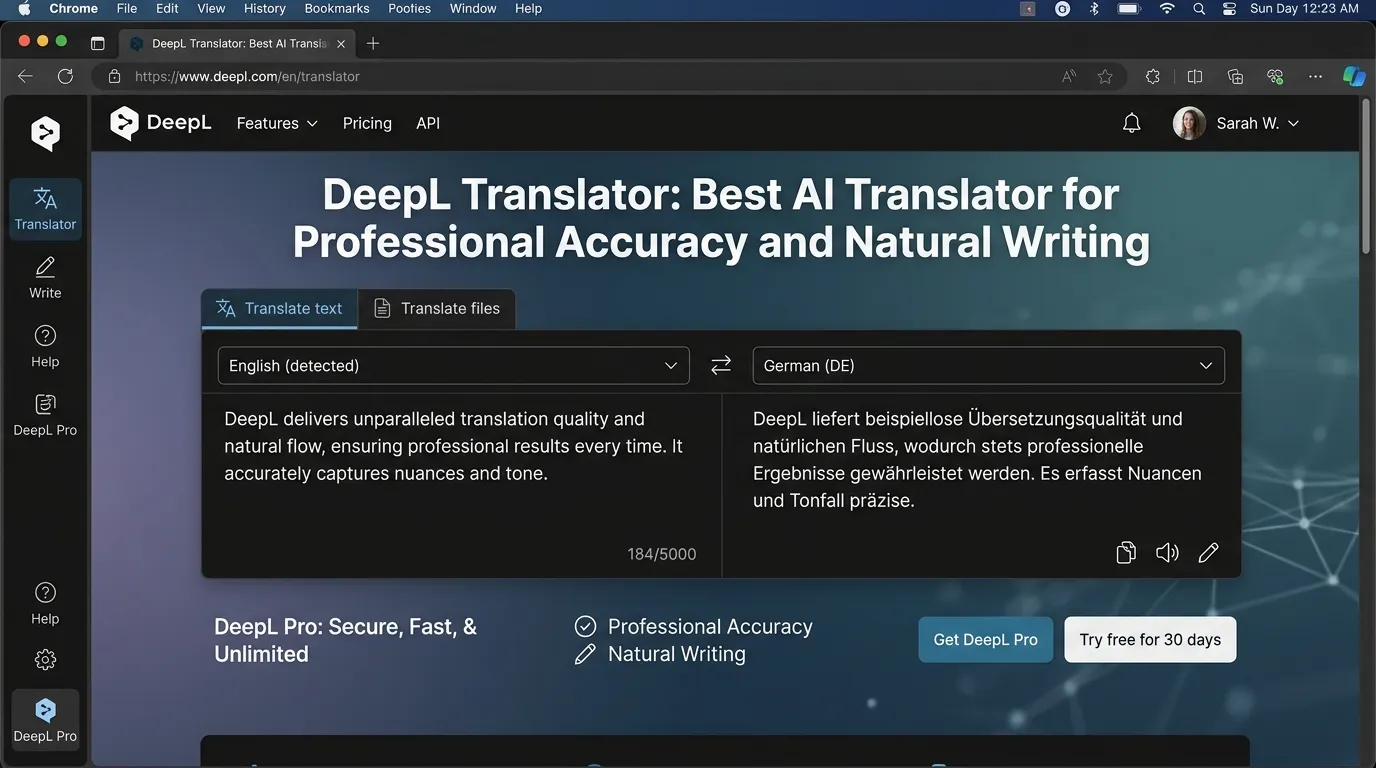
DeepL is one of the strongest AI translation tools in 2026 because it focuses on natural, high-quality translation rather than only broad language coverage. DeepL’s official platform supports text, file, speech, and API translation, and it positions itself as an AI platform for accurate translation and business productivity. (DeepL)
DeepL is especially useful for professional emails, business documents, academic writing, reports, marketing copy, and multilingual communication where tone matters. The translations often feel smoother and more human than basic machine translation output. DeepL also offers DeepL Write, which helps users improve spelling, grammar, punctuation, clarity, tone, and sentence alternatives. That makes it useful not only for translation but also for polishing translated content. (DeepL)
We recommend DeepL for users who care about translation quality, fluency, and professional tone. It is a strong choice for businesses, freelancers, students, consultants, marketers, and writers. The main limitation is language coverage compared with Google Translate. If we need a rare language, Google Translate may be better. If we need elegant translation in widely supported languages, DeepL is often the better first choice.
2. Google Translate: Best Free AI Translator for Language Coverage and Everyday Use
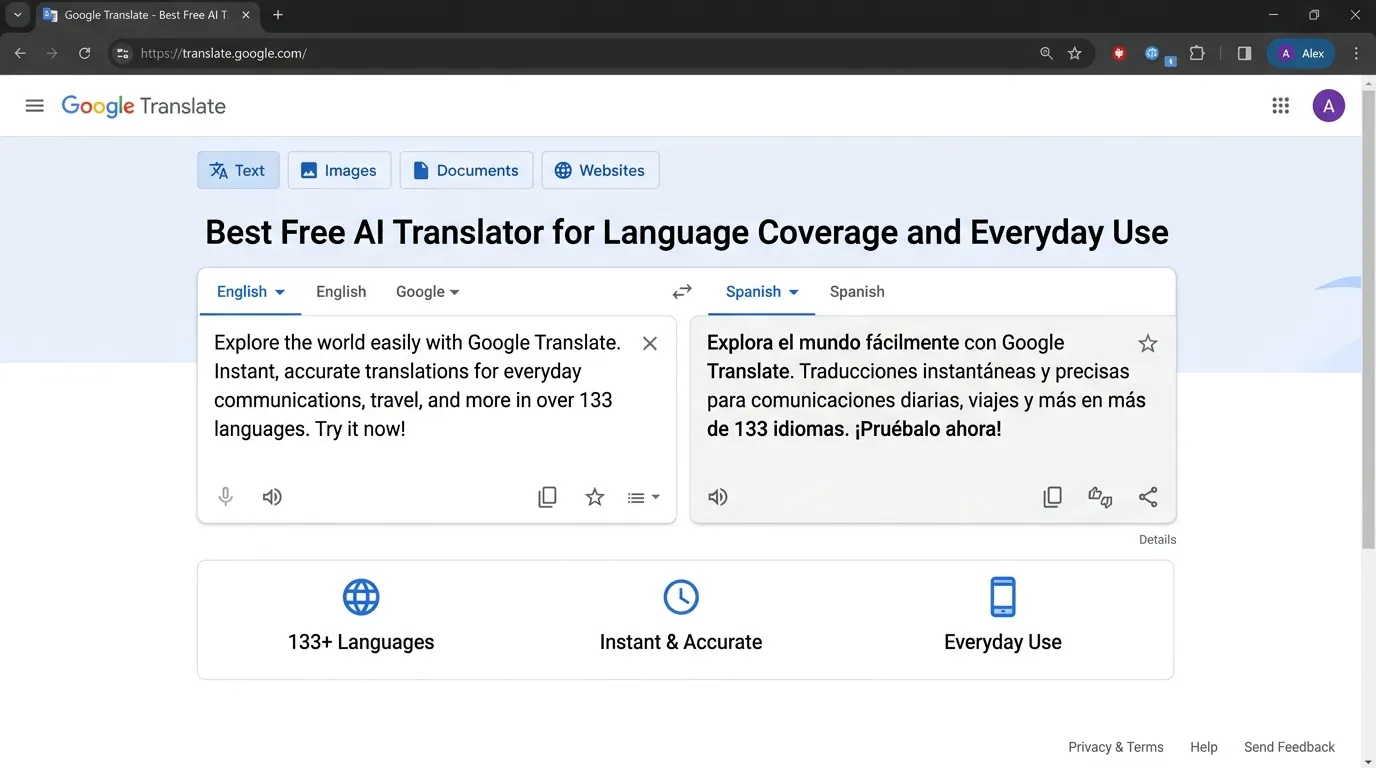
Google Translate remains one of the most useful AI translation tools in the world because of its massive language coverage, free access, mobile convenience, and real-time features. In 2026, Google says Translate supports about 250 languages and is used by around 1 billion people, which makes it the most widely accessible translation platform for everyday communication. (blog.google)
Google Translate is best for travelers, students, casual users, quick website translation, signs, menus, chats, and multilingual discovery. Its camera translation and speech translation features make it especially useful in real-world situations. Recent reporting also notes that Google has expanded live speech translation through headphones, with support for more than 70 languages in certain live translation features. (The Verge)
The biggest advantage of Google Translate is convenience. It is fast, free, widely available, and supports more languages than most competitors. The main weakness is that professional writing quality can vary, especially for complex documents, legal meaning, idioms, or culturally sensitive copy. We recommend Google Translate for speed and access, but not as the only tool for high-stakes business, legal, medical, or brand-sensitive translation.
3. Microsoft Translator: Best AI Translator for Microsoft Ecosystem and Business Meetings
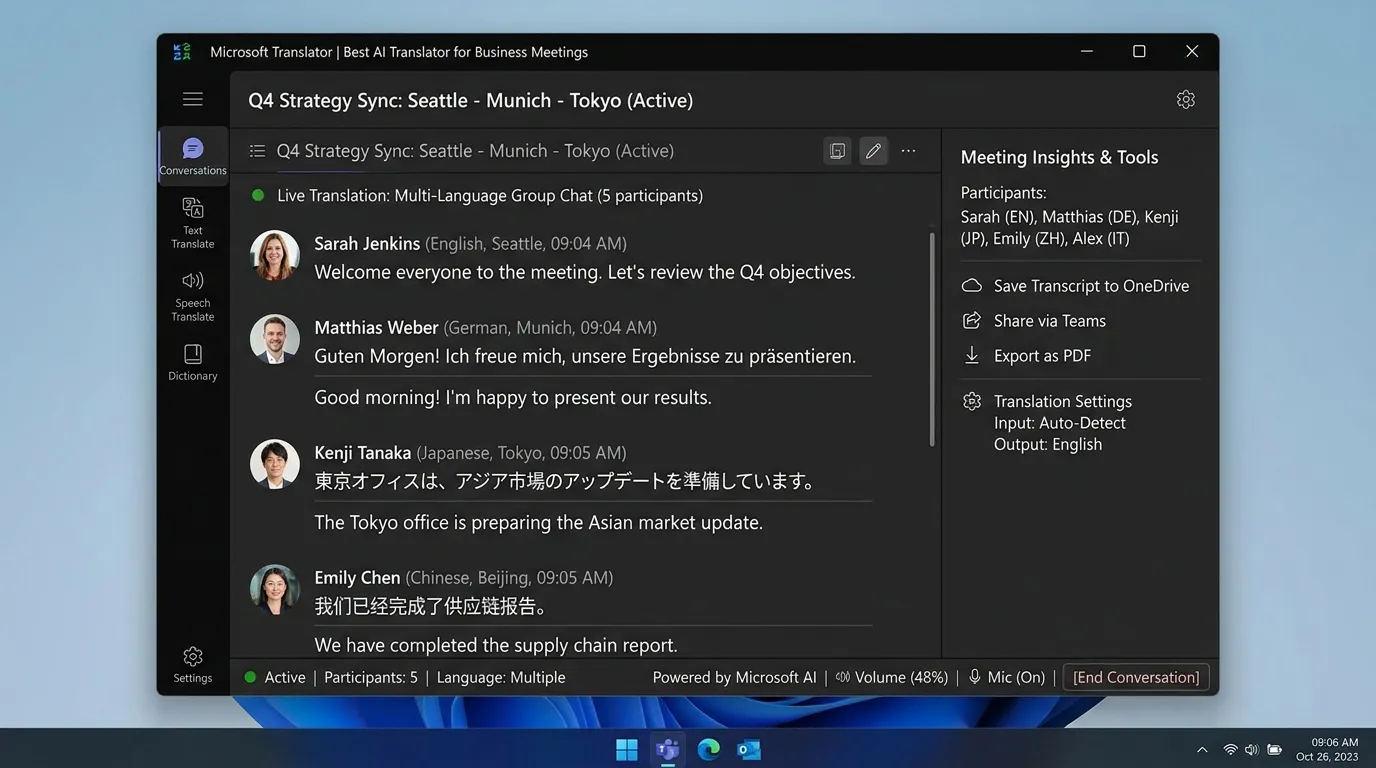
Microsoft Translator is a strong choice for businesses, schools, and teams already using Microsoft products. It works well for live conversations, meeting captions, multilingual communication, and translation inside Microsoft’s productivity ecosystem. For organizations that already rely on Teams, Outlook, Word, PowerPoint, and Azure, Microsoft Translator can fit naturally into daily workflows.
The biggest value of Microsoft Translator is business practicality. Teams do not always need a separate translation platform; they need translation available inside meetings, documents, emails, and collaboration tools. Microsoft Translator is useful for multinational teams, remote workers, customer support groups, educators, and companies that host multilingual meetings.
Microsoft Translator is not always the top choice for literary translation or deeply polished marketing copy, but it is dependable for workplace communication. We recommend it for organizations where translation needs are tied to meetings, collaboration, accessibility, and Microsoft-based work.
4. ChatGPT: Best AI Translator for Context, Tone, Localization, and Explanation
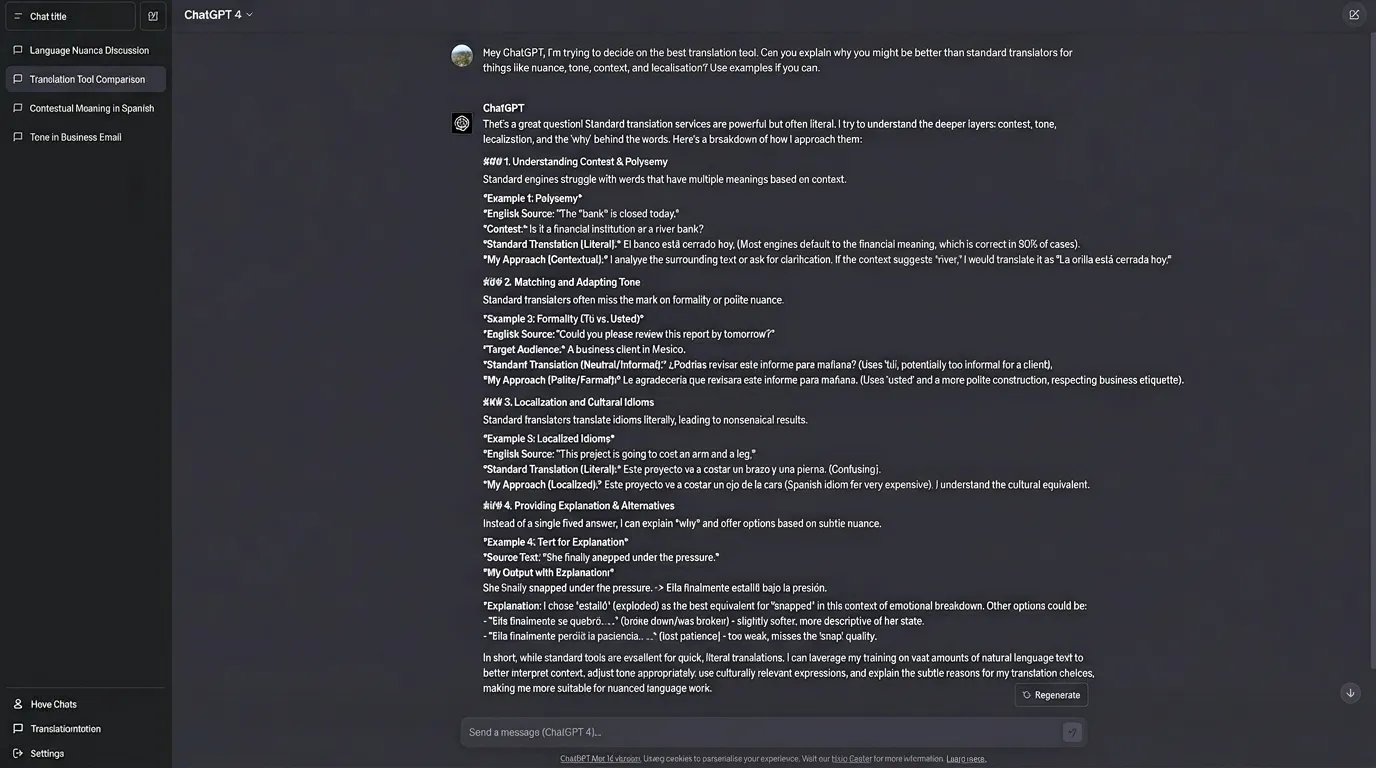
ChatGPT is one of the most flexible AI translators because it does more than translate words. It can explain translation choices, adapt tone, localize content for a specific country, rewrite translated text naturally, compare multiple versions, simplify difficult language, and adjust formality. This makes it especially useful when translation is part of a larger writing task.
For example, a direct translation may be technically correct but still sound strange to native speakers. ChatGPT can help turn that translation into natural English, professional Urdu, formal Arabic, conversational Spanish, or region-specific marketing copy. It can also explain why one phrase is better than another, which is extremely useful for students, language learners, and professionals.
We recommend ChatGPT for creative translation, marketing localization, email rewriting, social media captions, customer replies, bilingual content, and translation review. The main caution is accuracy. For legal, medical, financial, or official documents, users should verify important details and consider professional review.
5. Claude: Best AI Translator for Long-Form Documents and Careful Language Review
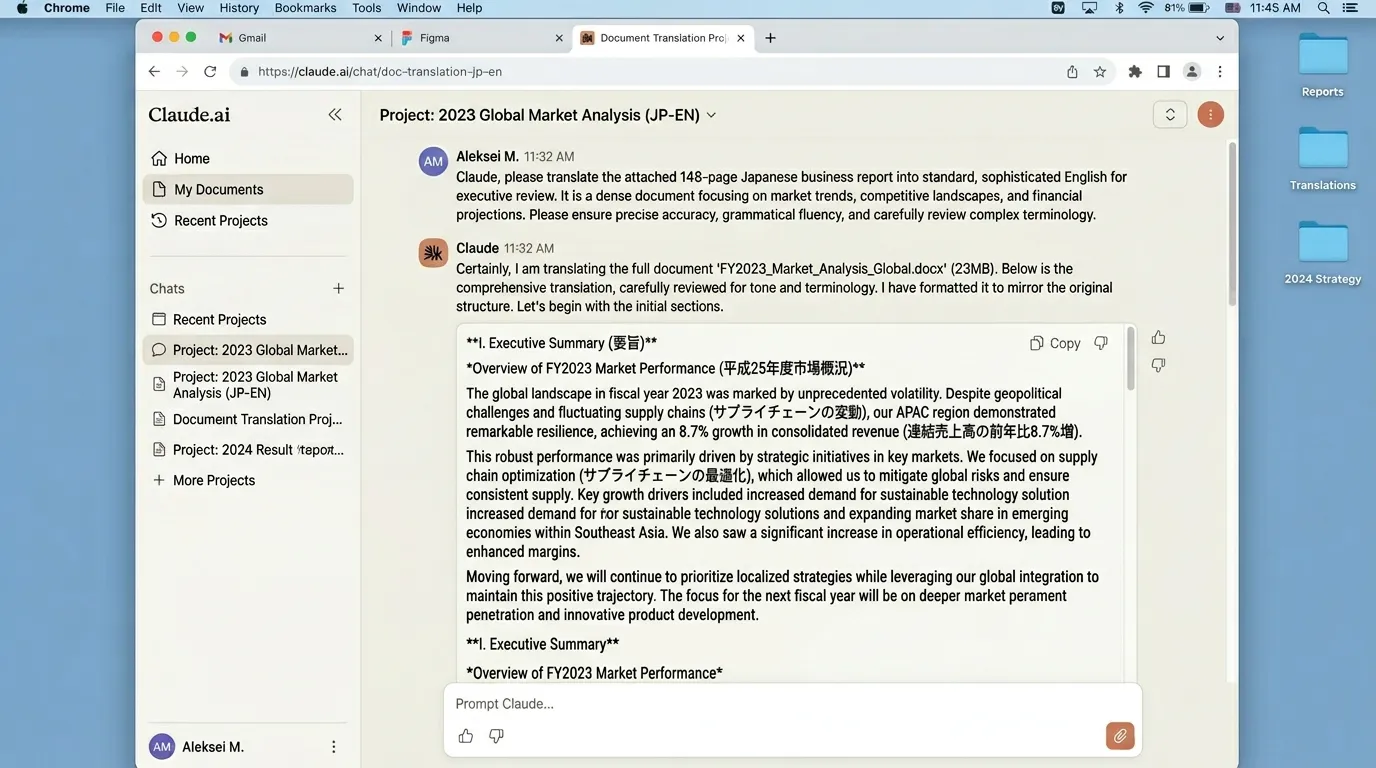
Claude is useful for long-form translation, document review, and careful rewriting. It is especially good when we need to work with large blocks of text, preserve meaning across long sections, and improve clarity without making the writing feel robotic. For research summaries, internal reports, essays, policy drafts, and long articles, Claude can act as both translator and editor.
Claude is strong when context matters. It can translate a passage, explain difficult phrases, identify tone problems, and produce a more natural version. This makes it useful for academic translation, professional documents, cross-cultural writing, and multilingual content development.
We recommend Claude when the translation task is not just “convert this sentence,” but “help us understand and improve this document.” It is not a dedicated translation management platform, but as an AI writing and translation assistant, it is extremely useful.
6. Doclingo: Best AI Document Translator for Business Files
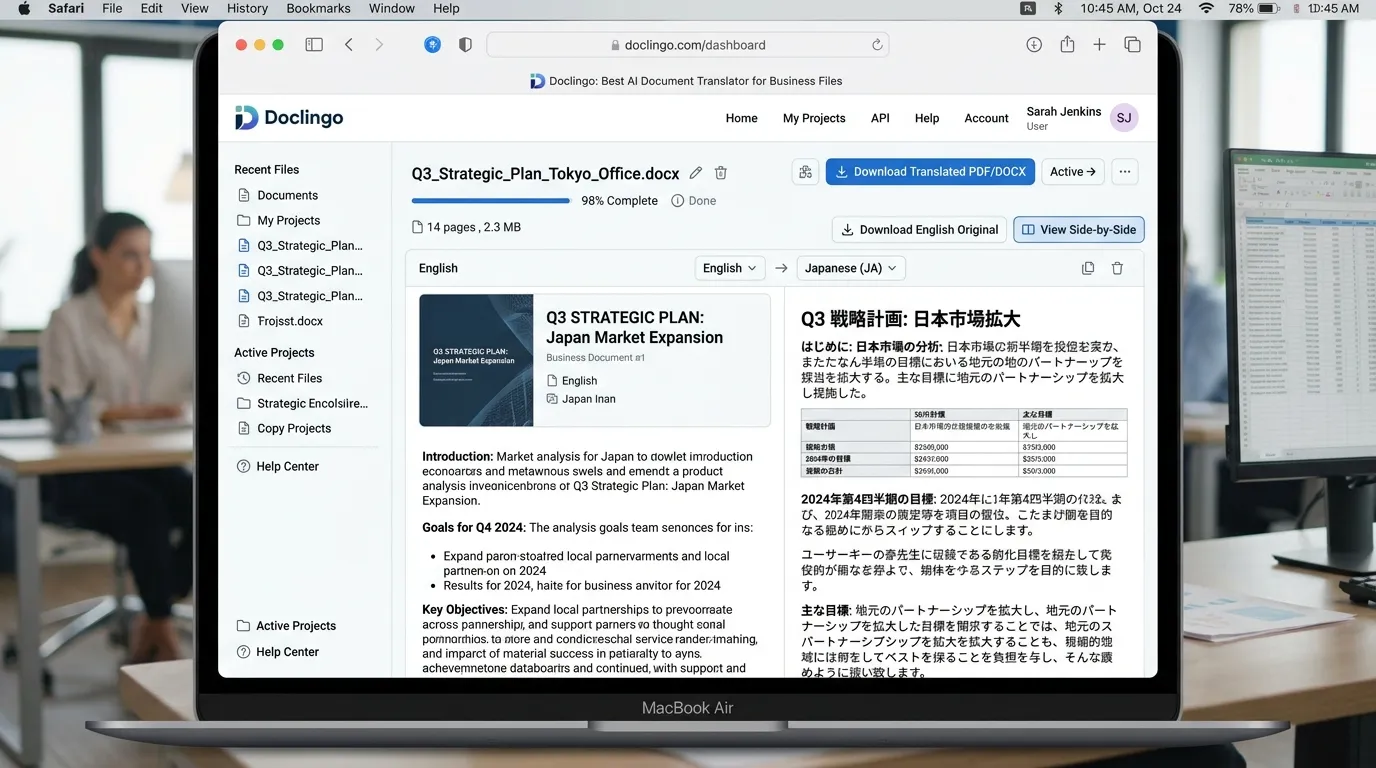
Doclingo is positioned around AI document translation, and its 2026 comparison tested translation tools on practical document types such as legal contracts, medical research papers, corporate financial reports, scanned government forms, and product manuals. That focus matters because document translation is harder than simple text translation. Documents have formatting, tables, headings, footnotes, terminology, scanned content, and layout issues. (doclingo.ai)
We recommend Doclingo for users who need to translate full files rather than copy and paste paragraphs. It is useful for businesses, researchers, legal teams, healthcare administrators, consultants, and international operations teams. The ideal user is someone who regularly handles PDFs, Word files, reports, forms, manuals, and structured documents.
The biggest advantage of a document-focused translator is workflow quality. A good document translator should preserve structure, reduce manual cleanup, and make review easier. If we translate documents often, a dedicated document translation tool can save far more time than a basic text translator.
7. Smartcat: Best AI Translator for Business Localization and Translation Management
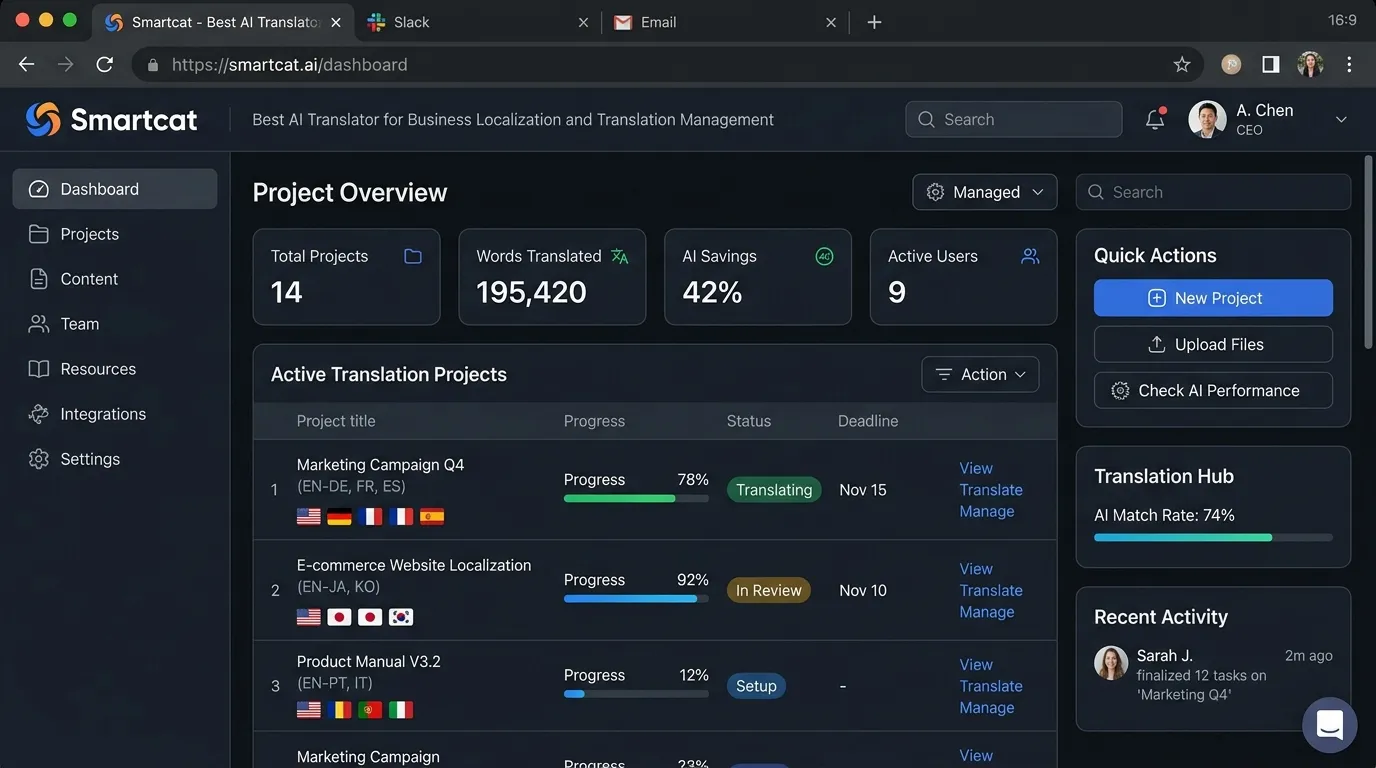
Smartcat is a strong option for businesses that need translation at scale. It is not just a translator; it is a localization platform designed for teams that manage multilingual content, vendor workflows, AI translation, human review, and project delivery. Smartcat’s own 2026 guide discusses top AI translation tools for business expansion and positions the category around scaling global content. (Smartcat)
Smartcat is useful for companies translating websites, training content, marketing materials, product documentation, support articles, and internal knowledge. The platform approach matters because business translation is rarely a one-time task. Content changes, teams need approvals, terminology must stay consistent, and translations often require review.
We recommend Smartcat for companies that want AI translation with workflow management. It is especially useful for marketing teams, localization managers, HR teams, SaaS companies, ecommerce brands, and global content teams.
8. Lokalise: Best AI Translation Tool for App, Website, and Software Localization
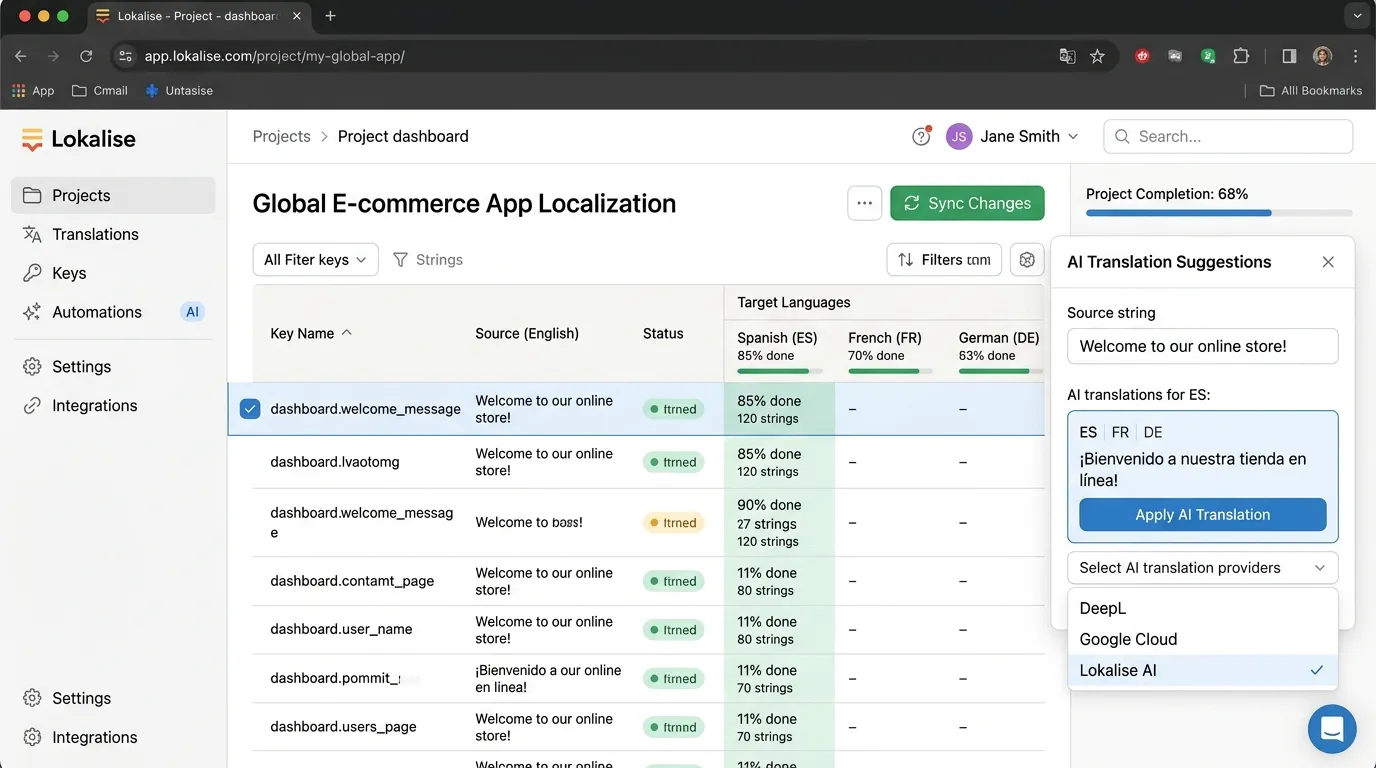
Lokalise is best for software localization. If a company needs to translate an app, website, SaaS product, user interface, help center, or product experience, a simple translator is not enough. Software localization requires string management, developer collaboration, translation memory, screenshots, context, quality assurance, and release workflows.
Jotform’s AI translator guide includes Lokalise among the best AI translators, which makes sense because localization is one of the most valuable translation use cases for growing digital businesses. (Jotform)
We recommend Lokalise for product teams, developers, SaaS companies, mobile app creators, ecommerce platforms, and global startups. It helps teams avoid the chaos of spreadsheet-based translation. Instead of sending text strings manually back and forth, teams can manage translation in a structured localization workflow.
9. SYSTRAN Translate Pro: Best Enterprise AI Translator for Secure Translation
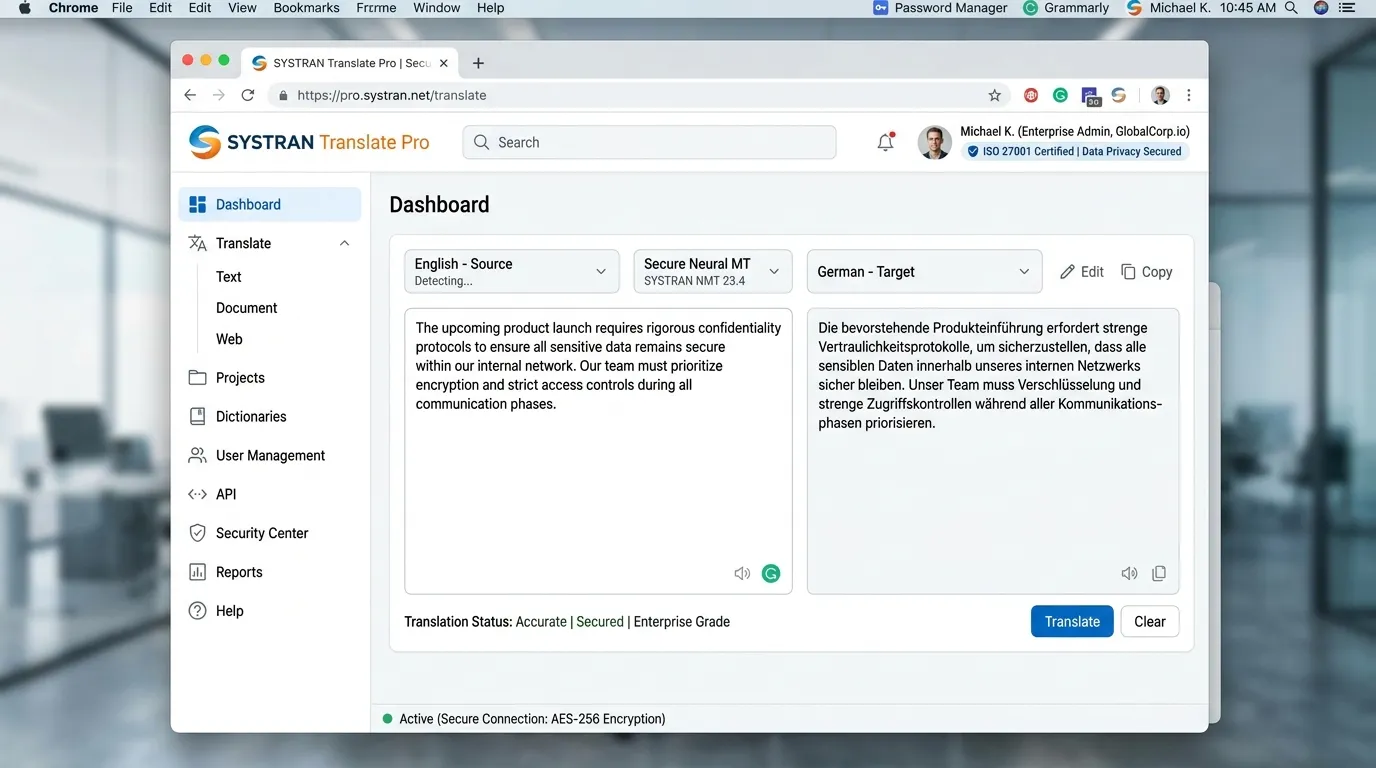
SYSTRAN Translate Pro is a strong choice for enterprises, especially those that need secure translation, industry terminology, and business-focused deployment. It is included in Jotform’s 2026 AI translator list as one of the best AI translators, particularly for professional and business use. (Jotform)
Enterprise translation has different requirements from casual translation. A business may need privacy, user permissions, terminology control, integrations, deployment options, auditability, and secure handling of confidential files. SYSTRAN has long been associated with professional machine translation, making it relevant for organizations where translation must be controlled and reliable.
We recommend SYSTRAN Translate Pro for companies in legal, government, manufacturing, defense, healthcare, finance, and regulated sectors. For everyday translation, Google Translate or DeepL may be simpler. For enterprise-level secure translation, SYSTRAN deserves attention.
10. Taia: Best AI Translator with Human Review Options
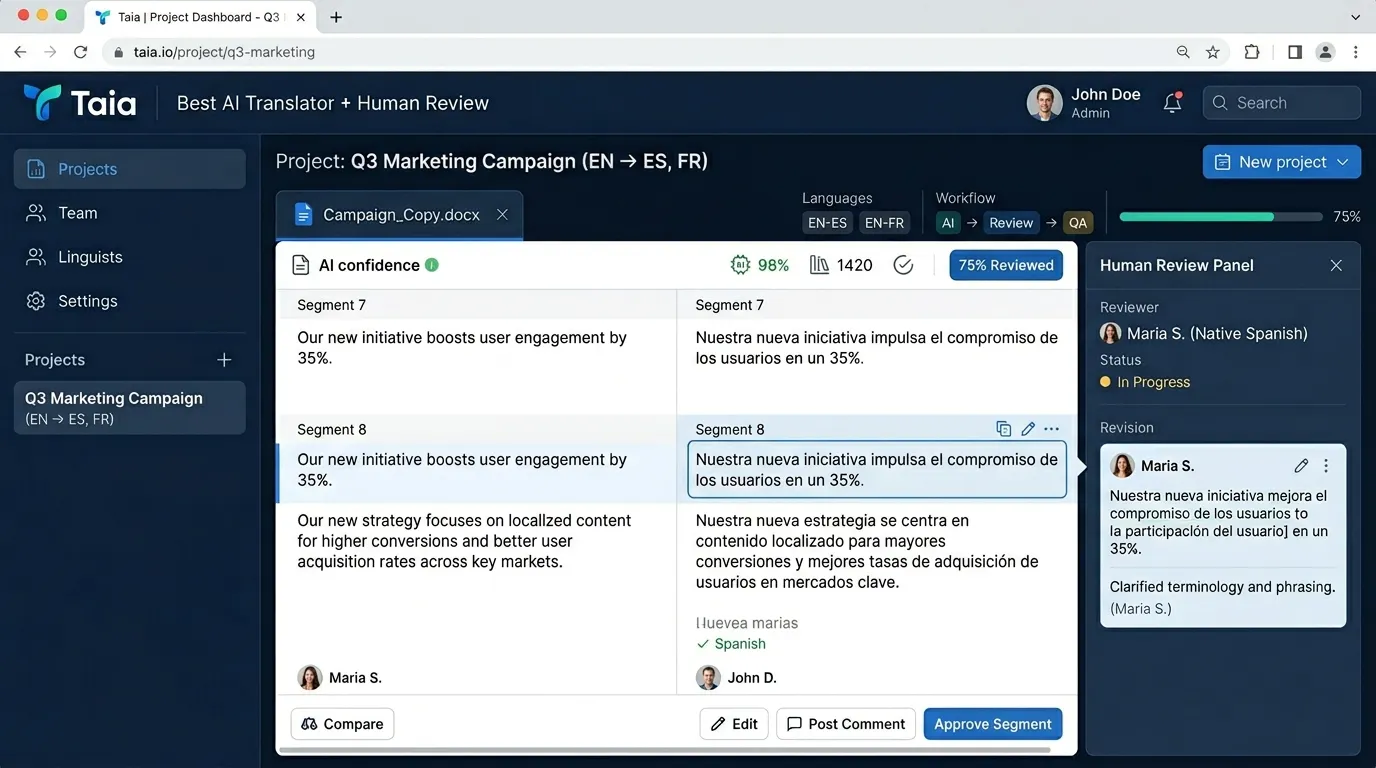
Taia is useful when users want the speed of AI translation but still need professional human review. Jotform’s guide includes Taia among the top AI translators, which reflects the growing demand for hybrid translation models. (Jotform)
Hybrid AI-human translation is important because not every document should be trusted to machine translation alone. Legal agreements, investor documents, medical content, brand campaigns, technical manuals, and official communications often need professional review. Taia-style workflows help bridge the gap between fast AI output and human-quality assurance.
We recommend Taia for companies that need reliable translation but do not want to manage translators manually. It is especially useful for businesses that need regular translation with quality control, delivery timelines, and professional editing.
11. QuillBot Translator: Best AI Translator for Students and Quick Writing Support
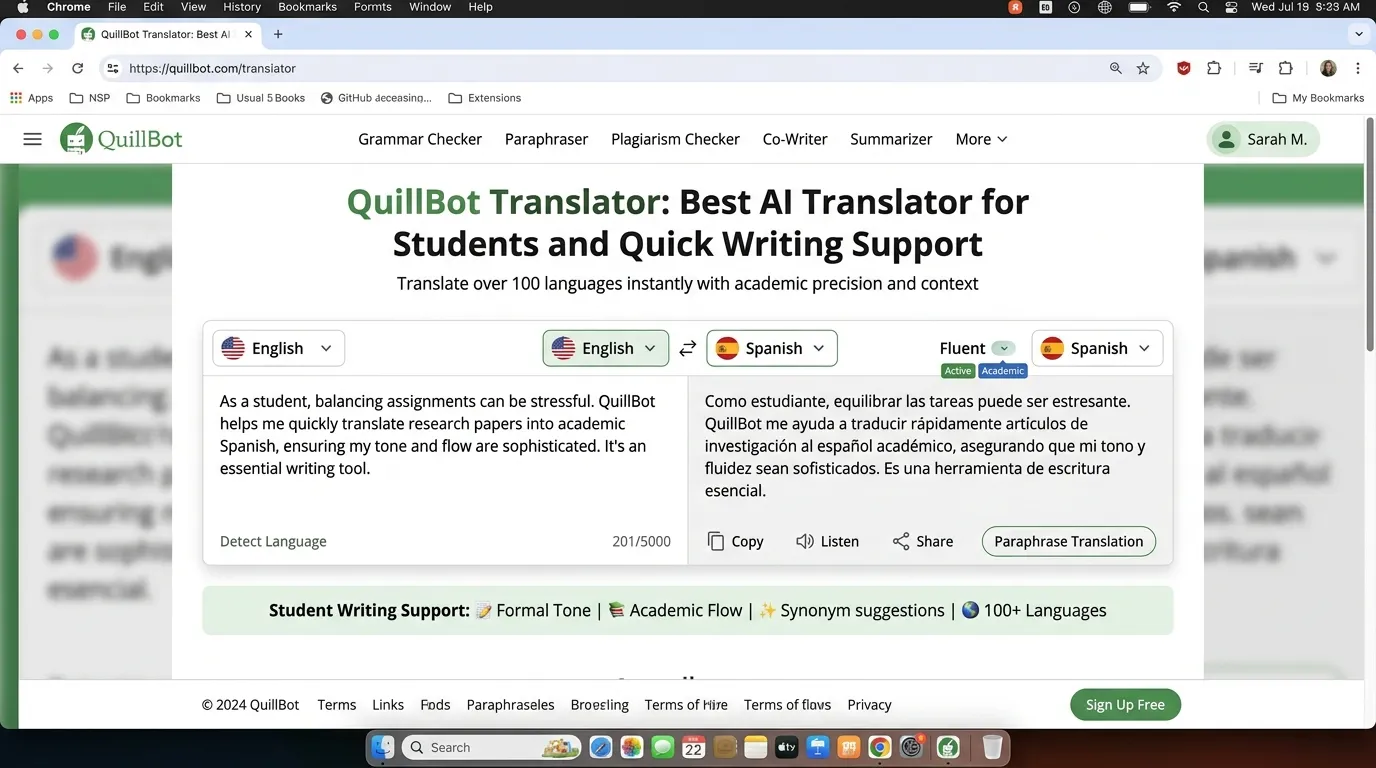
QuillBot is best known as a writing and paraphrasing tool, but it also appears in Jotform’s AI translator comparison as one of the best translator options. (Jotform)
QuillBot is useful for students, writers, and casual users who want translation plus writing improvement. A student may translate a paragraph, then simplify it, paraphrase it, or improve clarity. That combination makes QuillBot practical for academic reading, homework support, short documents, and everyday writing.
We recommend QuillBot for simple translation tasks, language learning, and writing cleanup. It is not the best tool for enterprise localization or complex document translation, but it is accessible and easy to use.
12. Instant AI Translator Devices: Best for Travel and Live Conversations
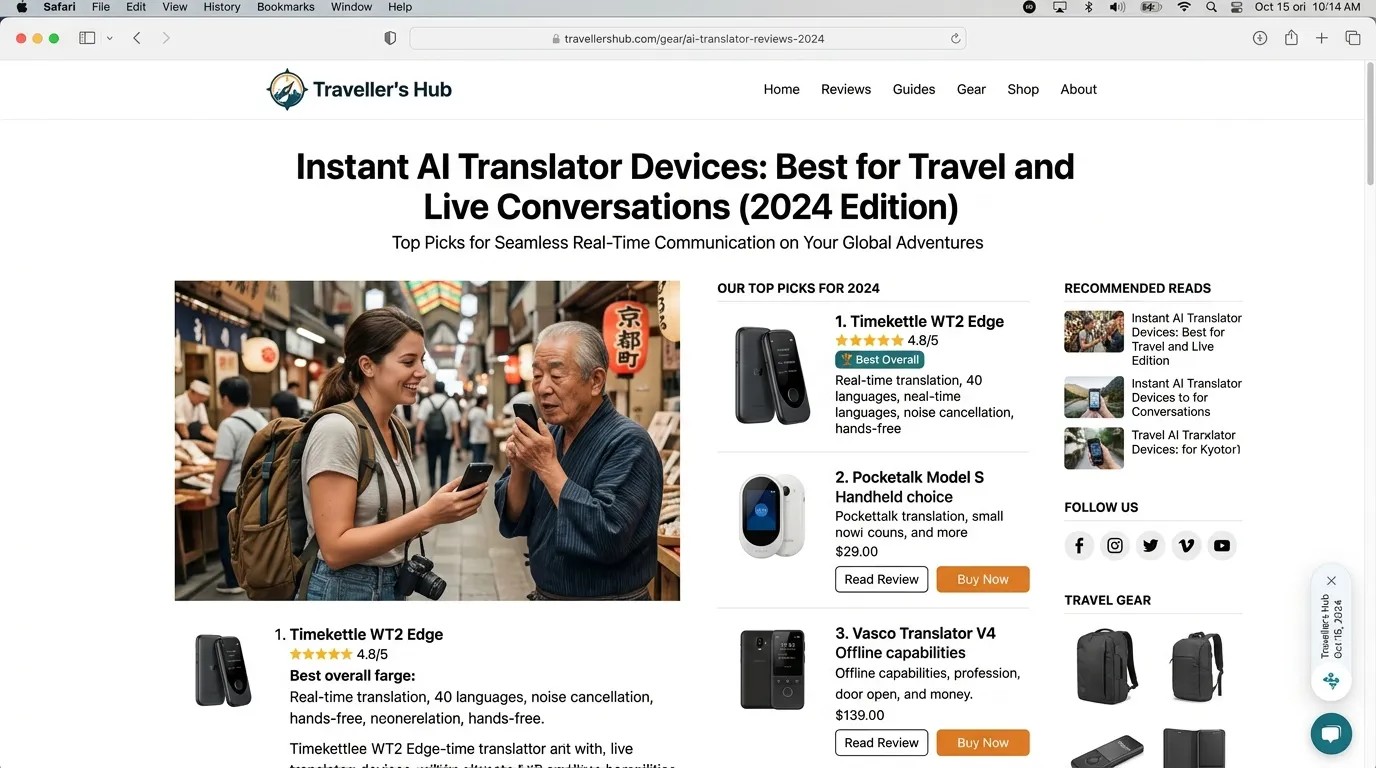
Instant translator devices are becoming more popular because they make translation portable. Instead of opening an app, typing text, and passing a phone back and forth, users can speak naturally and get live translation through a device or earbuds. TransyncAI’s 2026 article focuses on instant translator devices, showing the growing interest in hardware-based AI translation for travel and real-world conversation. (doclingo.ai)
These devices are useful for tourists, business travelers, international students, customer service workers, tour guides, and people who need hands-free communication. The biggest benefit is convenience. The biggest limitation is that real-time speech translation can still struggle with accents, noisy environments, slang, overlapping speech, and specialized vocabulary.
We recommend instant translator devices for travel and live conversation, but not for legal, medical, or official interpretation unless professional interpretation is available.
Best AI Translator by Use Case
| Use Case | Best Tools |
|---|---|
| Everyday quick translation | Google Translate |
| Professional text translation | DeepL |
| Business document translation | DeepL, Doclingo, Smartcat |
| Software and app localization | Lokalise |
| Enterprise secure translation | SYSTRAN Translate Pro |
| AI plus human review | Taia |
| Long-form contextual translation | Claude, ChatGPT |
| Marketing localization | ChatGPT, DeepL, Smartcat |
| Meetings and live captions | Microsoft Translator, Google Translate |
| Student translation support | QuillBot, Google Translate, DeepL |
| Travel conversations | Google Translate, instant translator devices |
| Website localization | Lokalise, Smartcat |
How to Choose the Best AI Translator in 2026
The best AI translator depends on the job. If we need quick translation across many languages, Google Translate is hard to beat. If we need polished professional writing, DeepL is often stronger. If we need document translation, Doclingo or DeepL may be better. If we need localization workflows, Smartcat or Lokalise are better choices. If we need secure enterprise translation, SYSTRAN deserves consideration. If we need tone, explanation, and cultural adaptation, ChatGPT or Claude can be extremely helpful.
The most common mistake is using one translation tool for everything. That is like using one vehicle for every road: a bicycle, truck, car, and airplane all move people, but they are not built for the same journey. Translation works the same way. A travel phrase, a legal contract, a mobile app, and a product manual all need different levels of accuracy, context, formatting, and review.
Key Features to Look for in an AI Translator
A good AI translator should offer more than basic text conversion. The strongest tools include document upload, formatting preservation, speech translation, tone adjustment, terminology control, translation memory, API access, collaboration, privacy controls, and human review options.
For business use, the most important features are security, workflow control, and terminology consistency. For students, the most important features are affordability, simplicity, and explanation. For travelers, speed and offline access matter most. For developers, localization workflow and integrations matter more than sentence-level translation.
Important features include:
| Feature | Why It Matters |
|---|---|
| Language coverage | Supports the languages users actually need |
| Translation quality | Produces natural, accurate output |
| Document translation | Preserves file structure and formatting |
| Speech translation | Supports meetings and travel |
| Tone control | Adjusts formal, casual, or professional style |
| Terminology management | Keeps industry vocabulary consistent |
| Human review | Improves accuracy for high-stakes content |
| API access | Supports apps and business systems |
| Privacy controls | Protects confidential information |
| Collaboration | Helps teams review and approve translations |
AI Translation vs Human Translation
AI translation is fast, affordable, and useful for most everyday translation tasks. It is excellent for understanding foreign-language content, drafting multilingual messages, translating internal documents, supporting customer communication, and speeding up localization workflows. However, human translators are still essential for high-stakes content.
Legal contracts, medical documents, immigration papers, investor communications, literary work, sensitive marketing campaigns, and regulatory documents need careful human review. AI can produce a strong first draft, but professional translators understand culture, intent, legal nuance, emotional tone, and industry risk. The best workflow in 2026 is not AI versus human translation. It is AI plus human review where accuracy truly matters.
Final Recommendation
For most users, the best AI translator in 2026 is Google Translate for everyday language coverage and DeepL for professional-quality translation. For business documents, Doclingo, DeepL, and Smartcat are strong choices. For app and software localization, Lokalise is one of the best options. For enterprise secure translation, SYSTRAN Translate Pro is a serious contender. For AI plus human review, Taia is useful. For contextual translation, rewriting, and localization, ChatGPT and Claude are excellent supporting tools.
The smartest approach is to build a translation stack. Use Google Translate for quick understanding, DeepL for polished text, ChatGPT or Claude for tone and adaptation, Lokalise or Smartcat for localization, and human review for important documents. That combination gives speed, accuracy, context, and confidence.
FAQs
1. What is the best AI translator in 2026?
The best AI translator depends on the use case. Google Translate is best for free everyday translation and language coverage, DeepL is best for professional-quality translation, Lokalise is best for software localization, and Smartcat is best for business translation workflows.
2. Is DeepL better than Google Translate?
DeepL is often better for natural, professional-sounding translations in supported languages. Google Translate is better for broad language coverage, travel use, camera translation, and free everyday translation across many languages.
3. Which AI translator is best for documents?
For documents, DeepL, Doclingo, and Smartcat are strong options. The best choice depends on whether the user needs simple file translation, formatting preservation, team review, or full business localization workflow.
4. Can AI translators replace human translators?
AI translators can replace many simple translation tasks, but they should not fully replace human translators for legal, medical, regulatory, literary, or brand-sensitive content. High-stakes translations still need expert review.
5. What is the best AI translator for travel?
Google Translate is one of the best AI translators for travel because it supports many languages and includes text, camera, and speech translation. Instant translator devices can also be useful for hands-free live conversations.
“`