
Why Do I Forget Everything Before Exams? Fix It Fast
You forget before exams because stress, poor sleep, and last-minute cramming block memory recall. To fix it fast, revise in short sessions, use active recall, practice past questions, and take small breaks. Sleep at least 7 hours, drink water, and avoid studying everything at once. Before the exam, breathe deeply and review key points only.
Quick Summary
- You don’t usually “lose” everything before exams. More often, stress blocks recall, so the information feels missing.
- The best fix is not more rereading. Use retrieval practice, spaced revision, sleep, mock tests, and exam-like practice.
- If your mind goes blank in the exam, pause, breathe, write memory cues, and start with easier questions to restart recall.
Why Do I Forget Everything Before Exams?
You forget before exams because exam stress puts your brain in “panic mode,” making it harder to recall what you already studied. Lack of sleep, cramming, fear, and no revision plan make it worse. To fix it, study in short sessions, use active recall, solve past papers, take breaks, and sleep well. Before the exam, stay calm and revise only key points.
You forget everything before exams because your brain is under pressure. Stress, poor sleep, cramming, passive rereading, and fear of failure can make it harder to retrieve what you already studied.
Here’s the simple answer: your memory has three steps — learning, storing, and recalling. Harvard Medical School explains learning as acquisition, consolidation, and recall, and poor sleep can hurt all three processes, especially memory consolidation and recall. (Harvard Sleep Medicine)
So when you say, “I studied everything, but now I remember nothing,” the problem may not be that your brain deleted the information. It may be that your brain can’t access it under exam stress.
Think of it like saving a file on your laptop but forgetting the folder name. The file is there. You just need the right search method.
What Is Exam Brain Fog?
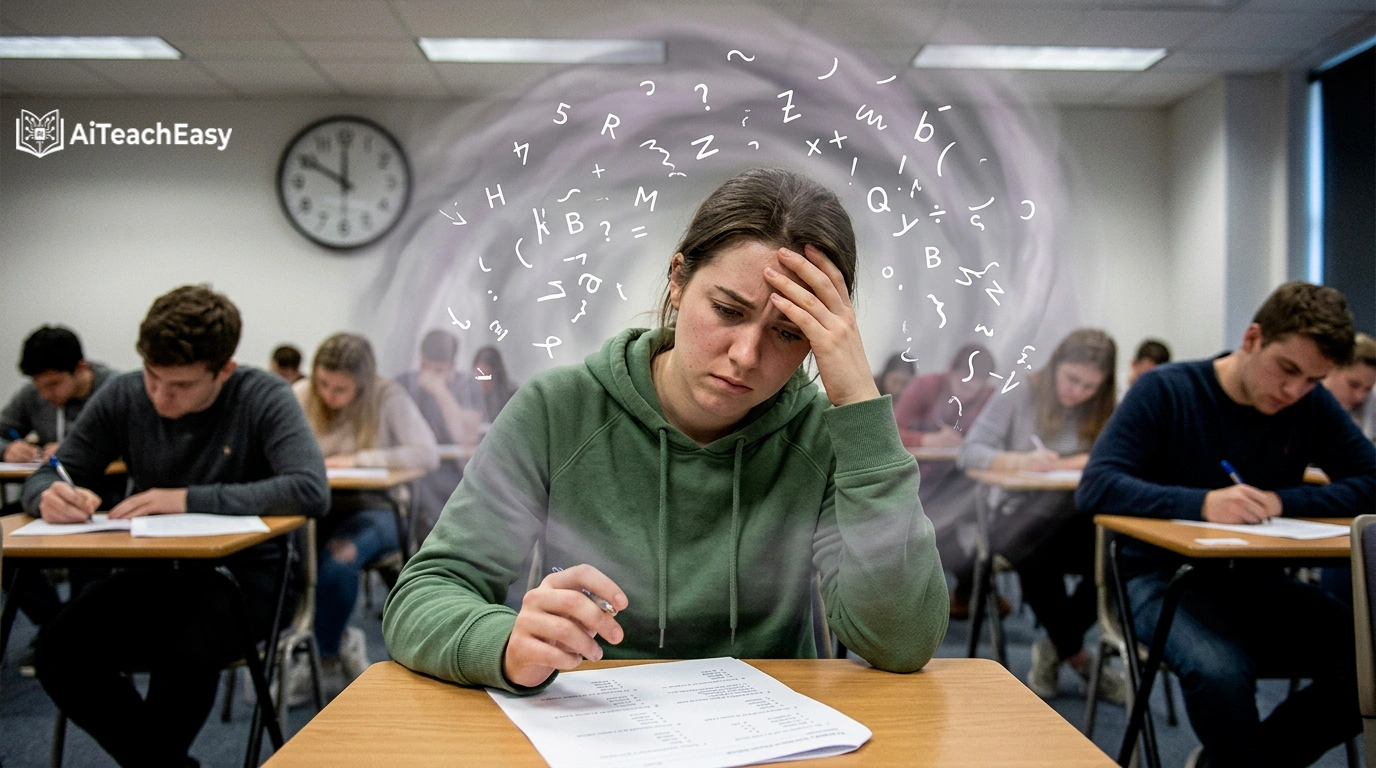
Why Do I Forget Everything Before Exams : Exam brain fog is when your mind feels blank, slow, or confused during study or exams. It usually happens because of stress, lack of sleep, fear of failure, or too much cramming. You may know the answer but cannot recall it quickly. To reduce it, take short breaks, sleep well, revise key points, drink water, and stay calm before the exam.
What is exam brain fog?
Exam brain fog is the feeling that your mind becomes slow, blank, or confused before or during a test. It often happens because anxiety overloads your working memory.
Working memory is like your brain’s small desk. During an exam, that desk should hold formulas, dates, definitions, and steps. But if the desk is full of “What if I fail?” and “I’m going to forget everything,” there’s less space left for actual answers.
Common signs include:
- You read a question three times and still don’t understand it.
- You remember studying the topic but can’t explain it.
- Your thoughts feel mixed up.
- You panic when you see a difficult question.
- After the exam, the answers suddenly come back.
Annoying? Yes. Permanent? No.
Why You Remember While Studying but Forget in the Exam

You remember while studying but forget in the exam because your brain learns in a relaxed state but recalls under pressure. Exam stress, fear, overthinking, poor sleep, and cramming can block memory. To fix it, practice active recall, solve past papers in timed conditions, revise in short sessions, and sleep well. Train your brain to recall information under exam-like pressure.
This is one of the most common student problems: “When I study, I remember everything. But during the exam, I forget everything.”
The reason is simple. Studying and testing are different skills.
When you reread notes, the answer is already in front of you. Your brain thinks, “Yes, I know this.” But in the exam, the answer is hidden. Now your brain must pull it out from memory.
That pulling-out process is called retrieval.
RetrievalPractice.org defines retrieval practice as bringing information to mind to improve learning. It also explains that learning improves when students pull knowledge out rather than only push information in through rereading. (Pooja K. Agarwal, Ph.D.)
Recognition vs recall : Why Do I Forget Everything Before Exams
Rereading gives you recognition.
You look at a sentence and think:
“Yes, I have seen this before.”
But exams require recall.
The paper asks:
“Explain this concept without looking.”
That is much harder.
This is why students often say:
“I knew this chapter yesterday!”
Actually, you recognized it yesterday. You may not have practiced recalling it.
How to Stop Forgetting Before Exams
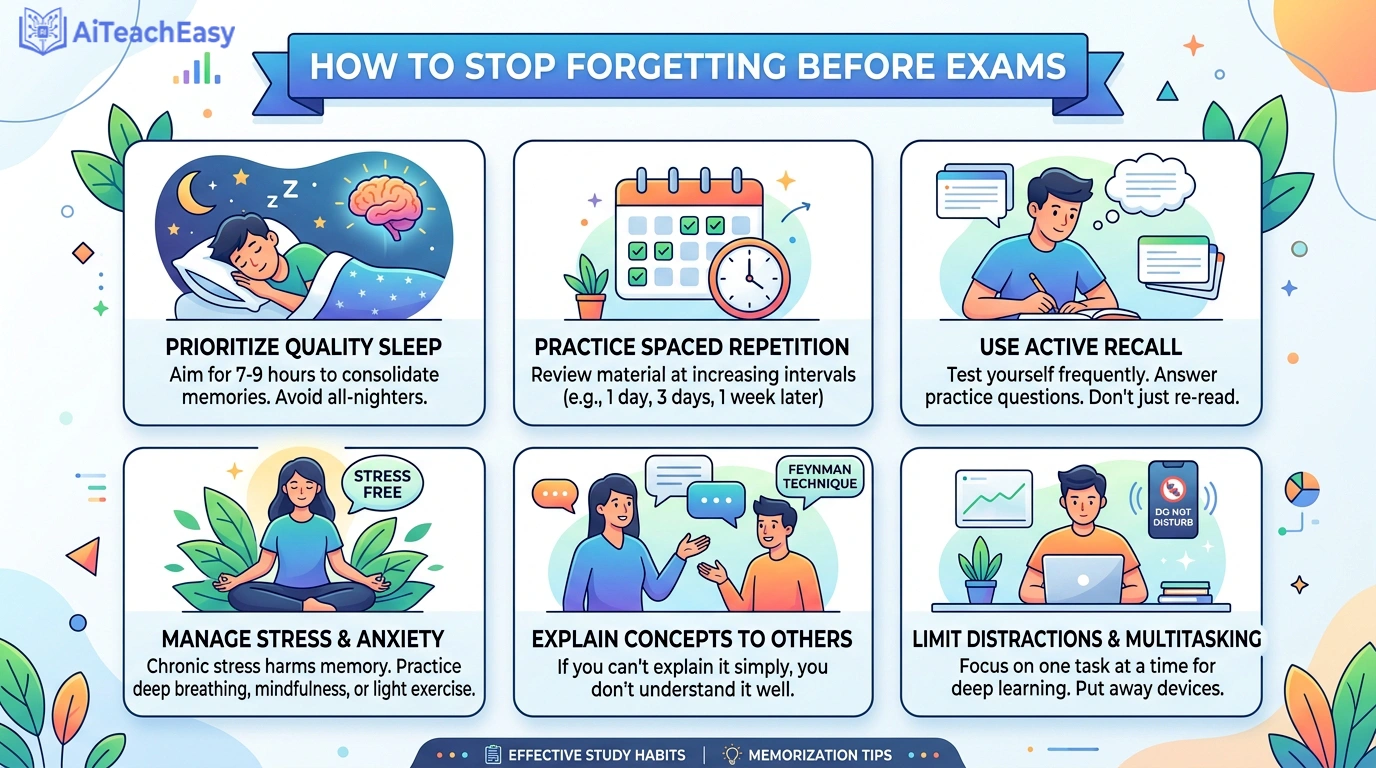
To stop forgetting before exams, avoid last-minute cramming and revise in short, focused sessions. Use active recall by closing your book and testing yourself. Practice past papers, make quick notes, and repeat important points daily. Sleep well before the exam because tiredness weakens memory. Stay calm, drink water, and revise only key concepts before entering the exam hall.
To stop forgetting before exams, you need to train your brain in the same way the exam will test you. Don’t only read. Recall. Write. Explain. Test yourself.
1. Stop rereading as your main method
Rereading feels comfortable, but comfort is not always learning. It can create a fake feeling of confidence.
Better methods include:
- Closed-book recall
- Practice questions
- Flashcards
- Past papers
- Teaching the topic to someone else
- Writing short answers from memory
A helpful routine is: read once, close the book, then write what you remember. After that, check what you missed.
For making this easier, you can use AI to turn your notes into flashcards with this guide: how to convert notes into flashcards.
2. Use spaced revision instead of cramming
Cramming puts too much information into your brain at once. Spaced revision spreads learning over time.
The spacing effect means memory improves when study sessions are spread apart instead of packed into one long session. A review in cognitive science describes the spacing effect as better long-term memory when learning events are separated in time. (PubMed Central)
Here’s a simple spacing schedule:
- First review: same day
- Second review: next day
- Third review: after 3 days
- Fourth review: after 7 days
- Final review: before exam
This works because each review tells your brain, “This information matters. Keep it.”
3. Practice under exam-like conditions
Your brain performs better when practice feels similar to the real test.
Try this:
- Sit at a desk.
- Keep your phone away.
- Set a timer.
- Use only allowed materials.
- Answer without checking notes.
- Review mistakes after the timer ends.
This reduces shock on exam day. Your brain thinks, “I’ve done this before.”
4. Sleep after studying
Sleep is not laziness. It is part of studying.
Harvard Medical School notes that sleep helps the brain consolidate memories, and the hours after learning may be especially important for memory consolidation. (Harvard Sleep Medicine)
So if you study all night and sleep only two hours, you may feel productive, but your brain may not store the material well.
A better plan:
- Study earlier.
- Sleep 7–9 hours if possible.
- Do a light review in the morning.
- Avoid learning a huge new chapter at midnight.
5. Lower anxiety before you revise
If you revise while panicking, your brain connects that subject with fear. Then the same fear returns during the exam.
Before studying, take two minutes:
- Inhale for 4 seconds.
- Hold for 2 seconds.
- Exhale for 6 seconds.
- Repeat five times.
Then start with one easy question. Small wins calm the brain.
Best Study Methods for Exam Recall : Why Do I Forget Everything Before Exams

The best study methods for exam recall are active recall, spaced repetition, and past paper practice. Instead of only reading, close the book and test yourself. Revise the same topic after short gaps to strengthen memory. Practice questions in timed conditions so your brain gets used to exam pressure. Use short notes, flashcards, and quick revision before the exam.
Method 1: Brain dump
A brain dump means writing everything you remember about a topic without looking.
Example:
Topic: Photosynthesis
Write from memory:
- Definition
- Equation
- Role of sunlight
- Chlorophyll
- Oxygen release
- Common exam questions
Then open your notes and fill the gaps.
This method is powerful because it shows what you actually know.
Method 2: Active recall flashcards
Flashcards should ask questions, not just show facts.
Weak flashcard:
Photosynthesis = process by which plants make food.
Better flashcard:
What is photosynthesis, and why is chlorophyll important?
Best flashcard:
Explain photosynthesis in 3 exam-style sentences.
You can also explore best AI tools for memorization to create better recall systems.
Method 3: Past paper practice
Past papers train three things at once:
- Memory
- Speed
- Exam pattern
Don’t only read past paper answers. Attempt them first.
Use this rule:
Try first. Check second. Correct third.
This teaches your brain to handle pressure.
Method 4: Teach it simply
If you can explain a topic to a younger student, you probably understand it.
Try saying:
“This chapter is basically about…”
Then explain it in plain language.
If you get stuck, that is not failure. That is your revision target.
Method 5: Interleaving
Interleaving means mixing related topics instead of studying one type of question again and again.
For example, in math:
- Algebra question
- Geometry question
- Word problem
- Graph question
- Equation question
This is harder, but exams are also mixed. Your brain learns to choose the right method, not just repeat one method.
For more exam-focused tools, check best AI tools for exam preparation.
What to Do the Night Before an Exam

The night before an exam, do a light revision instead of cramming everything. Review key points, formulas, summaries, and past mistakes. Pack your bag, set alarms, and sleep early so your brain can store information properly. Avoid heavy meals, too much phone use, and panic studying. Stay calm, drink water, and trust what you have prepared.
The night before an exam is not the time to become a superhero. Please don’t try to learn 12 chapters with one packet of chips and false confidence.
Your goal is to protect recall.
Do this instead
- Review your summary notes.
- Attempt 10–20 practice questions.
- Make a “last look” sheet.
- Pack your exam items.
- Sleep on time.
Your “last look” sheet should include:
- Formulas
- Dates
- Definitions
- Diagrams
- Mistakes you often make
- 5 key examples
- Important headings
Keep it short. One or two pages maximum.
Avoid this
- Learning brand-new topics late at night
- Scrolling social media “for five minutes”
- Comparing preparation with friends
- Drinking too much caffeine
- Pulling an all-nighter
If you must study late, study the most important weak areas first. Don’t waste the last hour decorating notes like a wedding card.
What to Do During the Exam If Your Mind Goes Blank

If your mind goes blank during the exam, pause for a few seconds and take slow deep breaths. Don’t panic or force the answer. Move to an easier question first to restart your thinking. Write any keywords, formulas, or points you remember. After your brain calms down, come back to the difficult question and build the answer step by step.
First, don’t panic. A blank mind is usually temporary.
Step 1: Pause for 20 seconds
Put your pen down. Breathe slowly. Tell yourself:
“I don’t need the full answer right now. I only need one clue.”
This lowers pressure.
Step 2: Start with easy questions
Easy questions warm up recall. Once your brain starts retrieving information, harder answers often come back.
Step 3: Write memory cues
On rough paper, quickly write:
- Formulas
- Keywords
- Chapter names
- Diagrams
- Examples
- Acronyms
Even one keyword can unlock the full answer.
Step 4: Turn the question into smaller parts
If the question says:
“Explain the causes and effects of inflation.”
Break it:
- What is inflation?
- What causes it?
- What happens because of it?
- Can I give an example?
Now the question feels less scary.
Step 5: Don’t fight one question for too long
If you spend 15 minutes staring at one question, anxiety grows.
Move on. Return later.
Many students remember the answer after solving another question because the brain keeps working quietly in the background.
7-Day Anti-Forgetting Exam Plan : Why Do I Forget Everything Before Exams

A 7-day anti-forgetting exam plan helps you revise smartly instead of cramming. For 7 days, study in short sessions, use active recall, revise old topics daily, and solve past papers under timed conditions. Make quick notes for weak areas and review them before sleep. On the last day, avoid learning new topics; revise key points, rest well, and stay calm.
Use this if your exam is one week away.
Day 7: Organize and diagnose
Make a list of all chapters.
Mark each topic:
- Green = I know it
- Yellow = I partly know it
- Red = I don’t know it
Start with yellow topics. They improve fastest.
Day 6: Active recall day
For each topic:
- Read summary.
- Close book.
- Write what you remember.
- Check gaps.
- Make flashcards.
Day 5: Practice questions
Attempt past paper questions.
Don’t worry if you make mistakes. Mistakes before the exam are gifts. Mistakes during the exam are expensive.
Day 4: Spaced revision
Review flashcards and weak topics.
Use short sessions:
- 25 minutes study
- 5 minutes break
- Repeat 3–4 times
Day 3: Mock test
Take one timed mock test.
After it, check:
- What did I forget?
- Where did I lose time?
- Which question type scared me?
- What mistakes repeated?
Day 2: Fix weak points
Revise only high-impact areas.
Focus on:
- Common exam topics
- Repeated mistakes
- Formulas
- Definitions
- Diagrams
- Short answer structure
Day 1: Light review and sleep
Do not overload your brain.
Review your “last look” sheet. Solve a few easy questions. Sleep properly.
Pro Tip: Use AI Without Becoming Lazy
Use AI as a study helper, not a shortcut. First try to understand the topic yourself, then ask AI to explain, quiz you, or check your answer. Don’t just copy AI responses because it weakens your thinking. Use it to make summaries, practice questions, and revision plans. The goal is to learn faster, not avoid learning.
AI can help you revise, but it should not do all the thinking for you.
Good AI prompts:
- “Turn these notes into 20 active recall questions.”
- “Ask me one exam question at a time and wait for my answer.”
- “Create a 7-day revision plan for these chapters.”
- “Explain this topic in simple words, then quiz me.”
- “Make flashcards from this lecture.”
Bad AI prompt:
- “Give me everything for my exam.”
That gives you information, not memory.
You can also build a complete revision workflow using this guide: how to build an AI study system.
Common Reasons Students Forget Before Exams
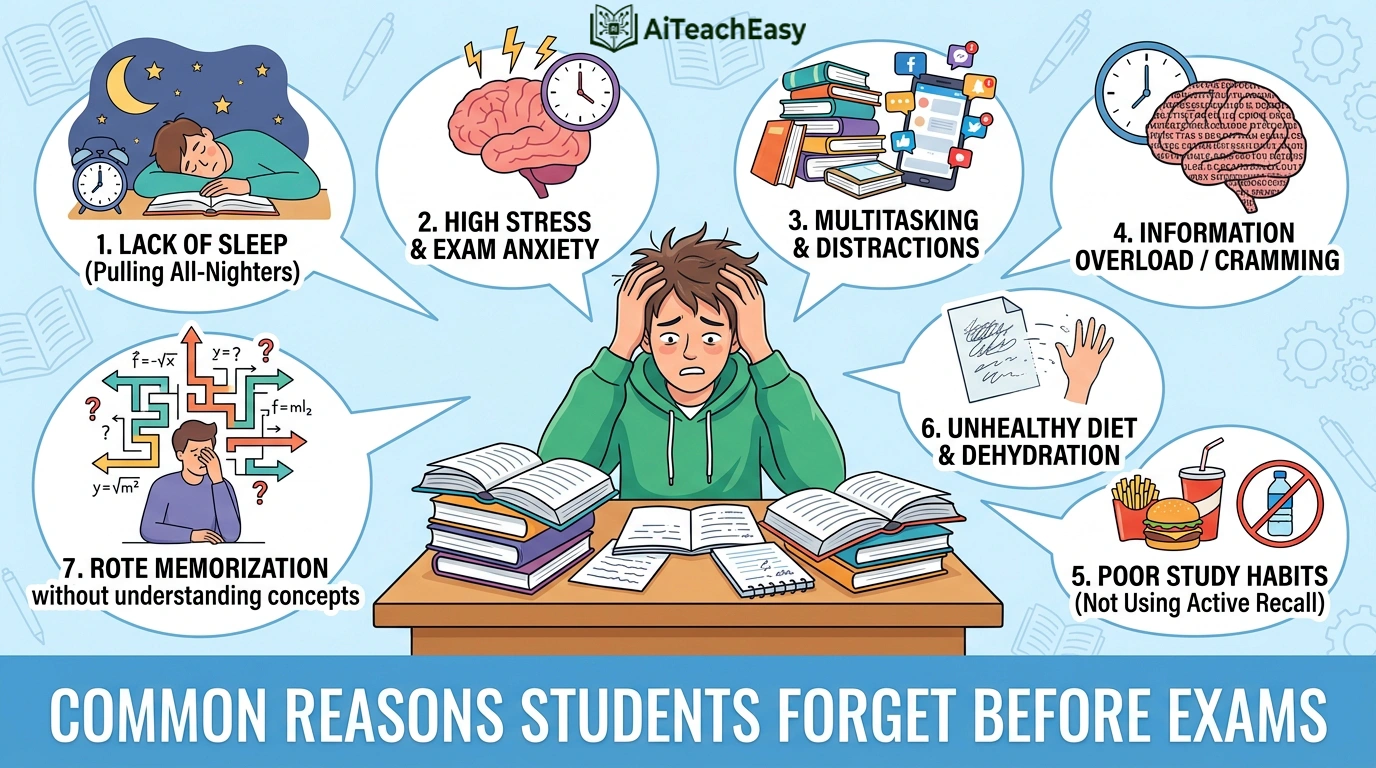
Students commonly forget before exams because of stress, lack of sleep, last-minute cramming, and poor revision habits. When the brain feels pressure, it becomes harder to recall information quickly. Studying without breaks, not practicing questions, and only reading notes can also weaken memory. To remember better, use active recall, revise daily, solve past papers, sleep well, and stay calm before the exam.
1. Passive studying
Reading, highlighting, and copying notes are not enough. They help you become familiar with content, but exams require recall.
2. Studying without testing
If you never test yourself before the exam, the exam becomes your first real recall practice. That is risky.
3. Cramming too late
Cramming can help short-term recognition, but it often fails under pressure. Spaced revision is safer for long-term memory.
4. Poor sleep
Sleep helps memory consolidation. Without it, you may study more hours but remember less. (Harvard Sleep Medicine)
5. Test anxiety
Anxiety can make easy information feel unreachable. The fix is not only “calm down.” The real fix is repeated exam-like practice.
6. No mistake review
If you don’t review mistakes, you repeat them.
Keep a mistake notebook with three columns:
| Mistake | Why I made it | Correct method |
|---|---|---|
| Forgot formula | Didn’t practice recall | Add to flashcards |
| Misread question | Rushed | Underline command words |
| Weak definition | Only reread notes | Write from memory |
How to Improve Memory for Exams Naturally

To improve memory for exams naturally, study in short focused sessions and use active recall instead of only reading. Revise the same topic after gaps using spaced repetition. Sleep 7–8 hours, drink enough water, eat healthy foods, and take short breaks while studying. Practice past papers to train recall under pressure. Stay calm, avoid cramming, and review key points before sleep.
You don’t need magic pills. Start with the basics.
Eat normally
A balanced meal before studying or before an exam helps energy. Avoid very heavy meals right before the test because they can make you sleepy.
Hydrate
Even mild dehydration can make you feel tired and unfocused.
Move your body
A 10-minute walk can reduce stress and refresh attention.
Use short breaks
Breaks stop your brain from becoming overloaded.
Try:
- 25 minutes study
- 5 minutes break
- After four rounds, take a longer break
Keep your phone away
Your phone is not just a distraction while using it. Even checking it once can break focus and make it harder to return to deep study.
FAQs Why Do I Forget Everything Before Exams
1. Why do I forget everything right before an exam?
You forget everything right before an exam because stress blocks recall, especially if you studied passively or crammed. The information may still be in your brain, but anxiety makes it harder to access.
2. Why do I remember after the exam is over?
After the exam, pressure drops. Your brain relaxes, and recall becomes easier. That is why answers often come back when you leave the exam hall.
3. Is forgetting before exams normal?
Yes, it is common. But if anxiety is extreme, causes panic attacks, or affects daily life, it may help to speak with a counselor, teacher, or health professional.
4. What is the fastest way to remember what I studied?
The fastest useful method is active recall. Close your book and write or speak what you remember. Then check your notes and fix the gaps.
5. Should I study all night before an exam?
Usually, no. All-nighters can hurt concentration and memory. Sleep supports memory consolidation, so a shorter focused review plus sleep is often better than staying awake all night. (Harvard Sleep Medicine)
6. How can I stop my mind from going blank during exams?
Pause, breathe slowly, start with easier questions, write memory cues, and return to difficult questions later. Practicing mock tests before exam day also reduces blanking out.
Conclusion
So, why do I forget everything before exams? Usually, it is not because you are weak or your memory is broken. It happens because stress, cramming, poor sleep, and passive revision make recall harder.
The fix is simple but not always easy: study in a way that matches the exam. Use active recall, spaced revision, mock tests, flashcards, sleep, and calm exam routines.
Don’t aim to “read everything again.” Aim to retrieve everything better.
Start today with one topic. Close your book. Write what you remember. Check your gaps. Repeat tomorrow.
That is how memory becomes exam-ready.
About Prof. Irfan
Prof. Irfan is an AI in education researcher and former classroom teacher. He helps educators and students use AI tools ethically and effectively for better learning, revision, and academic performance.