
How to Pass an Exam Without Studying: Last-Minute Guide
Quick Summary
- You can sometimes pass an exam without studying fully, but you need a smart last-minute plan, not panic reading.
- Focus on past papers, repeated topics, formulas, definitions, diagrams, and easy marks first.
- Sleep, calm breathing, time management, and smart answering can protect marks even when preparation is weak.
Can You Really Pass an Exam Without Studying?
Yes, you can sometimes pass an exam without studying properly, but it depends on the subject, exam type, your background knowledge, and how well you use the remaining time. If your exam is based on logic, general understanding, repeated past paper questions, or class concepts you partly remember, you still have a chance.
But let’s be honest. If you have never opened the book, skipped every class, and the exam is tomorrow morning, you are not “hacking the system.” You are doing academic first aid.
What is last-minute exam survival?
Last-minute exam survival means using limited time to collect the highest possible marks. You don’t try to master everything. You identify the most likely, most repeated, and easiest topics, then revise them fast.
The goal is not perfection. The goal is passing.
And no, this article will not tell you to cheat. Cheating can get you disqualified, damage your record, and create much bigger problems than one bad grade. This guide is about smart, ethical, last-minute exam strategy.
What Should You Do If Your Exam Is Tomorrow and You Haven’t Studied?

If your exam is tomorrow and you haven’t studied, do three things immediately: stop panicking, check the exam format, and study only high-value topics. Don’t start from page one of the textbook unless you enjoy suffering for no reason.
Your first 20 minutes matter.
Do this:
- Find the syllabus or topic list.
- Open past papers or sample questions.
- Mark repeated topics.
- Ask a classmate what the teacher emphasized.
- Make a small emergency revision list.
- Study the easiest high-mark topics first.
This is where many students make the biggest mistake. They try to “cover everything.” That sounds responsible, but when time is short, it becomes a trap.
You need marks, not emotional comfort.
How to Pass an Exam Without Studying Using Smart Revision
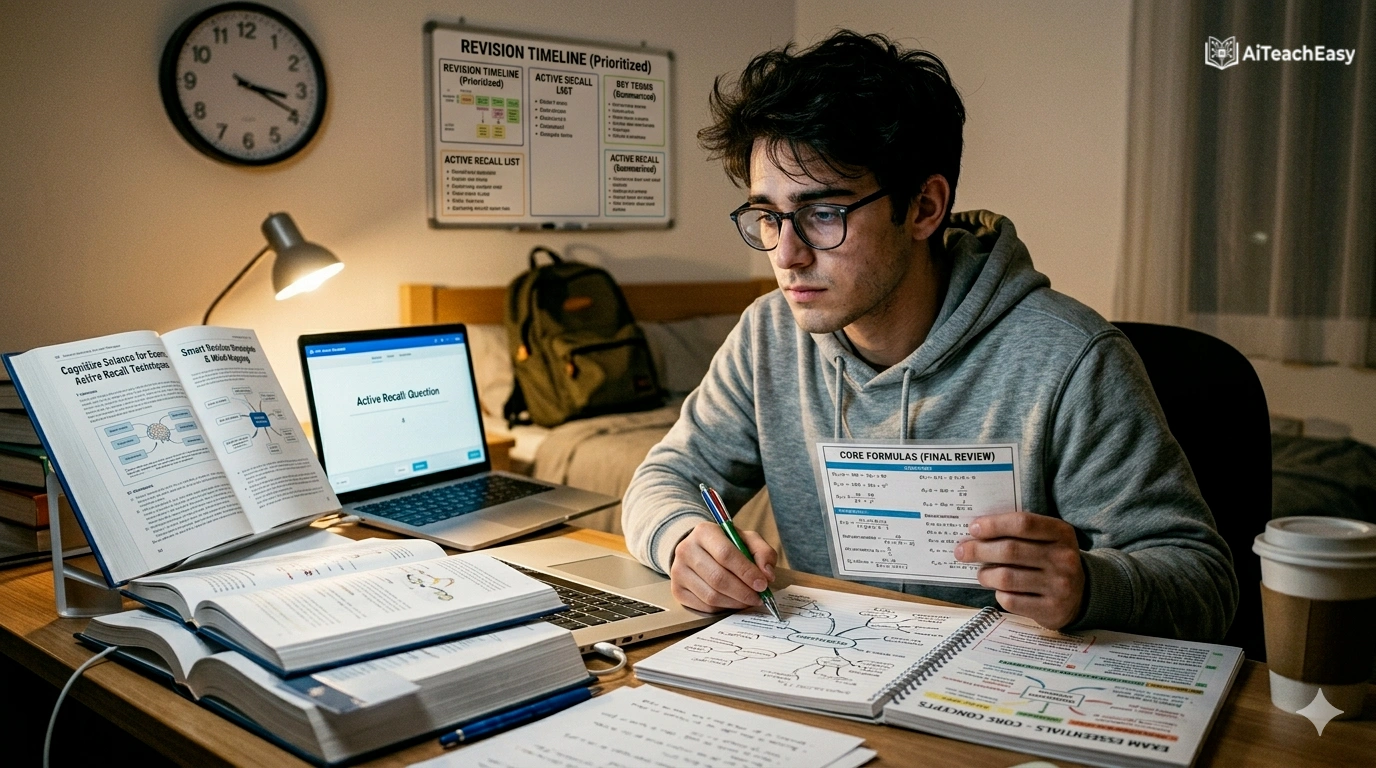
The best way to pass an exam without studying properly is to use smart revision. Smart revision means choosing what gives you the most marks in the least time.
Focus on high-yield topics
High-yield topics are topics that appear often, carry more marks, or are easy to answer.
Examples:
- Definitions
- Formulas
- Diagrams
- Short notes
- Repeated essay questions
- Important dates
- Key theories
- Common examples
- Chapter summaries
- Teacher-highlighted topics
If you have only a few hours, don’t spend all your time on one difficult chapter. A hard chapter may take three hours and give you five marks. Three easy chapters may take the same time and give you 25 marks.
That is the difference between panic and strategy.
Use active recall, not passive reading
Passive reading means reading notes again and again. It feels useful, but it is often weak for memory.
Active recall means closing the book and forcing your brain to remember.
For example:
- Read one page.
- Close the book.
- Write five points from memory.
- Check what you missed.
- Repeat.
Research on retrieval practice shows that pulling information from memory helps long-term retention better than simply rereading notes. (PubMed Central)
If you want to turn notes into quick recall material, use this guide on how to convert notes into flashcards.
Use the 80/20 rule
The 80/20 rule means a small number of topics often create a large number of exam marks.
Ask:
- Which topics came in past papers?
- Which topics did the teacher repeat?
- Which formulas are used in many questions?
- Which definitions are easy marks?
- Which diagrams can be drawn quickly?
Don’t treat all topics equally. They are not equal.
A two-page chapter summary may be more useful than a 40-page chapter you cannot finish.
How to Use Past Papers When You Have No Time
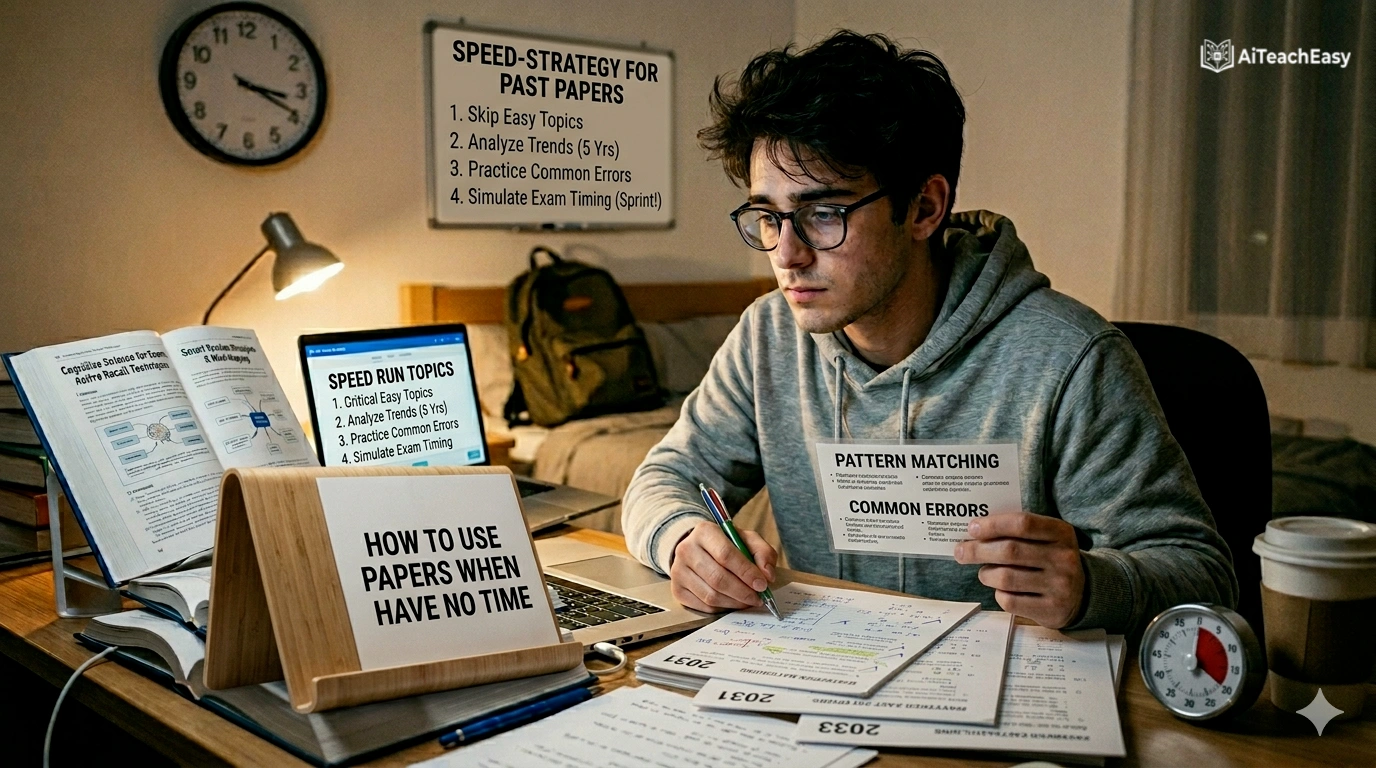
Past papers are your best friend when you haven’t studied. They show the examiner’s habits.
Step 1: Collect 3–5 past papers
Don’t just download them and feel productive. Actually scan them.
Look for:
- Repeated questions
- Repeated chapters
- Common wording
- Mark distribution
- Question types
- Easy sections
- Compulsory questions
Step 2: Make a repeated-topic list
Create a quick table:
| Topic | Appeared How Many Times? | Marks | Priority |
|---|---|---|---|
| Topic A | 4 times | 10 marks | High |
| Topic B | 1 time | 5 marks | Low |
| Topic C | 3 times | 15 marks | High |
Study high-priority topics first.
Step 3: Don’t solve everything
If you have enough time, solve questions. If you don’t, study the answer structure.
For each repeated question, learn:
- Opening definition
- 3–5 main points
- One example
- One diagram if needed
- Short conclusion
This gives you an answer skeleton.
Step 4: Learn command words
Command words tell you what the examiner wants.
| Command Word | Meaning |
|---|---|
| Define | Give meaning |
| Explain | Give reasons/details |
| Compare | Show similarities and differences |
| Discuss | Give balanced points |
| Evaluate | Judge strengths and weaknesses |
| List | Write points only |
Many students know the topic but lose marks because they answer the wrong task.
What to Study First When You’re Out of Time
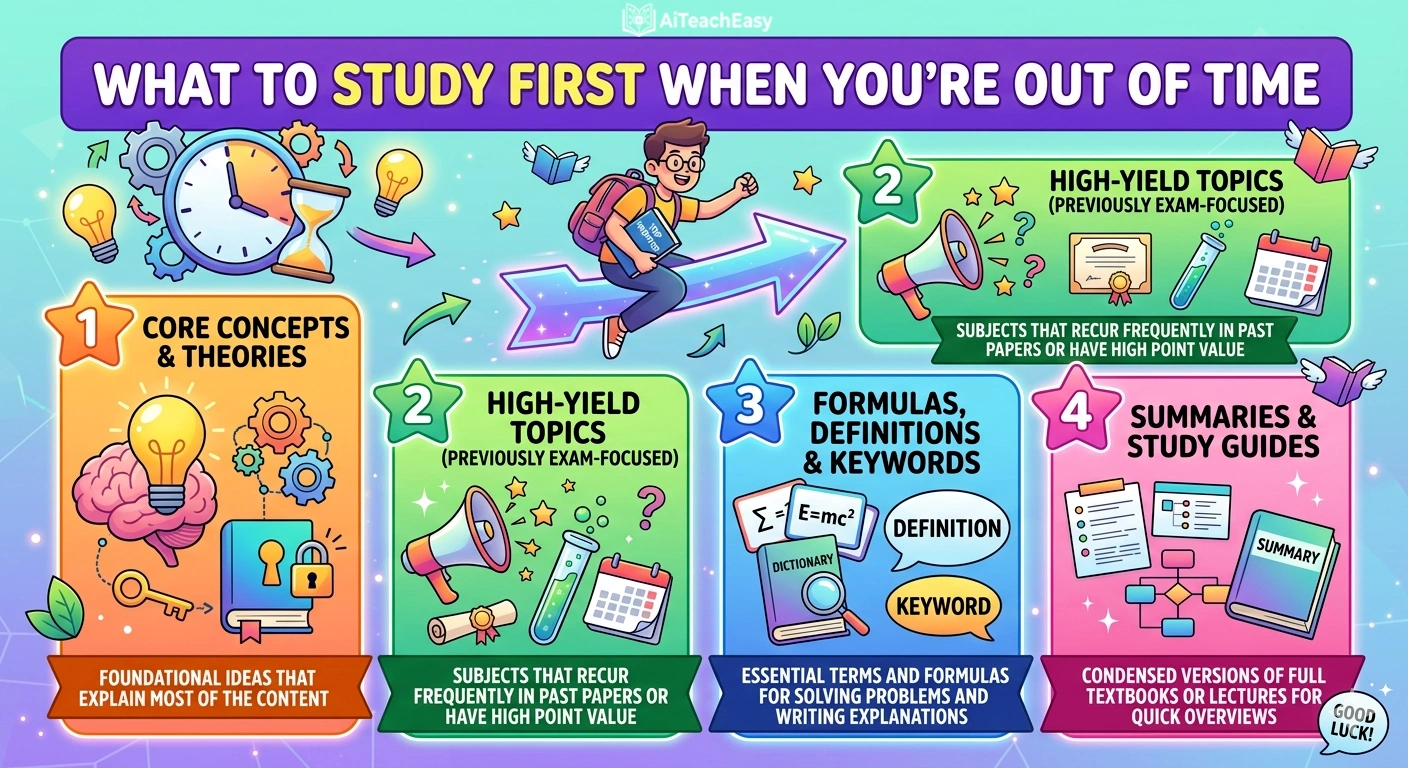
When you are out of time, study in this order:
1. Compulsory topics
If a section is compulsory, start there. Never ignore guaranteed marks.
2. Repeated past paper topics
Repeated questions are not a promise, but they are a clue.
3. Short questions
Short questions often give fast marks. Learn definitions, key terms, examples, and formulas.
4. Diagrams and tables
Diagrams can save time and improve answers.
Examples:
- Biology diagrams
- Geography maps
- Business models
- Computer science flowcharts
- Economics graphs
- Science experiment setups
5. Formulas and steps
For math, physics, accounting, and statistics, formulas are survival tools.
Write:
- Formula
- Meaning of symbols
- One solved example
- Common mistake
For math-based exams, this article on best AI tools to solve math word problems can help you practice similar problems quickly.
6. Easy chapters
Easy chapters build confidence and marks. Don’t avoid them because they feel “too simple.” Simple marks still count.
How to Stay Calm During the Exam
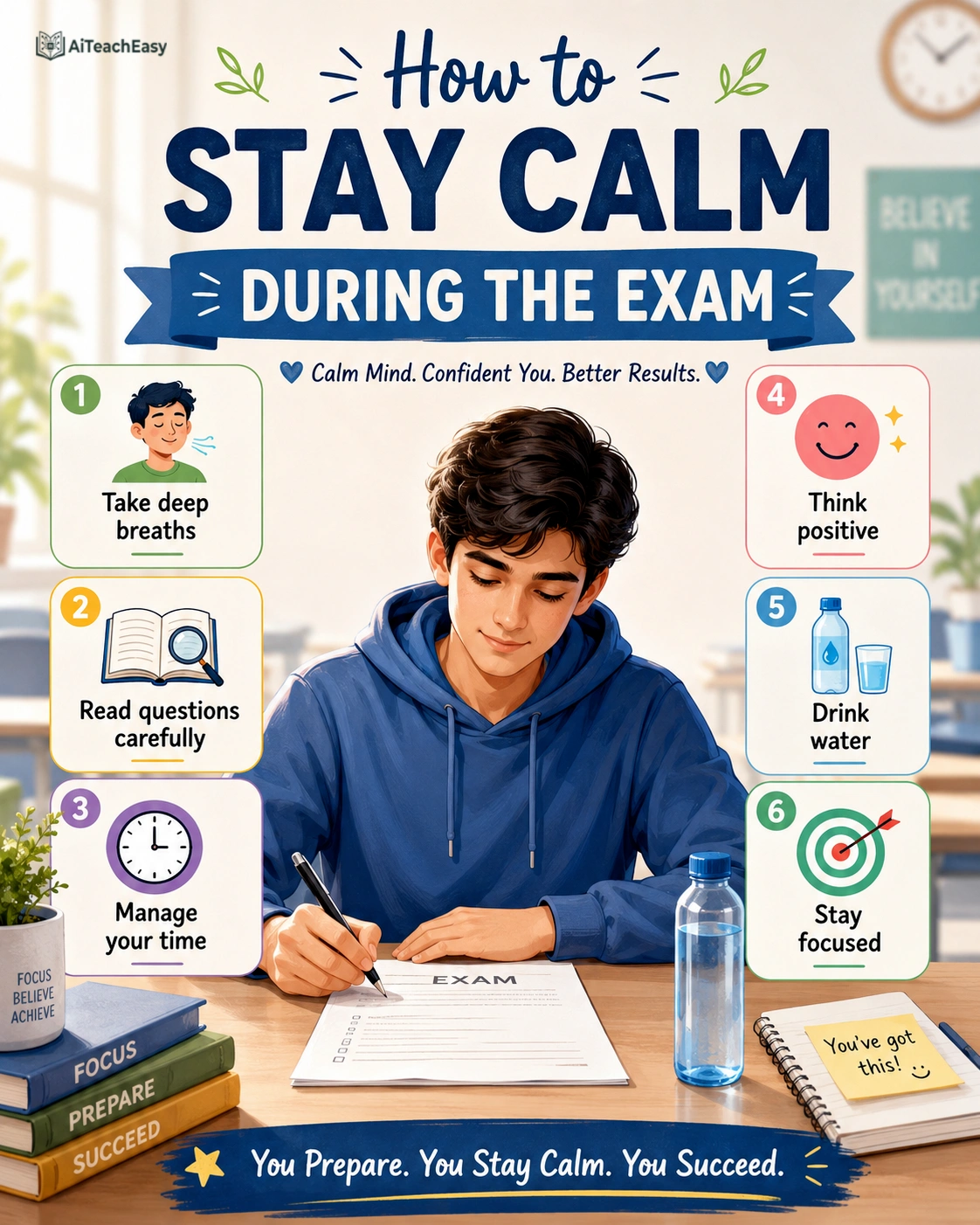
Staying calm can improve your performance even if your preparation is weak. Panic wastes working memory.
Working memory is the mental space you use to hold information while solving a problem. Test anxiety has been linked with weaker performance on working-memory-heavy tasks. (NIE Repository)
In simple words: the more your brain screams “I’m finished,” the less space it has to solve the paper.
Use the 30-second reset
Before starting:
- Put both feet on the floor.
- Relax your shoulders.
- Breathe in slowly.
- Breathe out longer than you breathe in.
- Tell yourself: “I will collect marks one by one.”
This sounds basic. It works because it stops panic from taking over your exam time.
Start with easy questions
Easy questions create momentum. Your brain warms up. Confidence returns.
Don’t start with the hardest question just to “get it over with.” That can destroy your mood in the first five minutes.
Use time blocks
If your exam is 2 hours and has 60 marks, your average is 2 minutes per mark.
So:
- 5-mark question = about 10 minutes
- 10-mark question = about 20 minutes
- 15-mark question = about 30 minutes
Keep moving. A half-complete paper is usually worse than a fully attempted paper with some weak answers.
How to Answer Questions When You Don’t Know the Answer
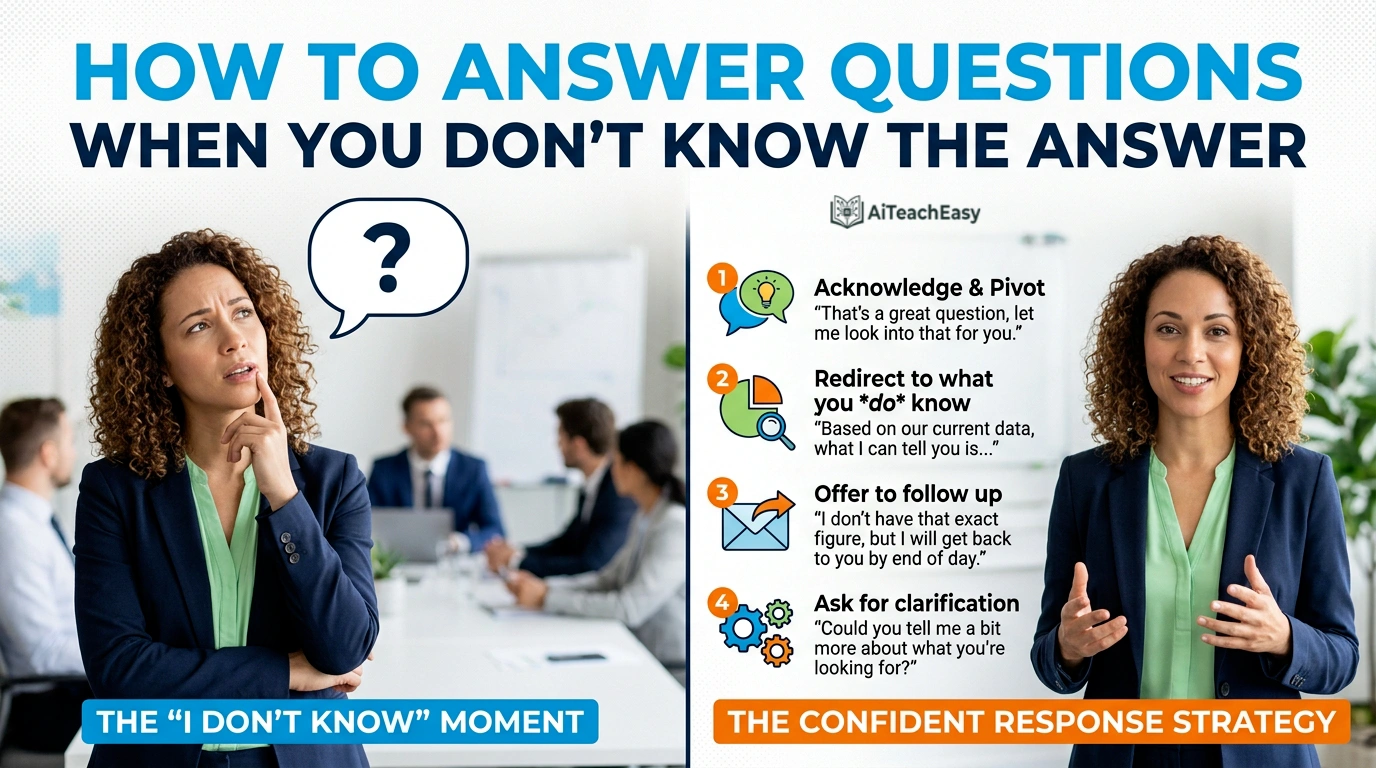
Sometimes you will see a question and think, “I have never seen this in my life.”
Stay calm. You may still earn partial marks.
Use the keyword method
Look for keywords in the question.
Example:
“Explain the impact of inflation on household purchasing power.”
Even if you forgot the full answer, you know some keywords:
- Inflation
- Prices rise
- Money buys less
- Household budget
- Lower purchasing power
- Example: groceries become expensive
Now build an answer.
Write a basic definition first
A simple definition can earn marks or at least show direction.
Example:
Inflation is a general increase in prices over time, which reduces the value of money.
Then add effects.
Use examples
Examples make weak answers stronger.
Instead of writing:
Inflation affects people badly.
Write:
For example, if a family spends Rs. 20,000 on groceries and food prices rise, the same money buys fewer items.
Specific beats vague.
Use structure
For long answers, use this format:
- Definition
- Main point 1
- Explanation
- Example
- Main point 2
- Explanation
- Conclusion
Even if your content is not perfect, structure makes it easier to read and mark.
For multiple-choice questions, eliminate wrong options
If you don’t know the correct answer, remove obviously wrong choices first.
Look for:
- Extreme words like “always” or “never”
- Options that don’t match the question
- Two options that mean the same thing
- One option that is too broad
- One option that is too specific
Then choose the best remaining answer.
This is not magic. It just improves your chances.
What to Do the Night Before the Exam
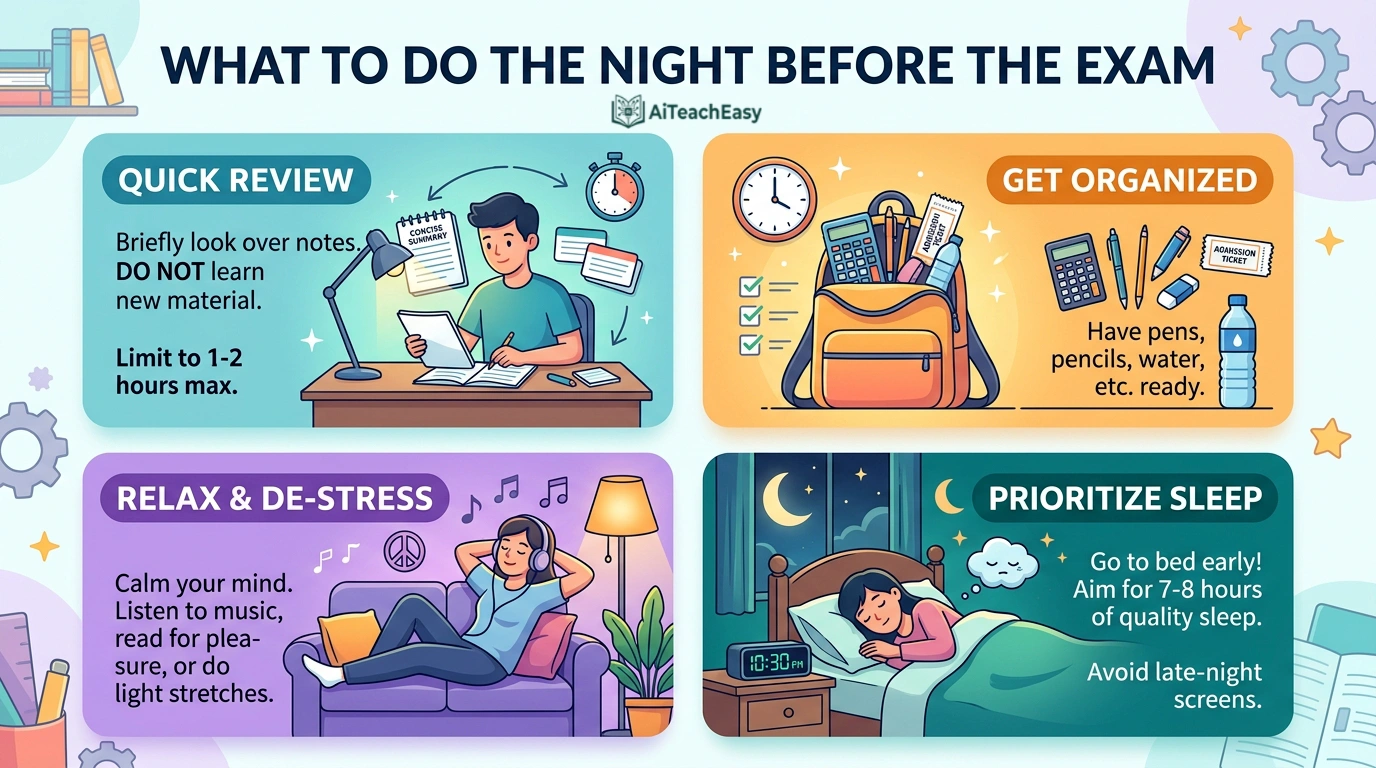
The night before the exam, your job is to protect your brain. Do not try to become a genius at 2:17 AM with cold tea and regret.
Make a one-page survival sheet
Include:
- Key formulas
- Definitions
- Dates
- Diagrams
- Essay outlines
- Repeated topics
- Common mistakes
- Important examples
This sheet is for final review, not decoration. No need for ten colors and perfect handwriting.
Sleep at least a few hours
Sleep helps memory consolidation. Harvard Medical School explains that sleep supports the brain’s ability to consolidate factual and procedural memories, and the period after learning is especially important. (Harvard Sleep Medicine)
If you stay awake all night, you may “cover” more content, but your recall, focus, and decision-making can suffer.
Avoid comparison
Do not ask friends:
“How much did you study?”
This question has ruined more students than difficult chapters.
Some students exaggerate. Some panic. Some say, “I studied nothing,” while secretly finishing the whole syllabus twice.
Protect your mind.
The 8-Hour Emergency Exam Plan
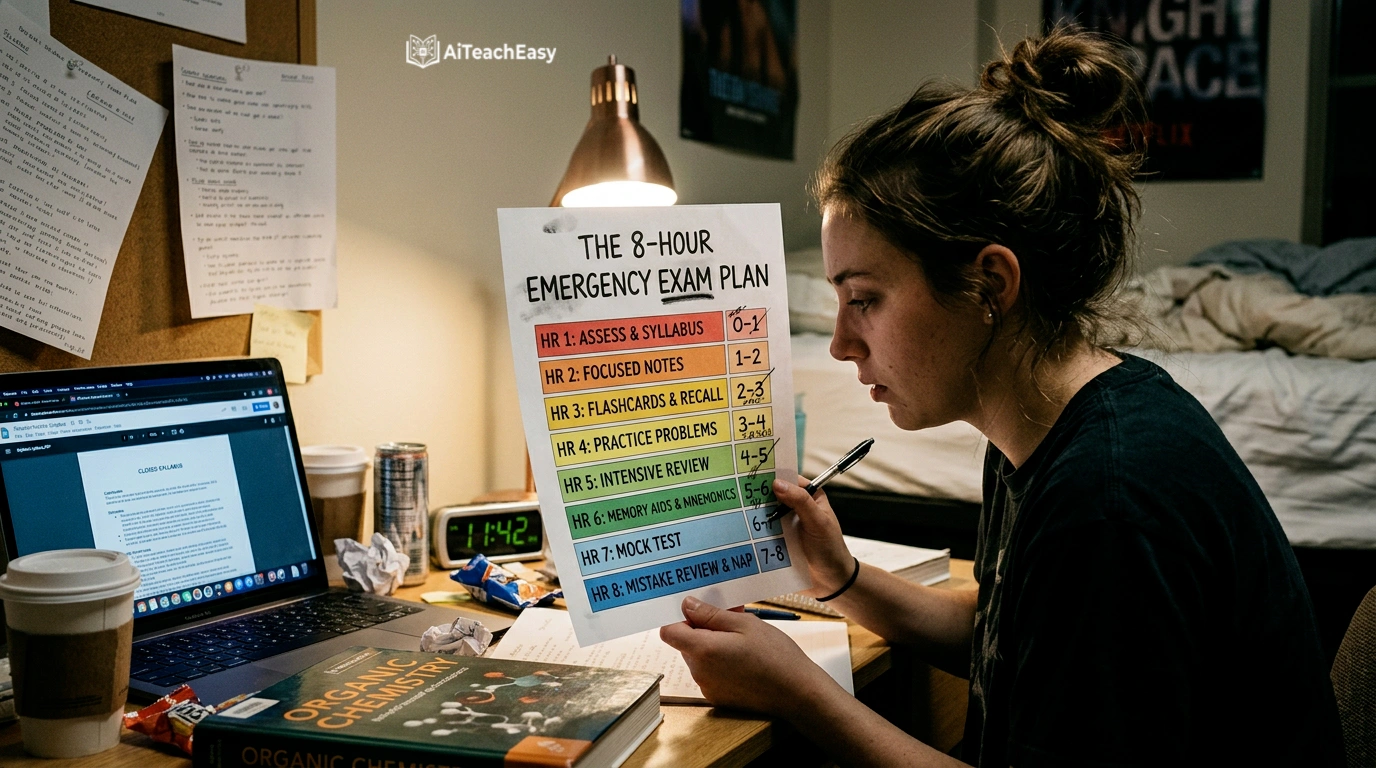
Use this plan if your exam is in about 8 hours.
Hour 1: Understand the exam
Find:
- Syllabus
- Marks distribution
- Past papers
- Question types
- Compulsory sections
Make a short priority list.
Hours 2–3: Study high-yield topics
Pick the top 3–5 topics.
For each topic, learn:
- Definition
- Main points
- Example
- Diagram/formula
- Likely question
Hour 4: Practice questions
Attempt selected questions without notes.
Don’t spend too long. Your aim is speed and recall.
Hour 5: Fix weak areas
Check your mistakes.
Write corrections in short form.
Example:
- “Forgot formula for acceleration.”
- “Need 3 causes of inflation.”
- “Diagram labels missing.”
Hour 6: Memorize survival sheet
Revise your one-page sheet.
Use active recall:
- Look
- Cover
- Recall
- Check
Hour 7: Rest and reset
Eat something light. Drink water. Take a short walk.
Do not start a brand-new difficult chapter unless it is guaranteed in the exam.
Hour 8: Final review
Review:
- Definitions
- Formulas
- Diagrams
- Repeated questions
- Mistake list
Then stop. Walk into the exam with a plan.
How AI Can Help You Prepare Fast

AI can be useful when time is short, but only if you use it correctly.
Good prompts:
- “Summarize this chapter into 10 exam points.”
- “Make 20 short questions from these notes.”
- “Quiz me one question at a time.”
- “Create a last-minute revision plan for this syllabus.”
- “Explain this topic in simple words with examples.”
Bad prompt:
- “Teach me everything.”
That is too broad and wastes time.
You can also use this guide on how students can use ChatGPT for study to revise faster without copying blindly.
For a complete revision setup, see how to build an AI study system.
Common Mistakes to Avoid
Reading the Whole Textbook
A full textbook is not your friend one night before the exam. Use summaries, past papers, and important topics instead.
Starting With the Hardest Topic
Hard topics drain energy quickly. Start with topics that can give marks fast and build confidence first.
Studying Without Testing Yourself
If you only read, you may feel familiar with the content but fail to recall it during the exam.
Ignoring Sleep Completely
No sleep can make you slow, emotional, and forgetful. Even a few hours of rest are better than none.
Leaving the Paper Incomplete
Attempt every required question if there is no negative marking. A weak answer may still earn partial marks.
Spending Too Long on One Question
If you get stuck, move on to the next question and come back later with a fresh mind.
Writing Messy Answers
Use clear headings, numbering, and spacing so the examiner can understand your answer quickly and easily.
Best Answer Structure for Weak Preparation
When you don’t know much, structure becomes your weapon.
Use this simple format:
For short answers
- Definition
- One key point
- One example
For long answers
- Introduction
- 3–5 headings
- Explanation under each heading
- Example or diagram
- Conclusion
For science answers
- Definition
- Formula or diagram
- Explanation
- Units
- Example
For essay answers
- Opening line
- Main argument
- Supporting points
- Example
- Balanced view
- Conclusion
A structured answer often looks more confident than a messy answer with more information.
Mini Story: The Student Who Saved His Grade
Last semester, imagine a student named Ali. He had a business studies exam the next morning and had barely studied. His first plan was to read the whole book overnight.
Bad idea.
Instead, he checked five past papers. He noticed that motivation theories, leadership styles, marketing mix, and business objectives appeared again and again.
He made four short answer outlines, memorized key definitions, practiced two long questions, and slept for five hours.
Did he top the class? No.
Did he pass? Yes.
The lesson is simple: when time is short, strategy beats panic.
FAQ
1. How can I pass an exam without studying?
You can improve your chances by focusing on repeated past paper topics, easy marks, definitions, formulas, diagrams, and structured answers. You should also sleep, manage time, and attempt every required question.
2. Can I pass if I start studying one night before?
Yes, sometimes. It depends on the subject and exam difficulty. Use past papers, high-yield topics, and active recall instead of trying to read the whole book.
3. What should I study first for a last-minute exam?
Study compulsory sections, repeated questions, short-answer topics, formulas, definitions, and easy chapters first. These give the fastest marks.
4. Is it better to sleep or study all night?
It is usually better to sleep at least a few hours. Sleep helps memory consolidation and focus, while all-nighters can damage recall and concentration. (Harvard Sleep Medicine)
5. How do I answer when I don’t know anything?
Start with a basic definition, use keywords from the question, write related points, add examples, and structure your answer clearly. Partial marks can help you pass.
6. Is cheating a good option if I didn’t study?
No. Cheating can lead to disqualification, suspension, or long-term academic problems. Use ethical last-minute strategies instead.
Conclusion
Learning how to pass an exam without studying is really about learning how to survive a bad preparation situation. You may not be able to master the whole syllabus overnight, but you can still protect marks with the right plan.
Focus on past papers, high-yield topics, active recall, definitions, formulas, diagrams, and answer structure. Stay calm, manage your time, and don’t leave questions blank.
And after this exam, do yourself a favor: don’t make this your regular study method. Last-minute survival is useful once in a while, but a proper study system is much less stressful.
Start earlier next time, revise smarter, and let this exam be the warning bell — not the whole fire alarm.
About Prof. Irfan
Prof. Irfan is an AI in education researcher and former classroom teacher. He helps educators and students integrate AI tools ethically and effectively for exam preparation, revision, and better learning habits.