
How to Study a Whole Semester in One Week
Quick Summary
- To study a whole semester in one week, don’t try to read everything. Rank topics by exam value, weak areas, past papers, and teacher emphasis.
- Use active recall, flashcards, blurting, past papers, and short timed study blocks instead of passive rereading. UNC says effective studying needs active engagement, not just reading notes again and again. (The Learning Center)
- Sleep is part of the plan. Sleep deprivation makes focus and recall worse, so a “no-sleep heroic study night” can turn into a confused exam morning. Harvard Medical School notes that lack of sleep makes it harder to concentrate and remember information. (Harvard Sleep Medicine)

How to Study a Whole Semester in One Week: A Realistic 7-Day Plan
Need to know how to study a whole semester in one week? First, breathe. You’re in a tough spot, but not an impossible one.
The goal is not to learn every sentence from every lecture. That’s fantasy. The real goal is to learn the highest-value material well enough to answer exam questions, explain core ideas, solve common problems, and avoid blanking out.
What is last-minute semester study?
Last-minute semester study means compressing weeks or months of content into a short revision window. It works best when you prioritize important topics, test yourself often, and use past papers instead of reading everything equally.
Can you pass after studying one semester in one week?
Yes, it’s possible, especially if you use strategic revision. But your result depends on your starting level, exam difficulty, subject type, and how well you focus during the week.
What is the best method to study a semester quickly?
The best method is: topic audit → priority list → active recall → past papers → mistake review → spaced mini-reviews. Birmingham City University’s one-week revision advice also starts with identifying weak spots, making a timetable, using breaks, and practicing with methods like past papers and blurting. (Birmingham City University)
Now let’s build a proper rescue plan.
Can You Study a Whole Semester in One Week?
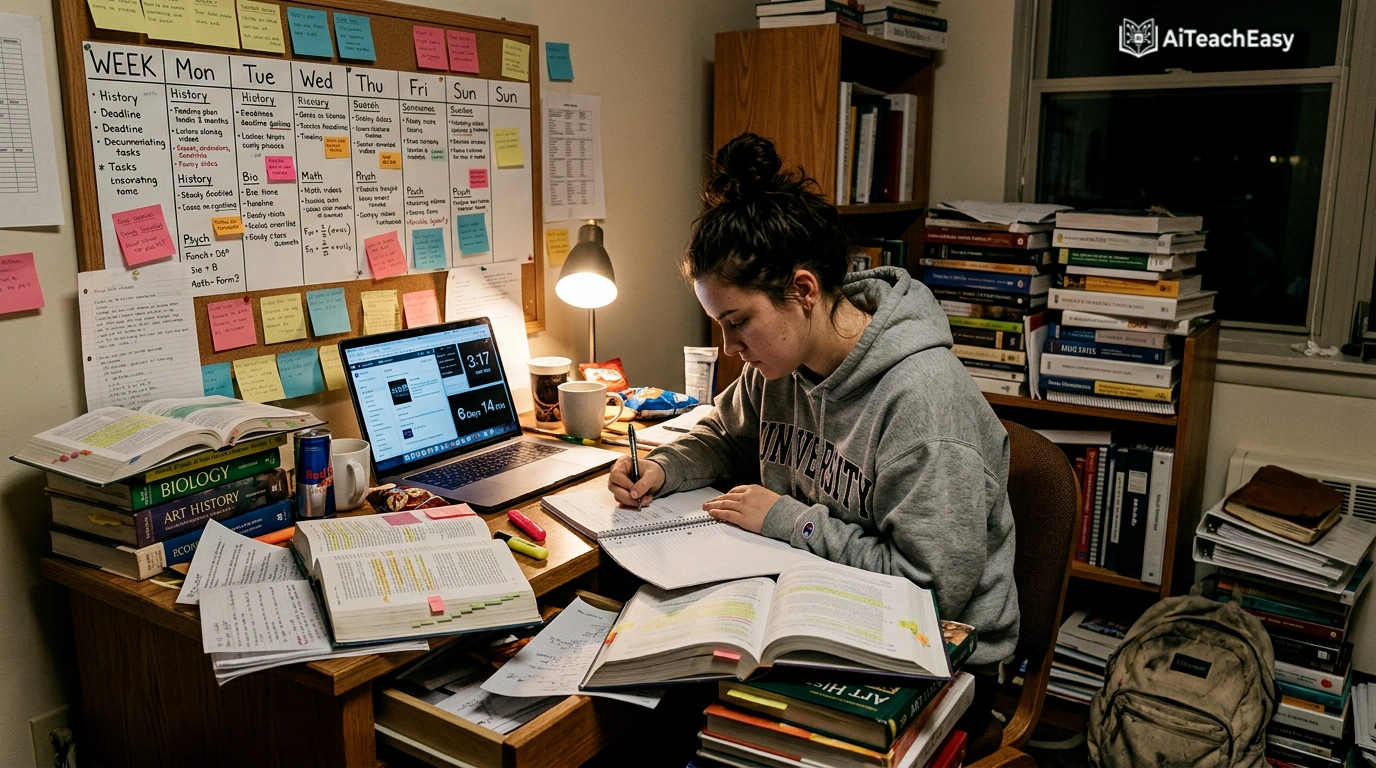
Yes, but only if you stop thinking like a normal student and start thinking like an exam strategist.
A normal student says:
“I need to study everything.”
A smart last-minute student says:
“I need to study what is most likely to appear and what gives me the most marks.”
There’s a big difference.
You probably cannot master every chapter deeply in seven days. But you can often learn enough to improve your grade if you focus on:
- High-weight topics
- Repeated exam questions
- Core definitions
- Key formulas
- Main theories
- Diagrams and processes
- Case studies
- Past paper patterns
- Teacher-highlighted material
- Weak areas that cost easy marks
Think of it like packing for a trip in five minutes. You don’t organize your whole wardrobe. You grab passport, wallet, phone, charger, clothes, and shoes. Same with exam revision. Grab the essentials first.
What Should You Study First?

Before you open chapter one and start suffering, make a priority map.
Step 1: Collect Everything
Gather:
- Lecture slides
- Class notes
- Textbook chapters
- Assignments
- Quizzes
- Past papers
- Mark schemes
- Teacher comments
- Study guide or syllabus
Don’t start studying yet. First, create the battlefield map.
Step 2: Divide Topics Into 3 Groups
Use this simple system:
| Category | Meaning | Action |
|---|---|---|
| A Topics | High marks, repeated, important | Study deeply |
| B Topics | Medium value, possible exam material | Study briefly |
| C Topics | Low value or unlikely | Skim or skip if needed |
This saves you from giving five hours to a tiny topic and five minutes to a major one.
Step 3: Find Exam Patterns
Look at past papers and ask:
- Which chapters appear again and again?
- What question style repeats?
- Are answers theory-based or problem-based?
- Do diagrams matter?
- Are definitions heavily tested?
- Are long essays required?
- Are calculations repeated?
If you have mark schemes, read them carefully. They show what examiners reward.
The 7-Day Plan to Study a Whole Semester
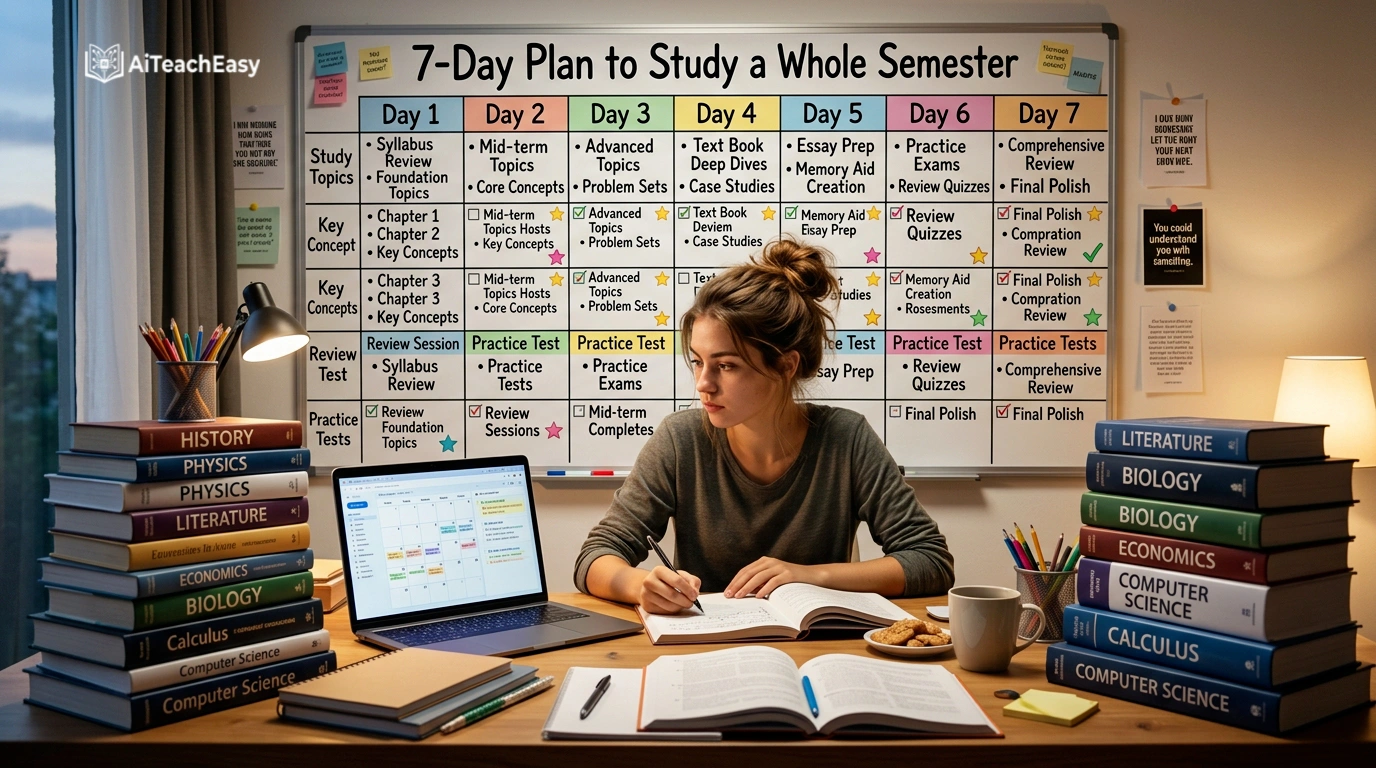
This plan assumes your exam is in one week. Adjust it if you have multiple exams.
Day 1: Audit the Semester and Build the Plan
Day 1 is not for random studying. It is for organizing and identifying what matters.
Your Day 1 Goals
- Collect all notes and papers
- List every topic
- Mark topics as A, B, or C
- Identify weak areas
- Create a timetable
- Start with the most important weak topic
BCU recommends using the first day of a one-week revision plan to identify weak spots, make a revision timetable, gather notes, tidy the study space, and prepare flashcards or apps. (Birmingham City University)
Day 1 Task
Create a table like this:
| Topic | Importance | My Confidence | Study Method |
|---|---|---|---|
| Topic 1 | High | Low | Deep study + past paper |
| Topic 2 | High | Medium | Flashcards + recall |
| Topic 3 | Medium | Low | Summary + quiz |
| Topic 4 | Low | Low | Skim only |
What to Avoid on Day 1
Don’t spend the whole day making a beautiful timetable with colors, stickers, and emotional damage. A simple plan is enough.
Your timetable should help you study, not become your new hobby.
Day 2: Learn the Highest-Value Topics First
Day 2 is for A topics.
These are the topics that are:
- Frequently tested
- Heavily weighted
- Needed to understand other topics
- Mentioned often by your teacher
- Linked to past paper questions
How to Study Each Topic
Use the 4-step method:
- Preview: Read headings, summaries, and learning outcomes.
- Understand: Watch or read one clear explanation.
- Recall: Close notes and explain the concept.
- Test: Solve questions or write answers.
Example
If you’re studying economics, don’t read 80 pages on inflation first.
Instead:
- Define inflation
- Learn causes
- Learn effects
- Learn diagrams
- Learn one example
- Practice one past paper question
That is exam-focused learning.
Day 3: Turn Notes Into Questions and Flashcards
Day 3 is where you stop reading and start testing.
If you only read your notes, you may feel like you know them. But the exam doesn’t ask, “Does this page look familiar?” It asks you to produce answers.
Make Flashcards for:
- Definitions
- Formulas
- Dates
- Key people
- Theories
- Short examples
- Steps in a process
- Common mistakes
You can make them by hand or use AI. This guide on how to convert notes into flashcards can help you turn long notes into active recall material quickly.
Good Flashcard Example
Front: What is opportunity cost?
Back: The value of the next best alternative given up when making a choice.
Bad Flashcard Example
Front: Economics Chapter 2
Back: Everything.
Keep cards small. One question, one answer.
Day 4: Practice Past Papers and Exam Questions
Day 4 is past paper day.
This is where you discover the truth. Not the truth you want. The truth your exam will reveal.
Past papers show:
- How questions are worded
- Which topics repeat
- How much detail is needed
- What your weak areas are
- How fast you can answer
- Whether you actually understand
The University of Waterloo advises strategic last-minute studying by focusing on high-value material, testing yourself, and using practice questions rather than trying to cover everything equally. (Wikipedia)
How to Use Past Papers
Don’t just read answers. Do this:
- Choose one question.
- Set a timer.
- Answer without notes.
- Check the mark scheme.
- Write what you missed.
- Repeat a similar question.
Create a Mistake List
Your mistake list is gold.
Write:
- Questions you got wrong
- Concepts you forgot
- Formulas you mixed up
- Definitions you couldn’t explain
- Topics that need review
This list becomes your Day 5 and Day 6 study plan.
Day 5: Fix Weak Areas
By Day 5, you should stop pretending everything is equally important.
Focus on the weak points that cost marks.
Use the 3-Layer Fix Method
Layer 1: Understand
Find a simple explanation. Don’t memorize confusion.
Layer 2: Recall
Close your notes and explain the topic aloud.
Layer 3: Apply
Solve a question or write an exam-style answer.
Example
Weak area: “Photosynthesis light-dependent reaction.”
Fix it like this:
- Watch or read a simple explanation
- Draw the process from memory
- Explain it aloud
- Answer a past paper question
- Review the mark scheme
This is much better than rereading the same paragraph while slowly losing your soul.
Day 6: Simulate the Exam
Day 6 is rehearsal day.
You need to practice under pressure before the real exam.
Do a Mini Mock Exam
Choose:
- 1 long question
- 3 short questions
- 5 definitions
- 5 MCQs or calculations
Set a timer. No notes. No phone. No “let me just check one thing.”
After finishing, mark your work honestly.
Review Your Mistakes
Ask:
- Did I misunderstand the question?
- Did I forget the content?
- Did I run out of time?
- Did I write too little?
- Did I know the topic but fail to structure the answer?
This step is important because exam performance is not only about knowledge. It is also about timing, structure, and confidence.
Day 7: Final Review and Memory Lock
Day 7 is not for learning brand-new chapters unless you have no choice.
It is for:
- Reviewing flashcards
- Rechecking mistake lists
- Practicing key questions
- Memorizing formulas
- Reviewing diagrams
- Reading summaries
- Sleeping properly
Final Review Method
Use three rounds:
Round 1: Fast Recall
Go through all key topics. Say main points aloud.
Round 2: Weak Spots
Review only the topics you still forget.
Round 3: Exam Pack
Prepare formulas, definitions, diagrams, and likely questions.
Final Night Rule
Do not stay awake all night unless there is truly no other option.
Sleep helps learning and recall. Harvard Medical School explains that inadequate sleep affects learning by making it harder to concentrate, take in information, and remember what you already learned. (Harvard Sleep Medicine)
Best Study Methods for One-Week Revision
1. Active Recall
Active recall means testing yourself without looking.
Instead of rereading:
The four causes of World War I were…
Ask:
What were the four causes of World War I?
Then answer from memory.
UNC says simply reading and rereading notes is not active engagement; stronger study involves working with the material through methods like questioning, explaining, and testing. (The Learning Center)
2. Blurting
Blurting means writing everything you remember on a blank page.
How to do it:
- Choose a topic.
- Close your notes.
- Write everything you remember.
- Open notes.
- Add missing points.
- Repeat later.
This works well for essays, diagrams, processes, and theory subjects.
3. Past Papers
Past papers are your shortcut to exam reality.
Use them for:
- Question prediction
- Time practice
- Answer structure
- Mark scheme language
- Weakness detection
Past papers are especially useful when you have only one week because they stop you from studying blindly.
4. Spaced Mini-Reviews
You don’t have months, but you can still use spacing inside one week.
Example:
- Morning: Learn topic
- Afternoon: Test it
- Night: Review mistakes
- Next day: Quick recall
- Day 7: Final check
This is better than studying a topic once and never returning.
5. Interleaving
Interleaving means mixing related topics instead of studying one thing for too long.
Example for math:
- 3 algebra questions
- 3 geometry questions
- 3 probability questions
- 3 equation questions
This helps you choose the right method in exams.
6. Teaching Aloud
Teach the topic to someone else, or pretend to.
Use this structure:
- “The main idea is…”
- “This matters because…”
- “An example is…”
- “A common mistake is…”
- “In the exam, they may ask…”
If you can teach it simply, you probably understand it.
How to Use AI to Study Faster

AI can save time, but only if you use it properly.
Don’t ask AI to “study for me.” Ask it to make your study active.
Use AI For:
- Summarizing long notes
- Creating flashcards
- Making quizzes
- Explaining hard concepts
- Building revision timetables
- Generating practice questions
- Checking answer structure
- Turning lectures into notes
For lecture-based courses, this guide on how to take notes from YouTube lectures using AI can help you convert video lessons into study notes.
For a full revision setup, read how to build an AI study system.
AI Prompt for One-Week Semester Study
Copy this:
I have one week to study a whole semester. I will paste my syllabus and notes. Create a 7-day study plan. Rank topics by importance, make active recall questions, create flashcards, and suggest past paper practice. Keep the plan realistic and focus on high-mark topics first.
AI Prompt for Past Paper Practice
Create 10 exam-style questions from this topic. Include short-answer, long-answer, and application questions. After I answer, mark my response and tell me what I missed.
AI Prompt for Weak Topics
Explain this topic in simple language. Then give me a memory trick, a diagram description, 5 flashcards, and 3 likely exam questions.
AI is not a magic brain. But it is a very useful study assistant when you use it for testing, explaining, and organizing.
What to Avoid During Last-Minute Study
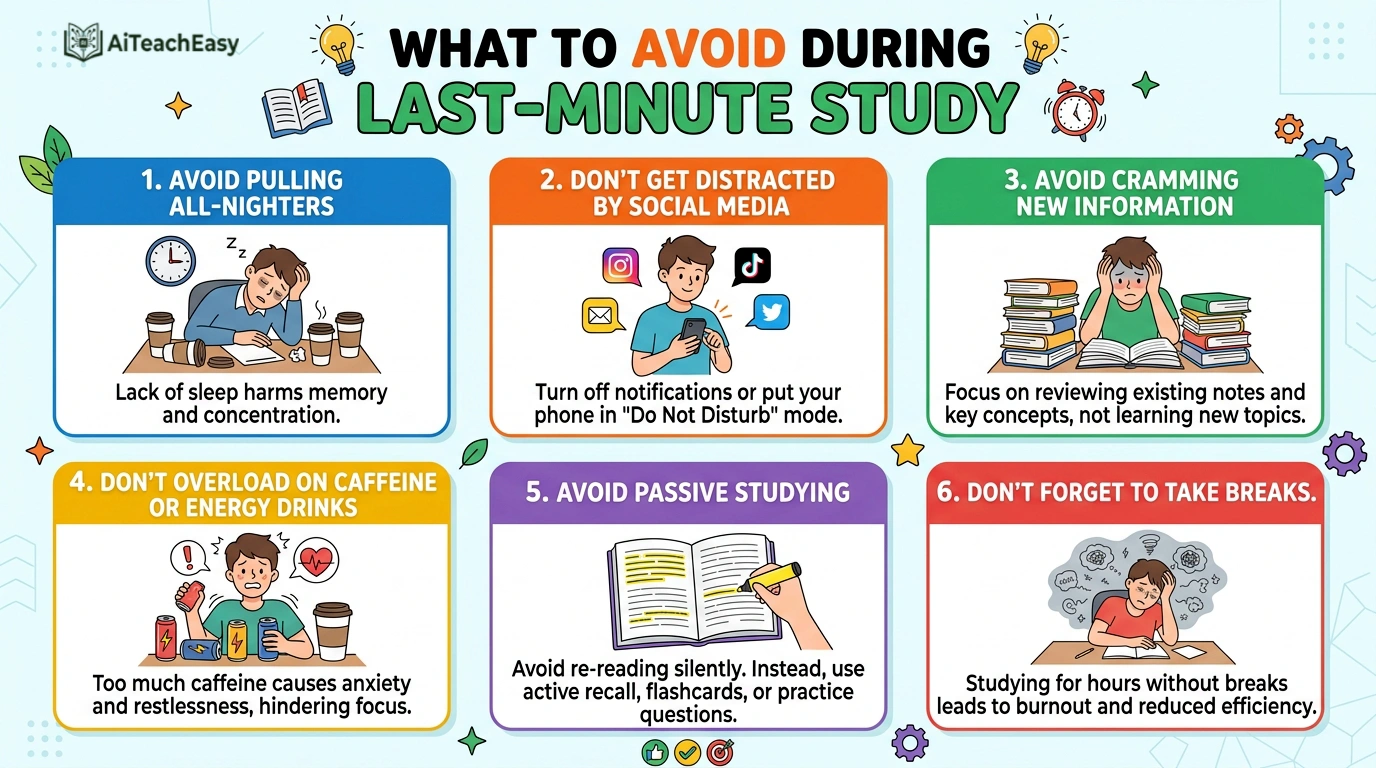
1. Don’t Rewrite All Your Notes
Rewriting feels productive, but it is slow.
Only rewrite:
- Key formulas
- Important definitions
- Mistake summaries
- Essay plans
- Diagrams
- Hard concepts
Don’t copy 60 pages by hand and call it revision.
2. Don’t Highlight Everything
If the whole page is yellow, nothing is important.
Highlight only:
- Key terms
- Dates
- Formulas
- Theories
- Main arguments
- Common exam phrases
3. Don’t Study Without Testing
Reading is input. Exams require output.
Every study block should include output:
- Answer a question
- Solve a problem
- Explain aloud
- Write from memory
- Draw a diagram
- Complete flashcards
4. Don’t Sacrifice All Sleep
One bad night may happen. Seven bad nights will hurt.
CDC data shows many students already get less than recommended sleep, and poor sleep is linked with trouble staying healthy and learning well. (CDC)
Protect sleep as much as possible, especially the night before the exam.
5. Don’t Keep Your Phone Beside You
Your phone is not just a distraction. It breaks your attention again and again.
Use:
- Airplane mode
- Focus mode
- Website blockers
- Study timer apps
- Phone in another room
Your future grade deserves more attention than random reels.
One-Week Study Timetable Example
Here’s a realistic timetable for one subject. Adjust it for your schedule.
| Day | Main Goal | Study Tasks |
|---|---|---|
| Day 1 | Plan and prioritize | Syllabus audit, topic ranking, timetable, first weak topic |
| Day 2 | High-value topics | Study A topics, make summaries, active recall |
| Day 3 | Flashcards and recall | Convert notes to questions, review definitions, test memory |
| Day 4 | Past papers | Timed practice, mark answers, make mistake list |
| Day 5 | Weakness repair | Relearn weak topics, solve targeted questions |
| Day 6 | Mock exam | Timed practice, review answer structure, fix gaps |
| Day 7 | Final review | Flashcards, formulas, diagrams, mistake list, sleep |
Daily Study Block Template
Use this for each topic.
10 Minutes: Preview
Read headings, learning outcomes, summaries, and past paper questions.
30 Minutes: Learn
Study the topic with notes, video, or textbook.
20 Minutes: Recall
Close notes and answer questions from memory.
20 Minutes: Practice
Solve exam-style questions.
10 Minutes: Fix
Check mistakes and write corrections.
This gives you a 90-minute deep study block.
Take a short break, then move to the next topic.
Example: How to Study 12 Chapters in One Week

Let’s say you have 12 chapters.
Don’t give equal time to all 12.
Rank them:
- 5 high-priority chapters
- 4 medium-priority chapters
- 3 low-priority chapters
Then divide:
- High-priority: 2–3 hours each
- Medium-priority: 1 hour each
- Low-priority: 20–30 minutes each
That gives you a better chance than spending one hour on every chapter with no strategy.
Pro Tip: Use the 80/20 Rule
The 80/20 rule means a small number of topics often create a large number of marks.
In exam terms:
About 20% of the content may help you answer 80% of the common questions.
This is not always exact, but it is a useful mindset.
Ask:
- Which topics appear most?
- Which formulas are used often?
- Which theories connect to many questions?
- Which diagrams are easy marks?
- Which definitions are repeated?
Study those first.
Short Story: The Student Who Stopped Studying Randomly

Imagine a student named Sara. She had one week before her final and a full semester of psychology notes.
On day one, she panicked and opened chapter one. After two hours, she was still on page six.
Then she changed the plan.
She checked past papers and found that research methods, memory, development, and abnormal psychology appeared again and again. She made those her A topics. She turned headings into questions, made flashcards, practiced past papers, and reviewed her mistakes daily.
Did she learn every detail? No.
But she walked into the exam knowing the topics most likely to matter. That’s what saved her.
The lesson is simple: last-minute study rewards strategy, not perfection.
Checklist: How to Study a Whole Semester in One Week

Use this before you begin:
- Did I collect all notes and past papers?
- Did I rank topics by importance?
- Did I identify weak areas?
- Did I create a 7-day timetable?
- Am I using active recall?
- Did I make flashcards for key facts?
- Am I solving past papers?
- Did I create a mistake list?
- Am I reviewing weak topics daily?
- Am I sleeping enough to remember?
FAQ
1. How do I study a whole semester in one week?
Start by ranking topics by importance. Study high-mark topics first, use active recall, make flashcards, solve past papers, and review mistakes daily. Don’t try to read every page equally.
2. Is one week enough to study for finals?
One week can be enough to improve your grade if you already know some material or if you study strategically. It may not be enough for full mastery, but it can be enough for focused exam preparation.
3. How many hours should I study per day for one week?
Many students can manage 4–8 focused hours per day, depending on energy, schedule, and exam difficulty. Quality matters more than raw hours. Use breaks and active study methods.
4. Should I study all night before the exam?
Usually, no. Sleep helps concentration and memory. A short final review plus proper sleep is often better than staying awake all night and forgetting what you studied.
5. What is the fastest way to revise a semester?
The fastest way is to use past papers, active recall, flashcards, topic summaries, and mistake review. Focus on high-value topics first.
6. Can AI help me study a semester in one week?
Yes. AI can summarize notes, create quizzes, make flashcards, explain hard topics, and build revision schedules. But you still need to test yourself and practice exam questions.
Conclusion
Learning how to study a whole semester in one week is about making smart choices under pressure.
You don’t have time for perfect notes, endless highlighting, or reading every chapter slowly. You need a plan: rank topics, study high-value areas first, test yourself, solve past papers, fix mistakes, and protect your sleep.
One week is not ideal, but it is enough to make progress if you study with focus.
Start with your syllabus today. Mark the top topics. Open a past paper. Build your plan. Then begin with the hardest high-value topic first.
That’s how you turn panic into a strategy.
About Prof. Irfan
About Prof. Irfan
Prof. Irfan is an AI in education researcher and former classroom teacher. He helps educators and students integrate AI tools ethically and effectively for better learning, exam preparation, and classroom productivity.