
How to Finish Summer Assignments Fast
📋 Quick Summary Box
Based on education research and student productivity studies, this guide gives you a 12‑step system to complete your summer coursework using smart planning, ethical AI support, and proven time management for students. You’ll get procrastination tips for students, learn how to finish homework faster, and build study habits for teens that actually stick – all while reducing academic stress management and preparing for back‑to‑school.
Last updated: April 24, 2026
Editorial note: This guide follows AI Teach Easy’s evidence‑based editorial policy. External sources are cited where used.
Pair this system with our best AI tools for online classes.

Table of Contents
“Why is it August already and I’ve done nothing?”
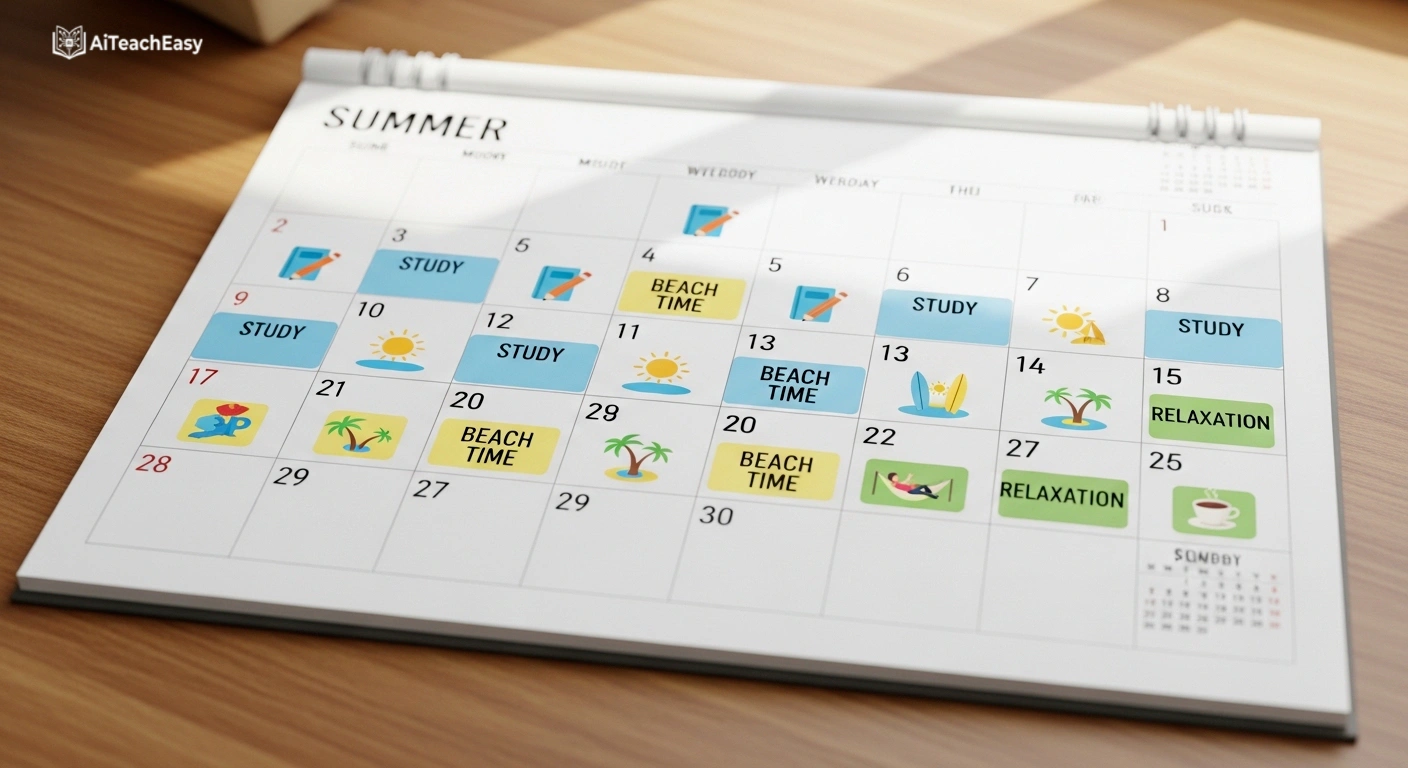
You swore you’d start early. You even made a cute study playlist.
Then July vanished. Now the books are still unopened, the math packet is untouched, and every time your parent asks “Have you started your summer reading?” you feel your stomach drop.
Here’s the thing: You’re not lazy. You’re missing structure.
Without daily deadlines, most students’ brains treat homework like invisible wallpaper. But today, we’re going to fix that – with real learning loss prevention strategies that work, even if you only have one week left.
What Are Summer Assignments?
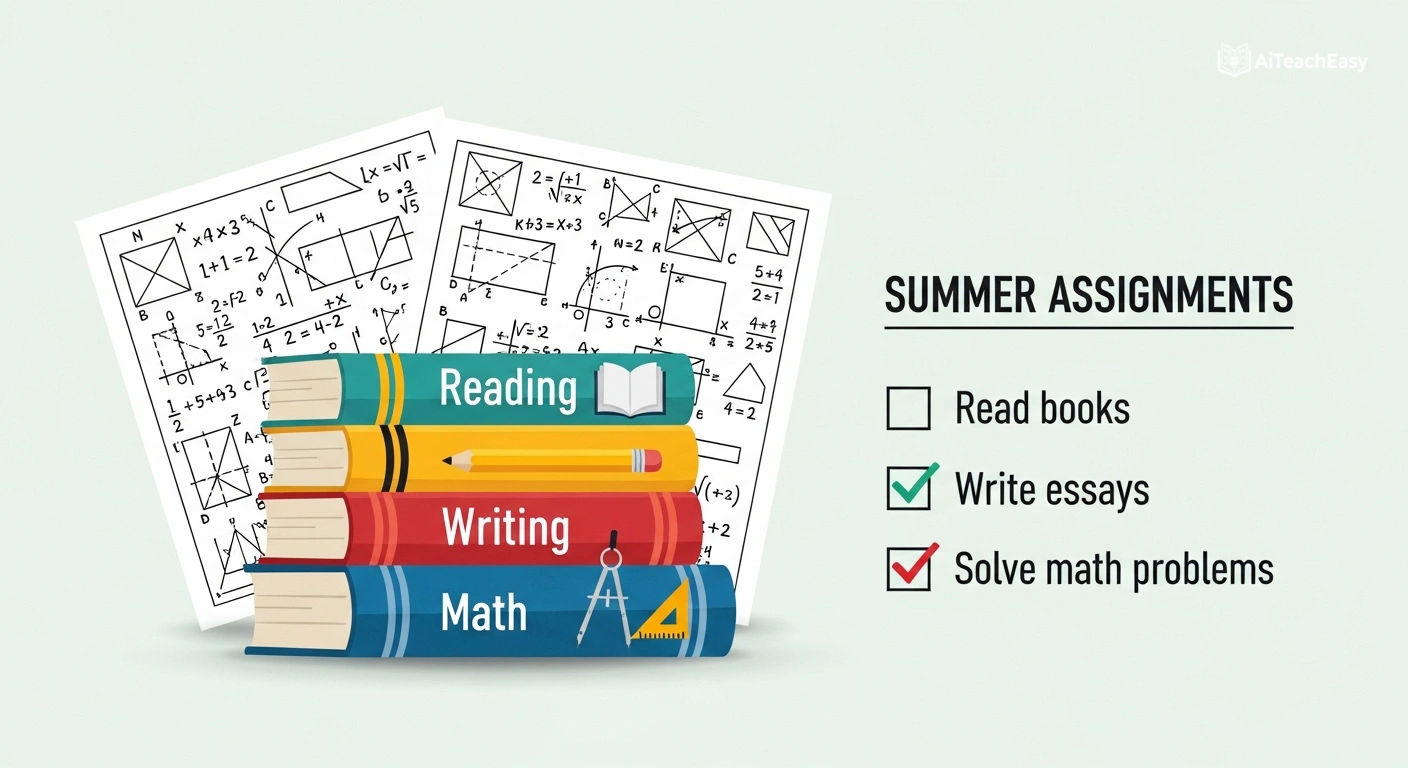
Summer assignments are projects, reading lists, or skill packets given by teachers to prevent summer learning loss – the 2–3 months of knowledge students typically forget during break. They keep your brain active and reduce back‑to‑school preparation stress.
Why Most Students Struggle With Their School Workload (Research‑Backed)

According to the Pew Research Center, over 65% of students say summer homework causes major stress – not because the work is hard, but because they lack a daily study routine. A 2025 report from Education Week found that students without a homework log are three times more likely to procrastinate until the last week.
Additional research from UCL (University College London) shows that students can lose up to 2–3 months of math and reading skills over summer – the “summer slide.” The solution isn’t more willpower; it’s better time management for students.
For further reading:
- OECD Education on learning loss
- UNESCO’s global homework studies
- Khan Academy’s summer learning tips
- EdTech research on AI study tools
The 4 Types of Summer Academic Tasks (And How to Handle Each)
| Assignment Type | What It Looks Like | Best Strategy |
|---|---|---|
| Summer reading | 1–3 books + a report | Chapter summaries + reading log |
| Essays / writing | 500–1500 words | Outline first → write later |
| Math packets | 50–100 problems | 5 problems/day + error log |
| Projects / research | Poster, slides, science fair | Break into stages: research → design → build |
You’ll use AI as a support tool (not a replacement) for repetitive parts, while focusing on real learning.
👉 For a complete toolkit, visit our student productivity hub – your pillar page for study systems.
The 12‑Step System to Finish Faster

Step 1 – The “Brain Dump” (Get Everything Out)
Write down every single academic task – even the worst homework assignments you’ve been avoiding. Name them.
Step 2 – Create a Homework Assignment Log
Use a simple assignment record sheet (paper or digital) with columns: Task, Due date, Time estimate, Status.
👉 See our homework helper tools for automatic tracking.
Step 3 – Chunk Big Tasks Into Micro‑Tasks
- “Read 200 pages” → “10 pages/day”
- “Math packet” → “5 problems each morning”
Step 4 – Build a Realistic Schedule
Start from the last day of summer and work backwards. Leave the final week empty – for emergencies or fun. This is a core learning loss prevention strategy.
Step 5 – Use AI for Planning (Ethical Way)
Ask ChatGPT: “I have these assignments: [list]. I have 4 weeks left. Give me a weekly plan with 2‑hour daily blocks.”
✅ This is like asking a tutor for help, not cheating.
Step 6 – Tackle Summer Reading With AI Support
Don’t skip the book – support your reading. Ask AI for a chapter summary first, then read the original to confirm.
Prompt: “Summarise chapter 3 in 5 bullet points. Focus on main characters.”
👉 More ideas: How to Use Claude AI for Study
Step 7 – Write Essays Faster (Without Copying)
Never ask AI to write the whole essay. Instead:
- Ask for 3 sample thesis statements – then write your own.
- Request an outline (thesis + 3 arguments + conclusion).
- Write each paragraph yourself.
- Use AI only for grammar checks.
That’s real homework help that builds study habits for teens.
👉 See ChatGPT Prompts for Assignments
Step 8 – Solve Math Packet Problems Step by Step
Stuck? Use AI to explain the method, not just the answer:
“Explain how to solve [problem]. Show each step, then give me a similar practice problem.”
This turns AI into a personal tutor – and it’s a great procrastination tip for students (starting is easier when a bot holds your hand).
Step 9 – Compare: With AI vs. Without AI
| Task | Without AI | With AI (Support) |
|---|---|---|
| Reading | Read everything | Summary → then read key parts |
| Essay | Blank page for 1 hour | Outline → then you write |
| Math | Stuck for 30 min | Method explained → you solve |
| Project | Disorganised research | Find sources → you analyse |
Step 10 – Real‑Life Case Studies (Pain + Fix)
Case 1 – Mia (Last Week Panic)
6 assignments, 5 days left. She used AI to summarise all reading, wrote “good enough” essays, passed. Lesson: Done > perfect.
Case 2 – James (Parent‑led rescue)
His mom sat with him, broke a 50‑page science report into 5 sections, used AI to find sources. Finished in 3 days. Lesson: External check‑ins kill procrastination.
Case 3 – “The 11 PM Student”
Kept swearing to start tomorrow. The fix? A homework assignment log on the fridge. Visual tracking beat willpower.
Step 11 – Weekly Schedule Template (For Time Management for Students)
- Mon–Thu: 1.5–2 hours focused work (morning is best)
- Friday: Zero schoolwork – rest is productive
- Saturday: 1 hour review
- Sunday: Update your log, plan the week
Step 12 – Final Review (One Week Before School)
- Check off completed tasks
- Use a simple checklist (no AI needed here)
- Pack everything the night before
👉 For exam prep: AI Tools for Exam Preparation
👉 To boost memory: AI Tools for Memorization
👉 For organised notes: Free AI Note Takers
How to Finish Summer Assignments Fast?
Finish faster by: (1) creating a homework assignment log, (2) chunking big tasks into 20‑minute micro‑tasks, (3) using AI only for planning and summaries (not copying), and (4) working 1.5–2 hours daily, not all day. Consistency beats intensity.
Ethical Reminder: AI as a Study Partner, Not a Ghostwriter
AI should be used for understanding and planning, not replacing learning.
- ✅ Good: Explaining a concept, creating a study plan, summarising a chapter you already read.
- ❌ Bad: Copying an AI‑generated essay or letting AI solve every problem without learning.
Disclaimer for students: Some schools have specific AI usage policies. Check your school’s rules before using AI for graded work. This guide promotes ethical, transparent support – not academic dishonesty.
Frequently Asked Questions
Q: What are summer assignments?
A: They are projects, reading lists, or skill packets given to prevent summer learning loss – the 2–3 months of knowledge students typically forget. They also reduce back‑to‑school preparation stress.
Q: How many hours per day should I work?
A: 1.5–2 hours maximum. More leads to burnout. Consistency beats cramming for academic stress management.
Q: Can I use ChatGPT for my summer coursework?
A: Yes – for planning, outlining, summarising, and explaining. Not for copying. See our prompt guide above.
Q: Do teachers assign too much homework?
A: Research from the APA shows moderate, purposeful homework (like summer reading) helps prevent learning loss. The key is time management for students – not the amount.
Q: What if I haven’t started and summer ends in 7 days?
A: Use the “Mia strategy” above. Prioritise high‑weight assignments. Use AI for summaries only. Aim for completion, not perfection.
Q: How can I stop procrastinating?
A: Two powerful procrastination tips for students: (1) the 5‑minute rule – open one task and work for just 5 minutes; (2) a visible homework assignment log on your wall.
Your Next Step (Do This Tonight)
Option 1 – Keep worrying, delay, and spend your last week in panic.
Option 2 – Spend 20 minutes creating your homework assignment log and choosing one strategy from this guide.
Open one book or one math problem. Use a planning method. Then stop and enjoy your evening.
Your summer isn’t ruined. You just needed a system.
Now go take the first step.
Author Section
Prof. Irfan – Educational Content Writer & Learning Systems Researcher
Prof. Irfan has been researching student productivity, AI in education, and learning loss prevention strategies since 2018. He writes for AI Teach Easy, drawing on academic studies (Pew, APA, Education Week, UCL, OECD) and real classroom experience. His focus is practical, ethical, and evidence‑based – no hype, just systems that work.
Editorial policy: This article is reviewed annually. Last update: April 24, 2026. Sources are linked where available. AI usage advice follows common academic integrity guidelines – always verify with your school.