
AI Tools for Student Retention and Success in Universities

Choosing the right AI tool for student retention can help universities identify at-risk students early, improve advising workflows, and reduce dropout rates. This guide compares the best AI tools for student retention and student success in 2026, including predictive analytics platforms, CRM tools, learning analytics software, academic advising systems, and early-warning tools.
What’s New in 2026
Student retention is one of the biggest challenges for universities, colleges, and online learning platforms. AI tools for student retention help institutions identify at-risk students early, track engagement, analyze attendance and grades, and send timely support alerts. In this guide, we compare the best AI-powered student retention and student success tools for 2026, including predictive analytics platforms, CRM tools, academic advising software, and student engagement systems.
This comprehensive guide explores the ai tools for student retention and success in universities that are reshaping how we identify, support, and graduate students. From predictive analytics to 24/7 AI support, we’ll provide a roadmap backed by data, expert insight, and real-world implementation strategies for 2026. For a broader look at how AI is changing the learning landscape, you might also find our roundup of browser-based AI tools for students insightful.
Quick Comparison of AI Student Retention Tools
Choosing the right AI tool for student retention depends on your institution’s main challenge. Some universities need predictive analytics to identify at-risk students early, while others need CRM communication, academic advising workflows, student engagement tracking, or learning analytics. The comparison below gives a clear overview of the most useful AI-powered student retention tools and software categories for colleges, universities, and online learning platforms.
| Tool Category | Best For | Main Features | Best Users | Priority |
|---|---|---|---|---|
| Predictive Analytics Tools | At-risk student detection |
|
Retention teams, institutional research teams, student success leaders | Very High |
| Student Success Platforms | Advisor and support team workflows |
|
Academic advisors, student success teams, support departments | Very High |
| Student CRM Tools | Communication and follow-up |
|
Enrollment teams, admissions teams, retention offices | High |
| Learning Analytics Tools | Course engagement tracking |
|
Online learning teams, faculty, course designers | Very High |
| Academic Advising Software | Student support workflows |
|
Advisors, faculty mentors, student support teams | High |
| Early-Warning Systems | Flagging students before dropout risk increases |
|
Retention officers, advisors, faculty, student support staff | Very High |
| Student Engagement Tools | Tracking student participation and activity |
|
Universities, online programs, student affairs teams | High |
| AI Chatbots for Student Support | 24/7 student help and quick answers |
|
Admissions teams, student service centers, online universities | Medium |
| Attendance Tracking Software | Monitoring absence and participation patterns |
|
Faculty, student affairs teams, retention departments | High |
| Enrollment Management Tools | Improving enrollment and re-enrollment |
|
Admissions teams, enrollment managers, university leadership | High |
| Financial Aid Analytics Tools | Finding financial-risk students |
|
Financial aid offices, retention teams, enrollment departments | Medium |
| LMS Integration Tools | Connecting course data with retention analytics |
|
Online learning teams, IT departments, learning designers | High |
| Cohort Retention Analytics | Comparing retention across student groups |
|
University leadership, analytics teams, program directors | High |
| Automated Reminder Tools | Reducing missed deadlines and disengagement |
|
Advisors, faculty, CRM teams, online learning platforms | Medium |
| Student Feedback Analytics | Understanding student satisfaction and concerns |
|
Student affairs teams, quality assurance teams, university leaders | Medium |
Main Types of AI Student Retention Tools Explained
Predictive Analytics Tools
Predictive analytics tools help universities identify students who may be at risk of dropping out. These platforms analyze attendance, grades, LMS activity, and engagement patterns.
- Best for early risk detection
- Useful for retention planning
- Helps advisors take action faster
Student Success Platforms
Student success platforms bring student data, advisor workflows, alerts, and intervention tracking into one system to improve support and academic outcomes.
- Best for advisor teams
- Supports case management
- Improves student follow-up
Student CRM Tools
Student CRM tools help institutions communicate with students through personalized emails, SMS reminders, re-enrollment campaigns, and automated follow-ups.
- Best for communication
- Improves re-enrollment
- Useful for admissions and retention teams
Learning Analytics Tools
Learning analytics tools track student activity inside LMS platforms, including logins, assignment submissions, course progress, and participation.
- Best for online learning
- Tracks course-level engagement
- Helps detect disengaged learners
Academic Advising Software
Academic advising software helps advisors manage student appointments, advising notes, degree progress, and intervention plans.
- Best for student support workflows
- Improves advisor productivity
- Supports intervention tracking
Early-Warning Systems
Early-warning systems automatically flag students who show signs of academic or engagement risk, such as missed classes, low grades, or reduced activity.
- Best for fast intervention
- Reduces late-stage dropout risk
- Supports proactive advising
Cohort Retention Analytics
Cohort analytics tools help institutions compare student retention across programs, departments, semesters, demographics, and enrollment groups.
- Best for leadership reporting
- Tracks retention trends
- Helps improve program performance
AI Chatbots
AI chatbots support students with quick answers, reminders, enrollment guidance, and basic support outside normal office hours.
- Best for 24/7 support
- Reduces support workload
- Improves student response time
Automated Reminder Tools
Automated reminder tools help students stay on track by sending alerts for assignments, appointments, registration deadlines, and advisor follow-ups.
- Best for deadline management
- Improves student accountability
- Supports CRM workflows
How to Choose the Right AI Student Retention Tool
The best AI student retention tool depends on your institution’s biggest retention problem. A university struggling with dropout prediction should prioritize predictive analytics and early-warning alerts. A college with weak follow-up should invest in CRM communication and automated reminders. Online learning platforms should focus on learning analytics, LMS activity tracking, and student engagement tools.
Choose predictive analytics and early-warning systems.
Choose student CRM tools and automated communication.
Choose learning analytics and LMS integration tools.
Choose student success platforms and academic advising software.
Student Retention Software vs Student Success Software
Student retention software and student success software are closely related, but they are not exactly the same. Student retention software mainly focuses on reducing dropouts and identifying students who may leave before completing their program. Student success software focuses on helping students perform better academically through advising, support, engagement, and intervention workflows.
What Is Student Retention Software?
Student retention software helps colleges and universities reduce dropout rates by identifying students who show signs of disengagement, academic risk, or enrollment risk. These platforms usually analyze attendance, grades, LMS activity, communication history, and engagement data.
- Detects at-risk students early
- Tracks dropout risk signals
- Uses predictive analytics and dashboards
- Helps retention teams take timely action
- Supports re-enrollment and follow-up campaigns
What Is Student Success Software?
Student success software helps institutions improve academic outcomes by supporting advising, intervention planning, student communication, progress tracking, and case management. It is commonly used by advisors, faculty, mentors, and student support teams.
- Improves academic support workflows
- Helps advisors manage student cases
- Tracks progress, notes, and intervention history
- Improves communication between students and support teams
- Supports long-term student achievement
| Feature | Student Retention Software | Student Success Software |
|---|---|---|
| Main Goal |
Retention Focus Reduce dropouts, improve persistence, and keep students enrolled until program completion. |
Success Focus Improve academic outcomes, student engagement, advising quality, and overall student experience. |
| Primary Users | Retention teams, enrollment teams, institutional research teams, admissions teams, and university leadership. | Academic advisors, faculty, mentors, student support teams, success coaches, and student affairs departments. |
| Core Feature | Risk detection, dropout prediction, retention dashboards, early-warning alerts, and re-enrollment tracking. | Advising workflows, case management, intervention plans, student profiles, and support communication. |
| Data Used | Attendance, grades, LMS activity, engagement signals, missed assignments, payment risk, and enrollment history. | Student profile, academic progress, advising notes, degree plan, support history, communication records, and goals. |
| Best For | Institutions that want to reduce dropout rates, identify at-risk students early, and improve student persistence. | Institutions that want to improve advising, academic support, student engagement, and completion outcomes. |
| Common Tools | Predictive analytics platforms, early-warning systems, cohort retention dashboards, CRM reminders, and risk scoring tools. | Academic advising software, student success platforms, case management systems, intervention tracking tools, and support portals. |
| Main KPI | Retention rate, dropout rate, persistence rate, re-enrollment rate, and at-risk student recovery rate. | Course completion, graduation rate, academic performance, advisor response rate, and student satisfaction. |
| Example Use Case | A platform flags a student who has missed multiple classes, stopped logging into the LMS, and submitted late assignments. | An advisor receives the alert, reviews the student profile, schedules a meeting, adds notes, and creates an intervention plan. |
How Both Systems Work Together
The strongest institutions often use both types of software together. Retention tools detect risk, while student success tools help teams act on that risk through advising, support, communication, and intervention planning.
Retention software identifies students with low attendance, falling grades, or reduced LMS activity.
The system sends an alert to an advisor, success coach, or retention team member.
Student success software helps the advisor create an action plan, schedule a meeting, and record notes.
Teams monitor whether the student improves attendance, submits assignments, and stays enrolled.
Which One Should Your Institution Choose?
If your institution is mainly struggling with dropout prediction, missed attendance, declining grades, or re-enrollment problems, student retention software should be the first priority. If your institution already knows which students need help but struggles to manage advising, communication, and support workflows, student success software may be more useful.
You need predictive analytics, early-warning alerts, dropout risk scoring, and retention dashboards.
You need advising workflows, case management, student profiles, and intervention tracking.
You want to detect at-risk students and also manage the full support process after the alert.
Use retention analytics to find risk and student success software to guide action, advising, and follow-up.
Why Student Retention Is a Critical Challenge for Universities
Student attrition is a multi-faceted crisis. It represents a personal failure for the student, a drain on institutional resources, and a negative mark on public accountability. Understanding the “why” behind the numbers is the first step toward building an effective ai-powered retention strategy.
Current Student Retention Statistics in Higher Education
The data is sobering. According to the National Center for Education Statistics (NCES) 2025 Condition of Education Report, the average first-year retention rate at four-year institutions hovers around 81%, but this figure drops significantly to 68% for non-selective and open-access schools . The cumulative college dropout rates mean that nearly 40% of students will not earn a degree within six years . For a mid-sized university with 5,000 first-year students, a 10% improvement in retention could translate to over $15 million in preserved tuition revenue across a four-year cohort, highlighting the immense cost of student attrition.
Understanding the distinction between persistence vs retention is crucial: persistence is the student’s power to continue, while retention is the institution’s power to keep them . This distinction is a key focus of modern enrollment management strategies.
Key Factors Affecting Student Success
Students don’t leave for one reason; they leave due to a confluence of pressures. In our work with university partners, we’ve consistently observed that effective dropout prevention strategies must address a web of interconnected issues:
- Academic disengagement: Students feel lost in large lectures and see no connection between coursework and their goals.
- Financial hardship: An unexpected bill or a confusing financial aid letter can derail a student’s entire plan.
- Mental health challenges: Anxiety and depression are at all-time highs, making it difficult to attend class or complete assignments.
- Lack of academic support: Students fall behind in key “gateway” courses and don’t know where to find help.
- Low campus engagement: They fail to form a community, leading to feelings of isolation.
- Attendance tracking issues: Inconsistent attendance is often the canary in the coal mine, signaling a student is starting to detach.
Manually monitoring these factors for thousands of students is impossible. This is the void that ai in higher education is uniquely positioned to fill.
What Are AI Tools for Student Retention?
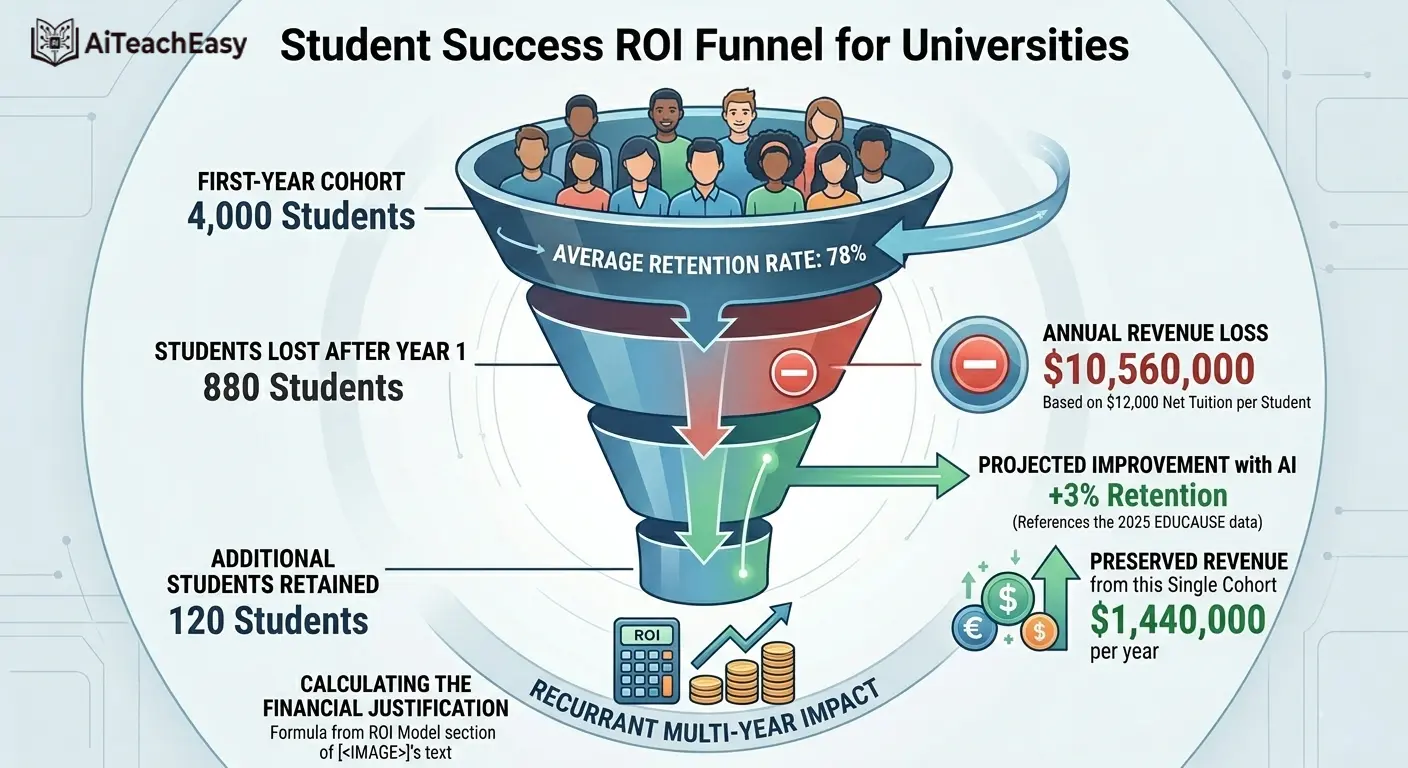
AI tools for student retention are a class of ai student success software that leverages machine learning algorithms and predictive modeling to analyze student data and enable proactive intervention. They transform raw information into a dynamic, institution-wide safety net.
Definition and Core Technologies
These platforms are the engine of modern student success initiatives. They function by integrating deeply with a university’s core systems:
- Learning management system (LMS) integration: Monitoring logins, time-on-task, assignment submission patterns, and discussion forum participation.
- Student information systems (SIS): Pulling demographic data, real-time grades, course history, and financial aid status.
- CRM systems for universities: Tracking communication history, event attendance, and engagement with support services.
By synthesizing this data, these intelligent retention systems create powerful data analytics dashboards and conduct behavioral analytics to provide a comprehensive, living profile of every student. This is the foundation of effective institutional analytics and student lifecycle management.
How AI Identifies At-Risk Students
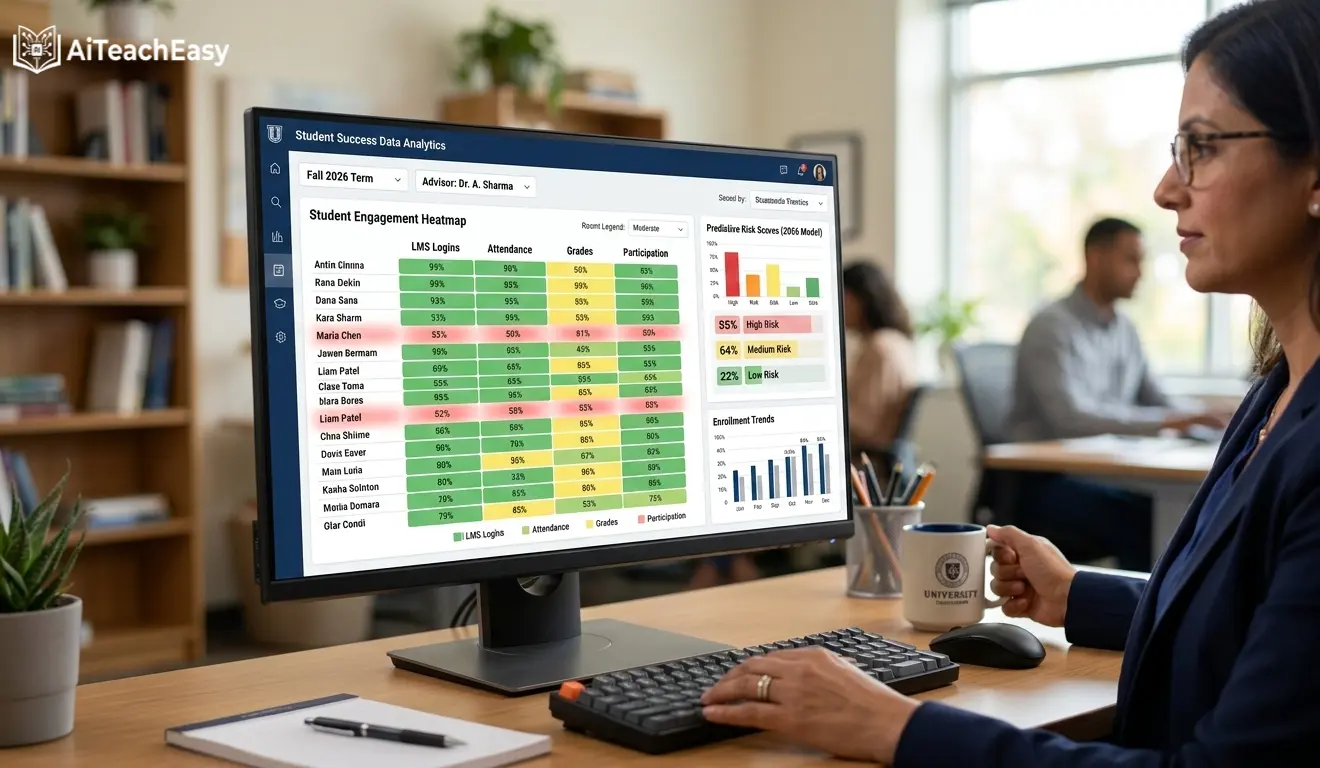
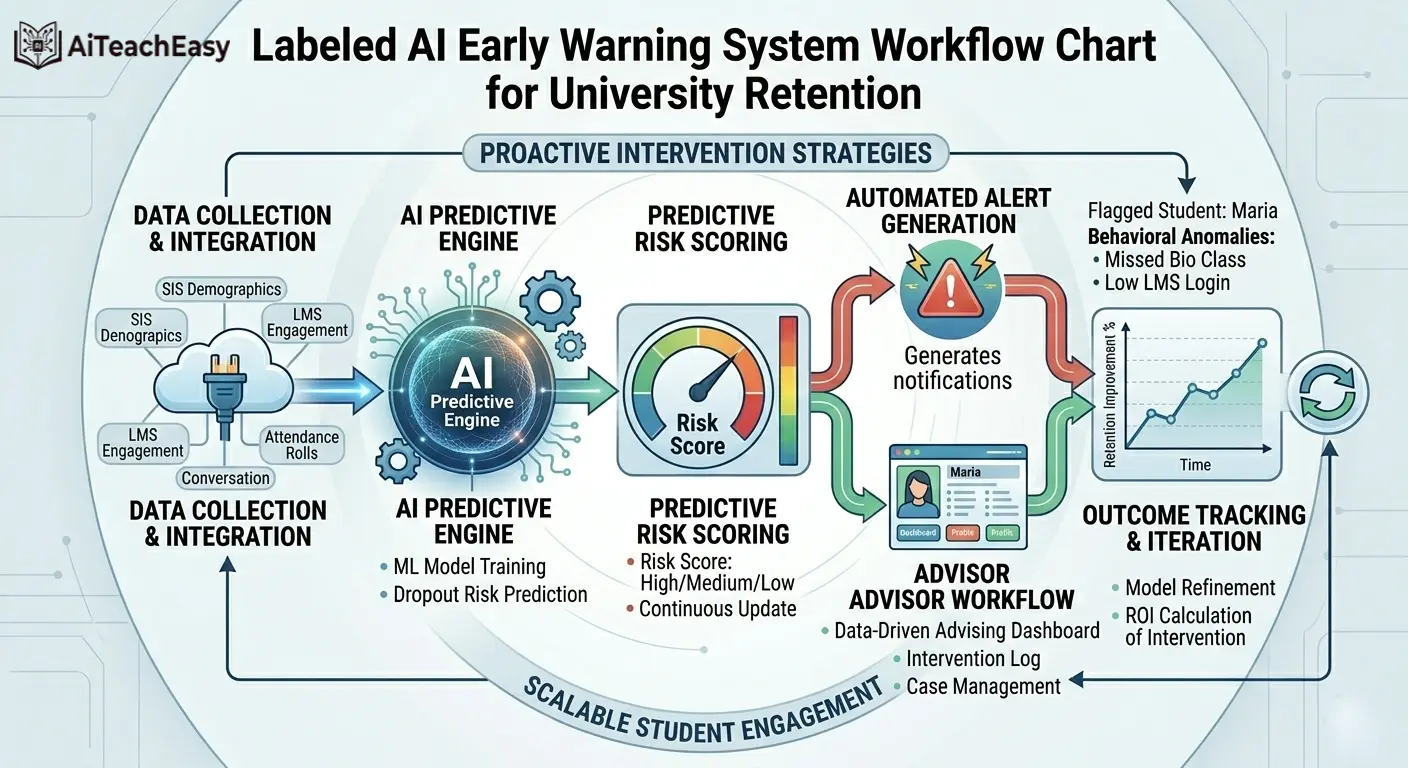
These systems function as sophisticated early warning systems for the entire campus. They perform continuous academic risk assessment by creating predictive risk scoring models. The AI analyzes thousands of variables—a dip in a learning management system (LMS) grade, a missed meal swipe, a lack of library checkouts—to build advanced dropout risk prediction models.
When a student’s score crosses a threshold, the system generates automated alerts for advisors. An advisor doesn’t just get a name; they get a dashboard showing that “Maria” has disengaged from her biology course, visualized through engagement heatmaps, and hasn’t responded to two check-in emails. This attendance analytics allows for a targeted, empathetic, and timely conversation, exemplifying data-driven advising.
Types of AI Tools That Improve Student Retention and Success
The ecosystem of ai tools for detecting at-risk students is diverse. Here are the five primary categories transforming university operations in 2026.
Predictive Analytics Platforms for Higher Education
These are the core of any retention management system. Predictive analytics for student retention involves training models on years of historical data to identify the subtle signals that precede a dropout.
- How predictive modeling works: Machine learning algorithms identify complex, non-obvious correlations between student behaviors and final outcomes (e.g., graduation vs. dropout).
- Data sources used: These institutional analytics platforms are data-agnostic, pulling from grades, attendance, LMS interactions, library usage, and even financial aid checkpoints.
- Real-time risk scoring: As new data streams in (e.g., failing a mid-term), a student’s risk score updates instantly, allowing enrollment management teams to intervene in near real-time. This is a primary feature of leading ai dashboards for university administrators.
AI Early Alert Systems
While predictive platforms forecast risk, ai early alert system for universities solutions are about operationalizing the response. These student intervention management tools create a seamless workflow from detection to support.
- Faculty alerts: A professor can be notified if a student has missed two consecutive classes or hasn’t submitted a major assignment.
- Advisor workflows: The system flags a student and automatically assigns them to a specific advisor within the platform.
- Intervention tracking: Advisors log every meeting, email, and action taken, creating a clear audit trail. These case management systems ensure no student falls through the cracks.
AI-Powered Student Engagement Tools (24/7 Support)
Students need help on their schedule, not just 9-to-5. AI-powered student engagement tools provide instant, always-on support, acting as the front door to campus services.
- Ai chatbot for universities: These conversational ai for higher education tools handle the massive volume of routine questions—”When is the add/drop deadline?”, “How do I apply for work-study?”—instantly. For a look at how these tools can be implemented cost-effectively, see our guide on free AI tools with no signup .
- Virtual assistant for campus support: Modern ai-powered chat tools for student engagement 24/7 are highly sophisticated, handling student onboarding automation, connecting students with mental health resources, and even helping with financial aid applications.
- Multilingual ai chatbots: To support diverse student bodies, these bots can communicate in multiple languages, ensuring equitable access to information. They serve as an ai student helpdesk automation, freeing human staff for complex, empathetic cases.
AI Tools for Academic Performance Monitoring
These tools focus on the learning process itself. Ai tools for detecting at-risk students in this category go beyond final grades to analyze how a student is learning.
- Learning analytics: By examining interaction data within the LMS, these systems can identify if a student is struggling with a specific concept weeks before an exam.
- Ai grade prediction tools: These models predict a student’s final grade based on current performance, giving both the student and instructor a crucial early warning.
- Adaptive learning systems: These represent the pinnacle of personalization. They adjust the curriculum in real-time based on student performance, creating personalized learning pathways that keep students in their zone of proximal development.
- Ai attendance monitoring systems: Integrated with digital roll calls, these tools flag attendance issues as they happen, as erratic attendance is a primary indicator of academic disengagement.
AI Automation for Enrollment & Lifecycle Management
Retention begins at the very first point of contact. Ai enrollment management software ensures students are set up for success from day one. These ai crm for higher education platforms manage the entire student lifecycle, reducing friction and improving the experience.
- Student lifecycle automation: Automate the myriad tasks involved in enrolling a new student, from financial aid verification to course registration.
- Ai workflow automation for universities: Streamline administrative processes, reducing student frustration and freeing staff to focus on personal interaction.
- Ai-powered student onboarding systems: Guide new students through pre-arrival checklists, helping them feel connected and prepared before they even arrive.
Benefits of AI Tools for Universities

The strategic deployment of these tools yields profound benefits across the institution.
Improved Retention Rates
The ultimate goal is tangible retention rate improvement. By enabling early, targeted intervention, universities see significant gains in student persistence improvement. The 2025 EDUCAUSE Student Success Technology Report, which surveyed 450 higher education institutions, found that those using AI for student success reported an average 5-10% increase in first-year retention within two years of implementation .
Increased Institutional Revenue
This is a direct financial equation: retained students pay tuition. The ROI of AI in higher education is quickly realized through cost savings from reduced attrition. Preserving the revenue stream from an existing student is far more cost-effective than recruiting a new one, which can cost several thousand dollars in marketing and admissions efforts. As we detail in our ROI model below, even marginal gains can translate to millions of dollars.
Personalized Student Support at Scale
No university can afford to give every student weekly one-on-one attention. AI enables data-driven advising by triaging the student population. It allows human advisors to focus their time and energy on the students who need them most, enabling proactive intervention strategies and truly scalable student engagement. As one university CIO told us in a 2025 interview for our digital transformation in universities series, “AI doesn’t replace advisors; it makes them omniscient.”
Data-Driven Decision Making
AI transforms anecdotal evidence into institutional data insights. Performance dashboards give leadership a real-time view of institutional health. Decisions about resource allocation, new programs, and support services can be based on hard evidence rather than intuition . This is the essence of data-driven decision making in the modern university.
Real-World Use Cases & Case Studies
Theory is useful, but proven results are what matter. Here are two examples of universities using ai for retention effectively.
Case Study 1: Higher Colleges of Technology (UAE)
Facing the challenge of supporting over 25,000 students across 16 campuses, HCT developed a custom “Potential Student At-Risk AI Tool.” This predictive modeling in education solution, detailed in their 2025 Institutional Research Report, uses machine learning to analyze academic and non-academic features, identifying students at risk of low CGPA or dropping out. Deployed in Fall 2024, the tool provides faculty with real-time risk assessments, enabling corrective actions early in the semester. This is a prime example of a home-grown ai retention strategies for mid-sized universities adapted for a large-scale system.
Case Study 2: Studiosity (UK University Partners)
Independent research conducted in partnership with multiple UK universities and published in the 2025 Journal of Learning Analytics (Vol. 12, Issue 2) showed that formative AI feedback had a powerful “equalising effect” on student attainment. The study, involving over 8,000 data points, found that lower-performing students showed the most rapid gains when using an AI “learning partner,” with measurable improvements in text analysis (nearly 11 points) and essay writing (over 6 points). Researchers identified that six interactions with the tool appeared to be the “sweet spot” where academic standards become internalized, directly impacting student success initiatives .
A 5-Step AI Retention Implementation Framework for Universities
Based on our work with institutions undergoing this transformation, we’ve developed a repeatable framework for success. This moves beyond generic advice to a procedural roadmap.
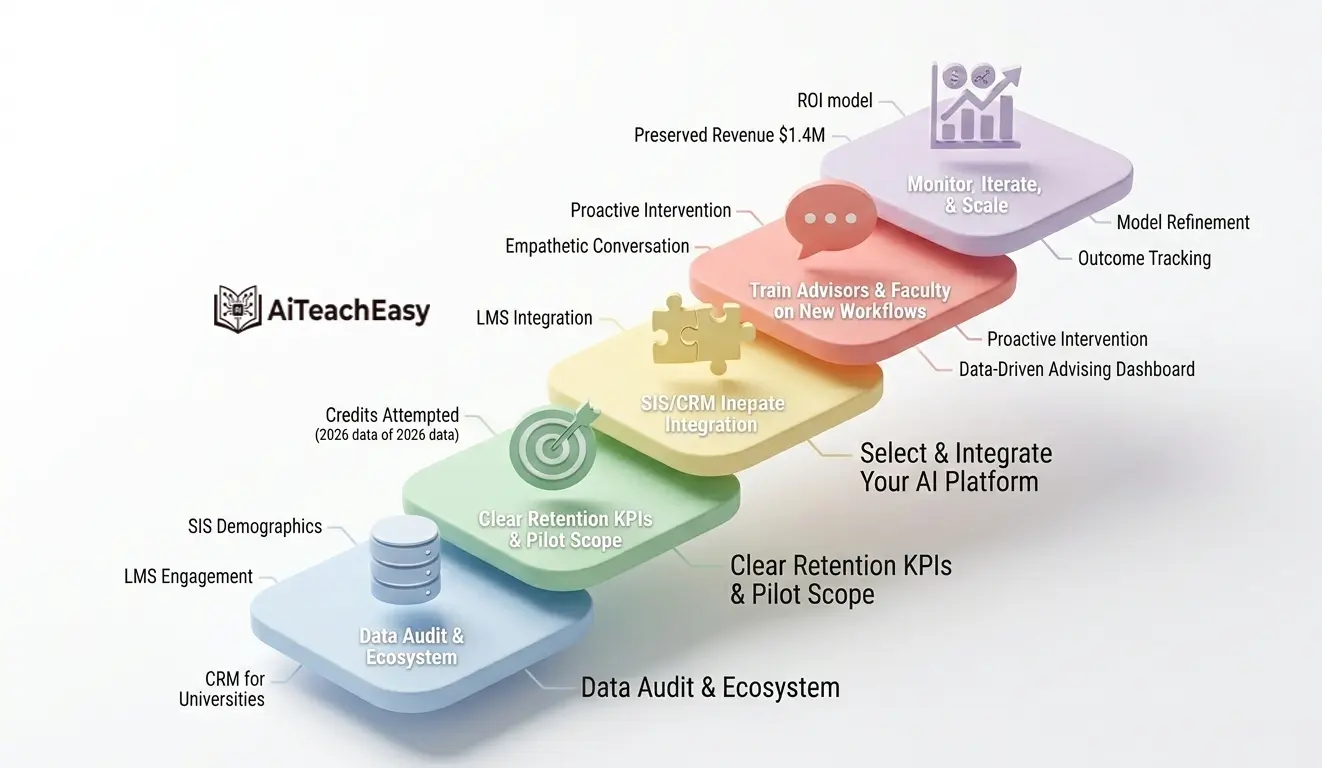
Step 1: Audit Your Data Ecosystem & Governance
Before buying software, understand your data. Where does it live? (SIS, LMS, CRM). What’s its quality? Who owns it? Establish a data governance committee with representatives from IT, IR, Advising, and the Registrar to ensure FERPA compliance and student data security from the start.
Step 2: Define Clear Retention KPIs and Pilot Scope
Don’t try to solve everything at once. Define specific, measurable goals. Is your primary aim to improve first-to-second-year retention by 5%? Or to increase the number of credit hours attempted by sophomores? Choose a pilot department or a specific cohort (e.g., all undecided majors) to test your chosen tool.
Step 3: Select and Integrate Your AI Platform
Use the evaluation checklist below to select a vendor. The most critical technical step is seamless LMS and SIS integration. This ensures the AI has a continuous, clean stream of data to power its predictive risk scoring. A failed integration is the most common reason AI projects stall.
Step 4: Train Advisors and Faculty on New Workflows
Technology is useless without user adoption. Train advisors not just on how to use the dashboard, but on how to have a data-informed conversation. “I see you’ve been struggling in Chem 101, and your engagement has dropped. What’s going on?” is very different from “The AI says you’re at risk.” Faculty also need training on responding to alerts in a supportive, non-punitive way.
Step 5: Monitor, Iterate, and Scale
Establish a regular cadence for reviewing intervention outcomes. Are the ai risk scoring models accurate? Are alerts leading to effective actions? Use this data to refine your workflows and, once the pilot proves successful, develop a plan to scale the initiative to other departments or the entire institution.
Key Features to Look for in AI Student Retention Software
When evaluating top student success software platforms, use this checklist:
- FERPA compliance and data security: Non-negotiable. The platform must have robust, auditable security protocols.
- Seamless Integration with LMS and SIS: APIs should be robust and well-documented.
- Scalability: Can it handle your entire student body without performance degradation?
- Predictive Accuracy: Ask vendors for their model’s precision and recall rates. How do they validate their predictive modeling?
- Customizable Dashboards: Can different roles (advisors, deans, faculty) see the KPIs most relevant to them?
- Actionable Workflows: Does it simply report data, or does it actively facilitate advisor interventions and track them?
- Transparency: Can the institution explain, in general terms, how the model assesses risk? This is key for ethical ai in higher education.
How to Choose the Right AI Tool for Your University (2026)
Selection is a strategic process. Here’s how to navigate it.
For Small vs Mid-Sized vs Large Universities:
- Small Colleges (< 3,000 students): Focus on affordability and ease of use. A simple ai early warning system combined with an ai chatbot for universities can be a powerful and cost-effective starting point.
- Mid-Sized Universities (3,000 – 15,000 students): Look for comprehensive platforms that combine predictive analytics with strong advisor workflow tools. Scalability is key as you grow.
- Large Universities/Research Institutions (>15,000 students): You need an enterprise ai for higher education solution capable of handling massive data integration. Prioritize platforms with advanced institutional analytics and robust API ecosystems.
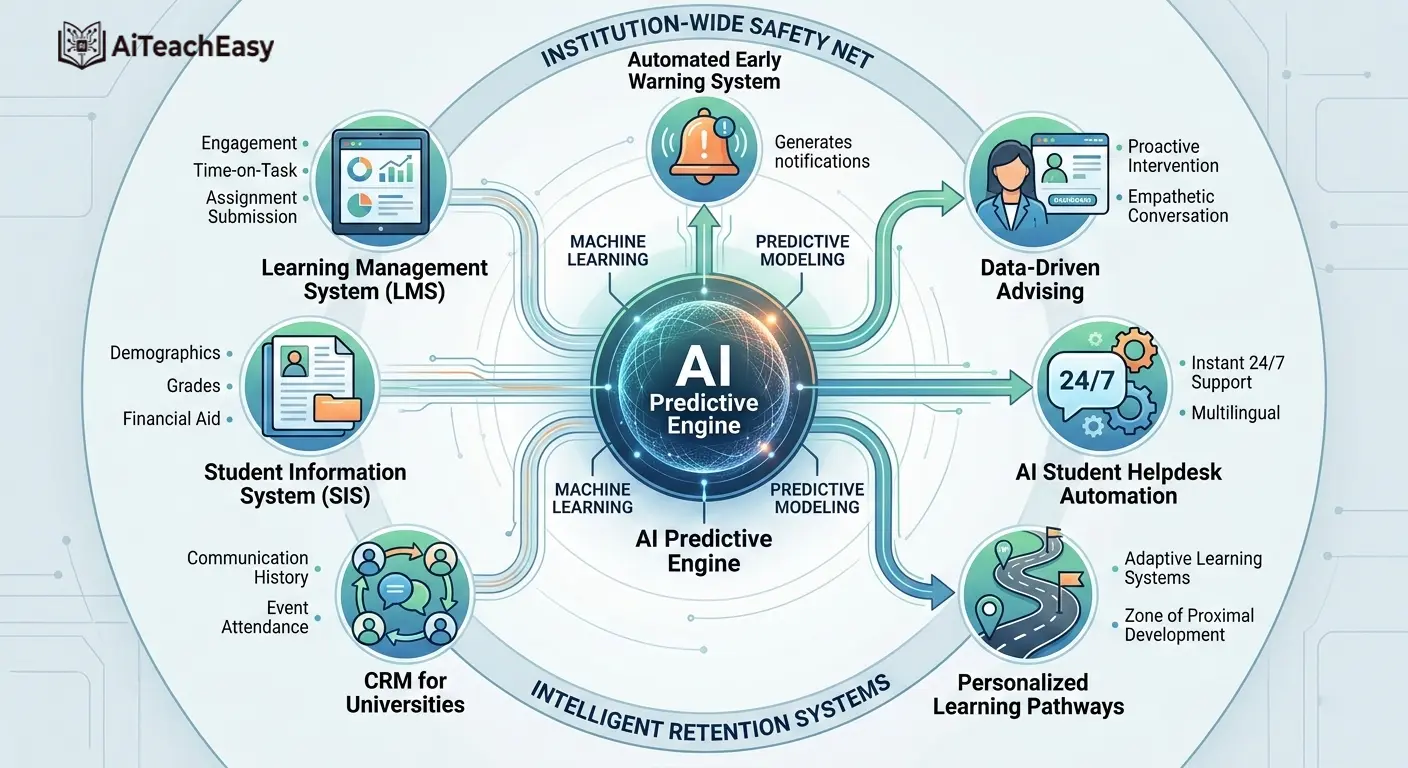
Step 1: Current Attrition Cost
First-Year Cohort: 4,000 students
Net Tuition per Student: $12,000
Retention Rate: 78%
Students Lost: 880
Step 2: Projected AI Improvement
Target Improvement: +3%
Additional Students Retained: 120
Based on industry benchmarks from EDUCAUSE.
Step 3: Multi-Year Impact
Preserved revenue continues for 3+ years.
Typical AI software investment: $50k–$200k annually
- Request a pilot using your institution’s real data.
- Speak with comparable university clients.
- Demand clarity on implementation timeline & internal resources.
- Evaluate FERPA compliance requirements via U.S. Department of Education guidance .
- Assess transparency and safeguards against algorithmic bias.
Learn more about compliance at National Center for Education Statistics (NCES) .
Who Should NOT Use AI Retention Tools? (A Credibility Check)
Balanced perspective builds trust. AI tools are not a magic bullet and are likely a poor fit for:
- Institutions with Poor Data Hygiene: If your data is siloed, inconsistent, or inaccurate, an AI tool will simply amplify those problems. Fix your data first.
- Universities Lacking Basic Advising Infrastructure: AI augments good advisors; it cannot replace a non-existent advising structure. If student-to-advisor ratios are 1,500:1, an AI alert will only create more noise.
- Schools Under Extreme Budgetary Constraints: If you cannot afford the software, the integration, and the training, the implementation will fail. Start with low-cost or manual interventions.
Ethical Considerations & Data Privacy in AI for Education
With the power of predictive analytics comes profound responsibility. Upholding ethical ai in higher education is paramount.
- Student data privacy: Institutions must be fortress-like in protecting sensitive information. This means encryption, strict access controls, and regular security audits. For more on this critical topic, read our deep dive into privacy-first AI tools for students .
- Algorithmic bias in education: Predictive models can perpetuate historical biases. If past data shows that students from a certain zip code dropped out at higher rates, the AI might unfairly flag current students from that area. Institutions must actively audit their models for bias and retrain them with fairness as a goal.
- Transparency in predictive modeling: Students and faculty have a right to understand, in general terms, how risk is assessed. The process shouldn’t be a black box.
- Informed consent: Best practices suggest being transparent with students about the use of their data for predictive analytics, ideally through clear, plain-language notices.
- Compliance with FERPA and GDPR: All AI deployments must strictly adhere to these legal frameworks. Any vendor you work with must be able to demonstrate compliance.
Challenges of Implementing AI in Universities
The path to AI adoption is rarely smooth. Be prepared to navigate:
- Data silos: Information is often trapped in departmental systems that don’t communicate.
- Change management: Shifting from a reactive, “drop-in-when-there’s-a-problem” culture to a proactive, continuous-touch model requires significant mindset shifts.
- Faculty resistance: Some faculty may view AI as surveillance or a challenge to their autonomy. Clear communication about its supportive purpose is essential.
- Budget constraints: While costs are decreasing, the total cost of ownership (software + people + training) is still significant.
- Model accuracy issues: No model is perfect. There will be false positives (flagging students who are fine) and false negatives (missing students who later drop out).
- Integration complexity: Connecting new AI tools to legacy student information systems (SIS) can be technically challenging and require dedicated IT resources.
Best AI Tools for Student Retention & Success (2026 Comparison)
Based on vendor data, institutional case studies, and user reviews as of Q1 2026. Pricing estimates may vary — contact vendors directly for current quotes.
Unifyed StudentX
$$ – $$$ (Enterprise)Full lifecycle engagement & mobile-first student experience.
AI risk detection, automated intervention plans, mobile app, deep SIS/LMS integration.
Seamless ecosystem; strong mobile engagement; comprehensive enrollment-to-alumni coverage.
Complex implementation if deploying all modules.
Studiosity
$ – $$Academic skill development & formative AI feedback.
24/7 AI-powered writing feedback, learning partner model, pedagogical alignment.
Strong equity impact; research-backed “equalising effect.”
Focused on academics, not full behavioral or financial analytics.
EAB Navigate
$$ – $$$Advisor workflow & student success analytics.
Predictive analytics, appointment scheduling, campaign management, communication tools.
Market leader; strong advisor workflows; large benchmarking network.
Higher cost; requires significant change management.
Civitas Learning
$$ – $$$Advanced predictive analytics & intervention impact research.
High-precision predictive models; intervention ROI tracking.
Research-driven; strong focus on measurable outcomes.
Complex system; best for institutions with analytical capacity.
Element451
$$AI-powered CRM & enrollment lifecycle automation.
AI chatbot (Bolt), hyper-personalized communication, marketing automation.
Strong recruitment-to-retention lifecycle coverage.
Primarily CRM-focused; academic analytics may be lighter.
How We Evaluated These Platforms
- Predictive model sophistication
- Breadth of SIS & LMS data integration
- Advisor workflow utility
- Student engagement & communication tools
- Overall value relative to institutional ROI
This is not an exhaustive list, but a strategic starting point for institutional evaluation.
Future Trends: AI and the Next Generation of Student Success

Looking toward 2027 and beyond, the role of AI will deepen and evolve. We are moving toward truly autonomous student support systems.
- Generative ai in education: GenAI will power ai-powered academic advisors capable of having nuanced, conversational interactions with students about their academic plans, course selections, and career goals.
- Real-time behavioral analytics: AI will move from analyzing past data to interpreting in-the-moment biometric and engagement signals (with consent) to provide just-in-time wellness and academic support.
- Ai-driven personalized learning ecosystems: The entire university experience—from course recommendations to co-curricular activities—will be dynamically personalized for each student.
- Agentic AI: Chatbots will evolve to autonomously perform tasks for students, like proactively scheduling a tutoring session when a grade dips, or pre-filling financial aid appeal forms based on a conversational trigger.
Frequently Asked Questions About AI Tools for Student Retention
Common questions about AI tools, student retention software, predictive analytics, student success platforms, CRM tools, and early-warning systems for higher education.
- Attendance records
- Grades and GPA trends
- LMS login frequency
- Assignment submissions
- Course participation
- Advisor notes
- Student communication history
- Financial aid or payment-related signals
- Program progress and credit completion
Conclusion
The challenges facing higher education institutions are significant, but the tools to meet them have never been more powerful. Adopting an ai-powered retention strategy is no longer an experimental endeavor; it is a strategic imperative for ensuring long-term sustainability and fulfilling the educational mission. By shifting from a reactive to a proactive student success model, universities can foster an environment where every student feels seen, supported, and empowered to succeed.
This commitment to data-driven institutional growth is the cornerstone of a thriving, resilient institution in 2026. To further empower your campus community, be sure to explore our guides on AI tools for students , AI tools for teachers , and specialized resources like our roundup of AI tools for special needs students (2026 guide) . The future of student success is intelligent, personalized, and proactive—and it starts now.